
Chasing the Big Five
Every safari visitor arrives with a list.
Whether they admit it or not.
Maybe it’s written down. Maybe it’s tucked away in the back of their mind. But almost everyone who heads into the African bush carries the same secret hope:
Will we see the Big Five?
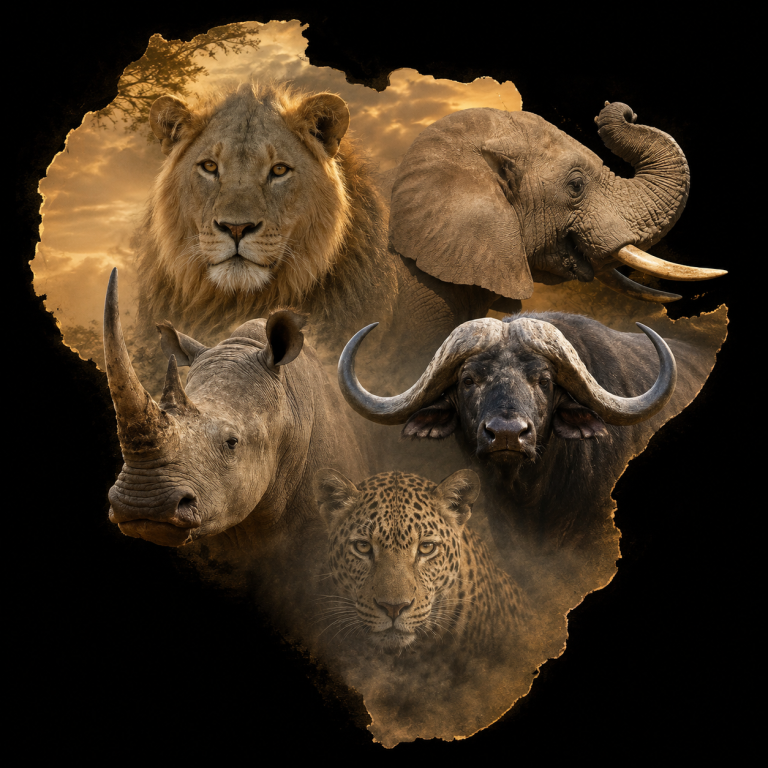
Lions. Leopards. Rhinos. Elephants. Buffalo.
The famous checklist has become almost synonymous with safari travel. Entire vacations are planned around finding them. Cameras are prepared. Binoculars are cleaned. Expectations quietly rise with every turn in the road.
What most people don’t realize is that finding the Big Five isn’t guaranteed. And that’s exactly what makes it exciting.
The Hunt Begins
By our third full day at Hippo Lakes, we had already seen more wildlife than many people experience in a lifetime. Elephants crossed roads in front of us. Giraffes wandered through the bush like living skyscrapers. Zebras grazed beside antelope. Hippos grunted from hidden waterways.
Yet despite all of that, conversations inevitably circled back to the same question.
“Have we seen all five yet?”
The answer, at least at that point, was no.
That wasn’t necessarily because we hadn’t found them yet.
Hippo Lakes sits within a vast protected area, but not every reserve in South Africa contains all members of the Big Five. Wildlife management is far more complicated than many visitors realize. Different reserves are licensed, equipped, and managed for different animal populations. Some specialize in predator conservation. Others focus on breeding programs, antelope species, or mixed ecosystems that may not include lions, rhinos, or other large animals.
At first, that surprised me. In my mind, Africa was one giant wilderness where animals simply wandered wherever they pleased. The reality is a little more nuanced.
Many reserves are separated by fences, property boundaries, conservation agreements, or natural barriers. While animals certainly don’t read maps, large and potentially dangerous species are carefully monitored. A lion that wanders into an area where it isn’t supposed to be can create problems. It’s not only for neighboring wildlife, but sometimes for livestock, nearby communities, or the conservation goals of the reserve itself.
That doesn’t mean movement never happens. Animals occasionally find gaps, damaged fencing, or simply demonstrate remarkable determination. When that occurs, wildlife authorities and reserve managers may intervene. Depending on the situation, an animal might be tracked, tranquilized, and relocated back to its intended range.
In other words, seeing the Big Five isn’t just about luck.
It’s also about geography, conservation planning, and being in the right place at the right time.
The good news was that not all of our game drives took place exclusively within Hippo Lakes. The lodge partnered with several nearby reserves and safari operators, giving us opportunities to explore different habitats and increase our chances of encountering animals that might not be found on the property itself.
The bush still had secrets.
The Kings (and Queens)of the Savannah
Our most memorable lion encounter didn’t happen at Hippo Lakes itself. It happened during one of the game drives at a nearby reserve.
The scenery alone would have made the trip worthwhile. Mountains rose in the distance, creating a backdrop unlike anything I expected from a safari. One formation reminded me of Steamboat Rock back in Washington State, only much larger. Looking at it, I couldn’t help but think that sunrise on that massive formation must be spectacular.
About an hour into the game drive, our guide explained that a local pride of three females and two males had made a successful kill earlier that morning. That was both good news and bad news.
The good news was that they knew roughly where the pride might be. The bad news was that lions that have recently eaten tend to do very little afterward besides rest and digest. The guides knew several areas where the pride liked to spend their afternoons, so we headed toward those locations.
Along the way we saw several other animals, but our guide pointed out something interesting. If certain prey animals were calmly grazing in an area, there was a decent chance the lions weren’t nearby.
Eventually we reached an area where another safari vehicle was already parked. Our guide pulled nearby and moved very slowly. Everyone scanned the tall (and empty) grass.
Nothing.
A few minutes passed. Still nothing.
Then one of the guests in our vehicle asked the guide to stop. She had spotted something near a tree surrounded by tall grass. We all grabbed binoculars and cameras.
At first nobody could see what she was talking about.
Then someone asked, “Is that a tail?”
Way out in the distance, a tail flicked above the grass and disappeared.
That was it, a tail. No lion. No face. No body. It could have easily been a bit of brush, except maybe …
“There!”, pointed someone, “was that a leg?” There was movement, but it could just as easily been the breeze.
The tail popped up again, just occasionally, just swatting at flies.
The guide eased the vehicle forward and the tail disappeared again. For a moment we thought we’d lost them. Then we moved a little farther down the road and stopped again.
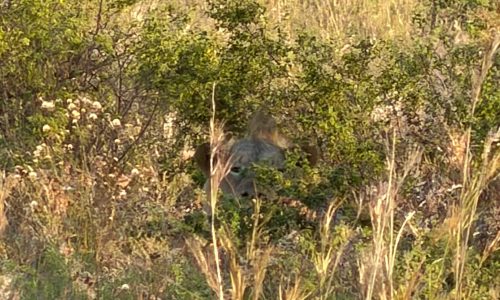
This time I spotted one, a lioness. She was lying in the grass, almost completely concealed except for her face. And she was staring directly at us.
Once we found her, the guide radioed the other vehicles. Within minutes a couple more safari trucks had joined us. Even then, we still couldn’t see the entire pride.
Then something unexpected happened. Our guide stood up. He had been talking on the radio with the other guides. He picked up what looked suspiciously like a broom handle, stepped out of the vehicle, and carefully walked a short distance toward the bushes.
The lioness raised her head.
Then she stood.
A low warning rumble rolled across the grass. Almost instantly the rest of the pride rose from their hiding places. One lioness, then another, then another. Finally, the two males rose.
What had looked like an empty patch of grass suddenly contained an entire pride of lions.
Then, one by one they walked away, leaving the first to watch as they disappeared through the grass in search of a more private place to continue digesting their breakfast. When they were away, she too turned and disappeared into the bush.
The guide climbed back into the vehicle, laughed, and explained that the guides had been discussing who was going to volunteer to encourage the pride to move. Apparently he had drawn the short straw.
That’s safari. Sometimes you spend thirty minutes looking at grass.
Then the grass stands up and turns into lions.
The Ghost of the Bush
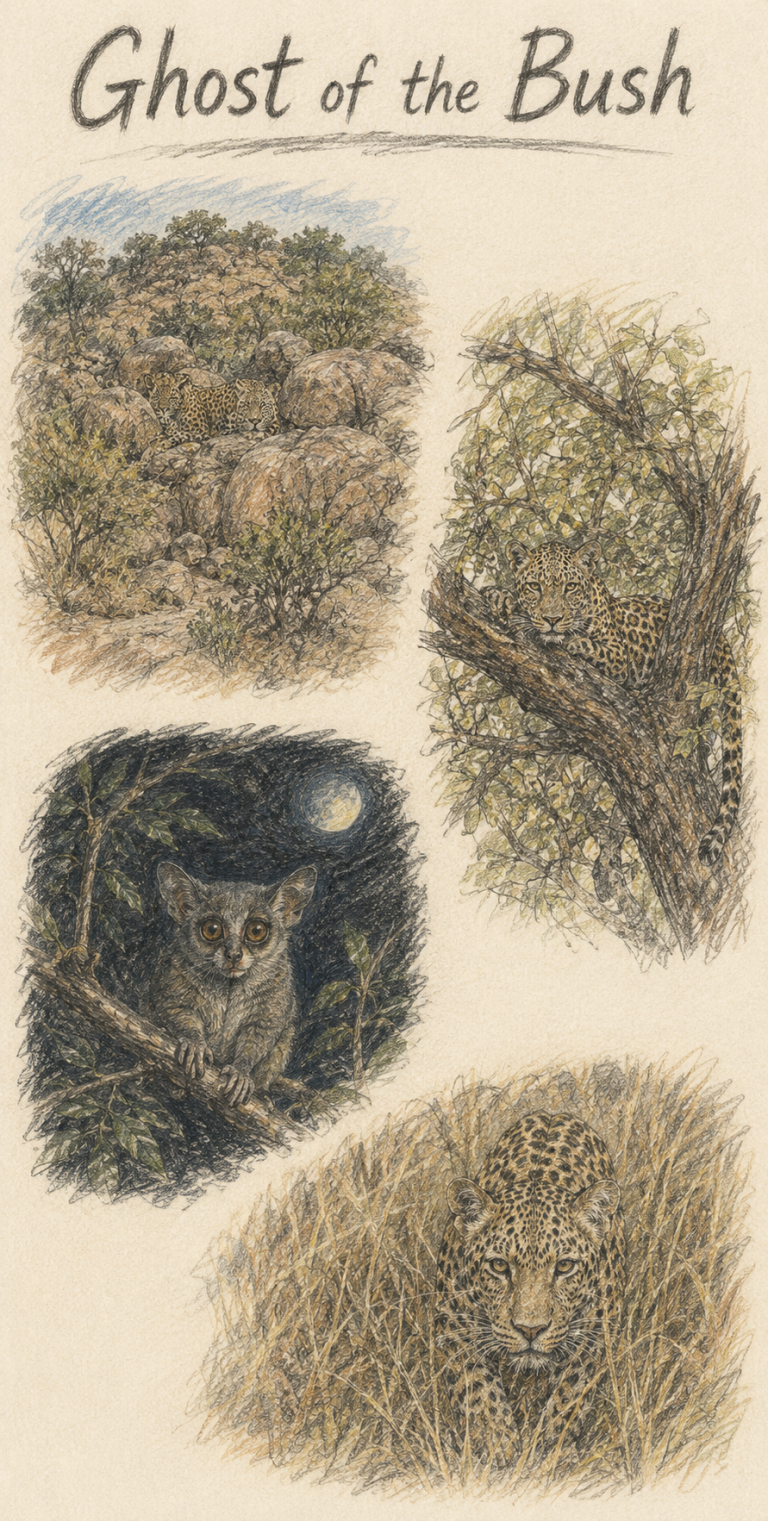
If lions are celebrities, leopards are ghosts.
Leopards are notoriously difficult to spot. They blend into the landscape so well that guides can be staring directly at one without see it while guests continue looking in the wrong direction.
And sometimes? You don’t see them at all. The leopard became our white whale (or perhaps our spotted one).
Throughout the trip, guides regularly mentioned leopard sightings. One had been seen earlier that morning. Another had crossed a road during the night. Yet another had apparently been spotted by a vehicle just before we arrived.
We searched. And searched. And searched some more.
Morning drives. Afternoon drives. Night drives.
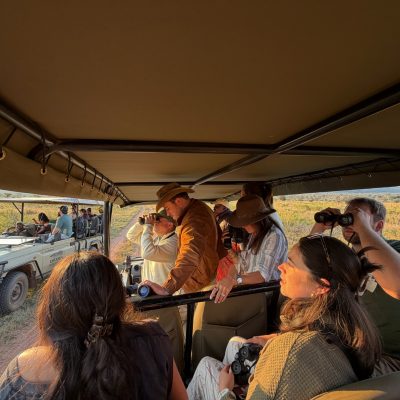
Every promising tree, every rock where they can sun themselves, they became a suspect. I should note that while we think leopards climb trees to stalk or sleep, that is not so. They do climb trees with a kill sometimes, but they don’t sleep there.
Still, every shadow prompted someone to ask, “Could that be it?”
It never was.
The night drives only added to the mystery.
After sunset, the guides used powerful spotlights to scan the bush. One of the tricks they taught us was to watch for reflected eyes. Red or yellow often suggested predators. Green usually meant prey.
One evening we spotted a pair of eyes across a lake on a distant ridge.
The vehicle stopped. Spotlights locked onto the location. Binoculars came up. Camera lenses zoomed in.
There it was. Two glowing eyes staring back at us from the darkness.
Then it moved, its eyes disappearing.
A scan around the area found them again, and again it moved in the rocks and trees along the ridge. With every glimpse, anticipation grew.
Was this finally our leopard?
Finally, the animal stepped out of the brush and into the light.
“A bush baby,” the guide announced with a sigh. A collective laugh rolled through the vehicle.
Okay, not a leopard. But still pretty cool.
We watched for a few minutes before continuing our search.
The ghost remained one step ahead of us.
As the days passed, the leopard became a running joke in our WhatsApp chat. Blurry bushes became “confirmed sightings.” Suspiciously perfect photos appeared. Eventually people started posting AI-generated leopards.
“Finally found one!” Sure you did.
By the end of the trip, nobody in our group had seen a leopard. Not one.
While we managed to find four of the Big Five, the leopard remained undefeated.
And honestly? I’m okay with that.
Every adventure should leave you with a reason to come back.
Rhinos and Reality
Unlike our search for leopards, rhinos seemed determined to make appearances.
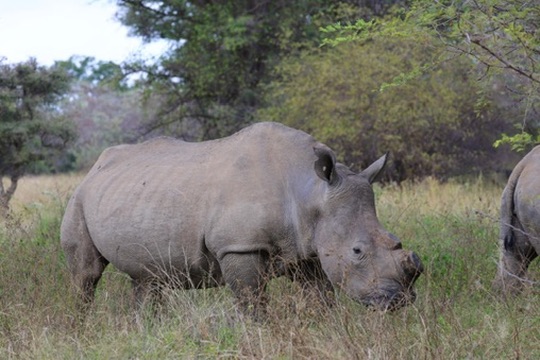
We spotted them on three different game drives in three different reserves, both black and white rhinos. Every sighting felt special. And every sighting also came with a reminder of why they need protection.
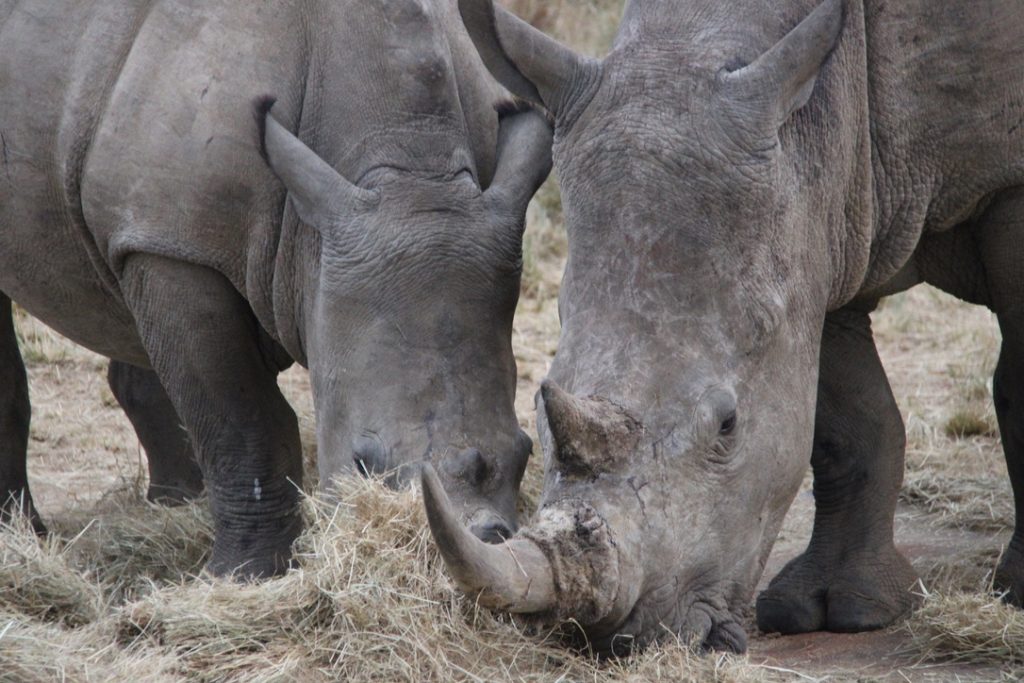
One of the things we learned was that the names black rhino and white rhino have very little to do with color. Both are generally shades of gray. The difference is primarily in the shape of their heads and mouths. White rhinos have broad, square lips designed for grazing on grasses, while black rhinos have a more pointed, hooked upper lip that helps them browse leaves and branches from shrubs and trees. Once our guides pointed it out, the difference became surprisingly easy to spot.
One guide explained a relatively new anti-poaching strategy that sounded like something from science fiction. Recently, rhinos have radioactive isotopes introduced into their horns. The process doesn’t harm the animal, but it makes the horn easier to detect if traffickers attempt to move it through ports, airports, or border crossings. Reportedly, it can even be detected in a large shipping container.
The technology was fascinating. The reason it exists was not. Poaching remains one of the greatest threats facing rhinos.
Hippo Lakes had only recently received authorization to introduce rhinos onto the property. The animals were still acclimating to their new home and were being monitored closely. While we saw the other rhinos at a bit more of a distance, here we go very close.
We were driven to the “acclimation” portion of the sanctuary. Here, the vehicles were allowed to drive into an open field and close to where the rhinos were. At one point, we may have gotten too close. One of the bulls turned. The guide abruptly moved the vehicle away.
We also noticed armed guards. Not for the tourists, but for the rhinos, protecting them from poachers.
It’s easy to focus on the poacher carrying the rifle and taking a horn, but the real problem extends much farther. Rhino horns and elephant tusks can command enormous prices on the black market. As long as buyers exist, someone will be willing to supply them.
The poacher is often just the lowest rung on a much larger ladder. The real money flows through traffickers, brokers, smugglers, and buyers operating far from the African bush. Stopping poaching isn’t just about catching someone in a reserve. It’s about disrupting an international market.
That’s much easier to say than it is to accomplish.
Watching a rhino peacefully grazing while armed guards stood watch nearby created a striking contrast. Our hosts gathered the vehicles at the top of the field overlooking the rhinos and we were allowed to get out. They pulled out coolers and a table. Bottles of African wine and beer came out (plus soft drinks). As we gathered, I raised a toast to our hosts and guides, and to us as well. This was an amazing trip so far!
The Buffalo Surprise
Cape buffalo are often the least glamorous member of the Big Five.
They’re not as photogenic as lions. They’re not as charismatic as elephants. They’re certainly not as elusive as leopards. Yet buffalo command enormous respect from guides. And for good reason.
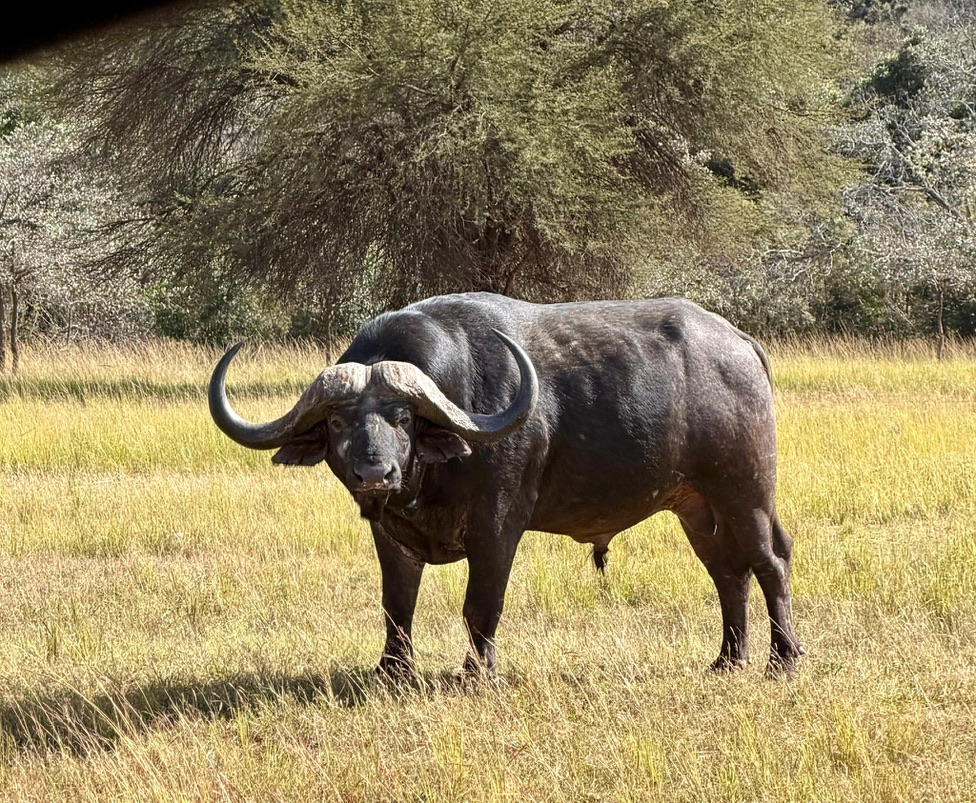
We saw buffalo in several reserves, often in surprisingly large numbers. Some grazed peacefully in herds. Others stood off by themselves, staring at our vehicles with an expression that suggested they had absolutely no interest in making new friends.
One of the guides explained that buffalo are responsible for more injuries and deaths to hunters than many of Africa’s predators.
That caught me off guard. When people think “dangerous African animal,” they usually picture lions. The guides often picture buffalo.
Of course, by this point in the trip, we’d already learned not to judge danger by appearance. The hippos around Hippo Lakes had taught us that lesson. They weren’t members of the Big Five, but more than one guide had reminded us to give them plenty of respect… and plenty of space.
Standing face-to-face with a mature buffalo bull made it clear why buffalo belong in those conversations as well.
The animal doesn’t look impressed by your camera. Or your vehicle. Or even your presence.
It simply stares back. There is an old saying that buffalo look at you like they are already considering your obituary. After spending time around them, I understand where that reputation comes from.
As memorable as the wildlife was becoming, some of the best moments happened after the game drives ended.
0 Comments