
The Reason We Came
You hear Victoria Falls before you see it. Not metaphorically. Literally.
The roar begins long before the water comes into view. At first it sounds like distant thunder. Then it gets louder. And louder. You actually start to feel it, in your bones.
The strange thing is that the sky is perfectly clear. The sound isn’t coming from a storm.
The storm is the waterfall.
Victoria Falls, or Mosi-oa-Tunya as it was known long before David Livingstone arrived, translates roughly as The Smoke That Thunders.
As it turns out, that’s not poetic exaggeration. It’s a remarkably accurate description.
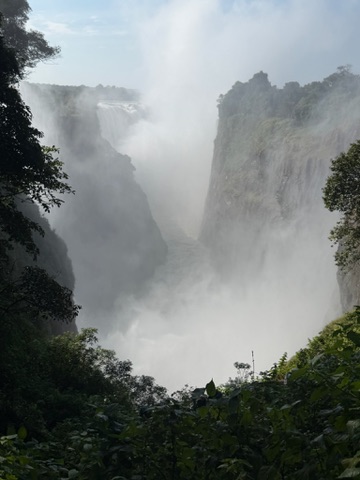
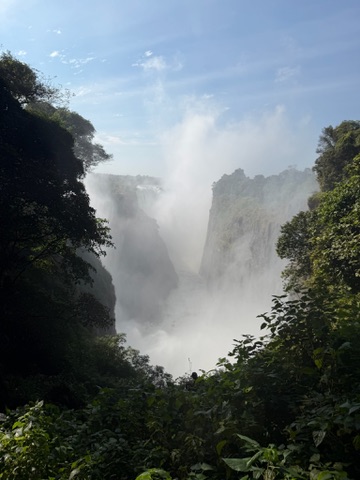
As we followed the pathways between viewpoints, the sound continued to build. Before reaching the first major overlook, we could already see what appeared to be a cloud hanging over the landscape. Only it wasn’t a cloud.
It was water.
Millions upon millions of gallons of water crashing into the gorge below, creating a plume of mist that rises hundreds of feet into the air before drifting back down as rain. Victoria Falls doesn’t just create a waterfall. It creates its own weather.
Standing there for the first time, it finally clicked.
Smoke.
That.
Thunders.
The local people had named it perfectly.
When All the Falls Are Falling
Before arriving, several people told us we were visiting during the wet season. I nodded politely. What I didn’t fully understand was what that actually meant.
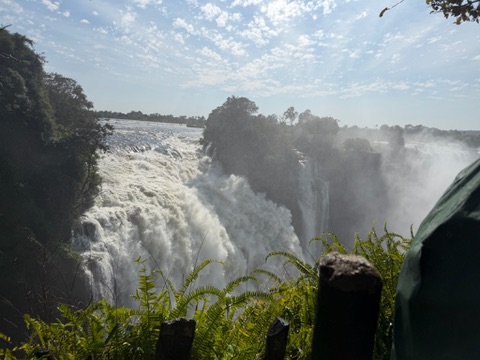
The Zambezi River flows year-round, and sections such as Devil’s Cataract and the Main Falls are always active. During the wet season, however, enormous volumes of additional water pour over nearly the entire cliff face.
Areas that might be exposed rock later in the year become waterfalls of their own.
Every viewpoint revealed another curtain of water. And another. And another.
The scale is difficult to describe. People naturally compare Victoria Falls to Niagara Falls because most of us have heard of Niagara. And Niagara is impressive. Very impressive (or so I am told, we need to get there some day).
But Victoria Falls creates the largest curtain of falling water in the world. Photographs don’t prepare you. Videos don’t prepare you. Even standing there doesn’t quite prepare you.
Your brain knows what it’s seeing. It just struggles to comprehend the scale.
One of the most famous attractions associated with the Falls is Devil’s Pool, located on the Zambian side near Livingstone Island. During the dry season, visitors can swim in a natural rock pool right at the edge of the waterfall.
During the wet season? Not happening. Standing there watching the sheer volume of water pouring over the edge, I was perfectly content admiring it from a safe distance.
Sometimes wisdom and cowardice look remarkably similar.
A Photographer’s Dream… and Nightmare
For photographers, Victoria Falls is paradise.
For camera equipment, it is something closer to a survival exercise.
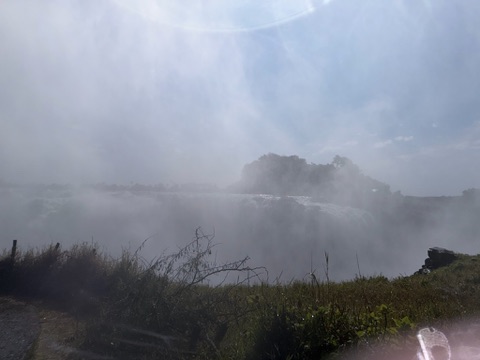
As water crashes into the gorge below, it explodes into mist. That mist rises into the air, forms clouds, and then falls back down as a constant rain. Not occasional rain. Not a passing shower.
Constant rain.
In some areas of the trail, we were effectively walking through a rainforest created entirely by the waterfall itself.
Everything gets wet.
Your clothes. Your shoes. Your backpack. Your camera. Your phone.
Possibly your soul.
If you plan to visit during the wet season, do not bring water-resistant gear. Bring waterproof gear. There is a difference. And if you don’t know the difference, Victoria Falls will gladly teach you.
Our DSLR spent most of the tour sealed inside a protective bag because I wasn’t interested in conducting an expensive science experiment involving electronics and several million gallons of airborne water.
Instead, we relied mostly on our phones, safely tucked inside waterproof cases. Even then, some photos ended up with water droplets on the cover over the lens. Oddly enough, I don’t mind.
Normally photographers work hard to eliminate imperfections. These droplets became part of the memory. When I look at those pictures now, I don’t see flaws. I remember standing in the spray. I remember the roar. I remember getting soaked.
Sometimes the best photographs aren’t the perfect ones.
Sometimes, they’re the ones that remind you exactly what it felt like to be there.
Lunch With a View
After spending the morning exploring Victoria Falls, we returned to the lodge, dried off, and met Mark and Diane for lunch at MaKuwa-Kuwa Restaurant.
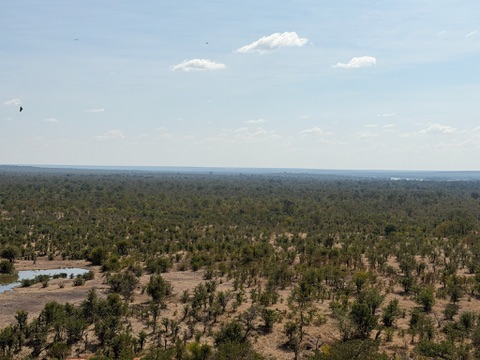
The restaurant sits high above a watering hole overlooking the bush.
The food was excellent. But honestly? The view may have stolen the show. As our waiter approached the table, none of us were looking at the menu. Something was happening below. Near the water’s edge stood a Cape buffalo. At first that didn’t seem unusual. Then our waiter leaned in and we learned the story.
Earlier, a calf that came down to drink with its mother. A crocodile had surprised the calf and had been dragged into the water and drowned, leaving the mother pacing the shoreline.
Searching. Waiting. Looking for answers she would never find.
It wasn’t easy to hear. But it was Africa. Predators hunt. Prey remains vigilant. Life continues.
We often romanticize nature. Nature has never signed up for a Disney script. The circle of life sounds beautiful when accompanied by music. It’s a little more sobering when you’re watching it unfold in real time.
Nearby, vultures were gathered around another kind of meal.
Back home, vultures tend to get a bad reputation. Here we learned how important they are to the ecosystem and how conservation efforts actively protect many species. Nature needs cleanup crews too.
As for lunch itself? I honestly don’t remember what I ordered. Normally that would bother me. I like details. I write a travel blog, after all.
But sometimes you become so immersed in an experience that the specifics fade away. What remains are the conversations. The laughter. The view. And the feeling of being exactly where you’re supposed to be.
The Great Postcard Expedition
After lunch, we visited one of the local craft markets often called the Elephant Market.
If you’ve never been to a market like this, imagine dozens of stalls packed tightly together, each displaying incredible works of art.
Hand made wood carvings of all the popular animals. Stone sculptures too. Paintings. Masks. Jewelry. Wall hangings. If someone could carve it, paint it, weave it, or polish it, chances are someone was selling it.
The talent was remarkable. The pricing system was… flexible.
Very few items displayed prices. Instead, nearly every conversation began the same way, the artist asking you as you pick up a piece, “What is your best price?”
My father taught me many lessons over the years. One of them was simple. Never start the bidding. If you make the first offer, you’re negotiating against yourself.
The vendors, however, appeared to have attended a different business school.
You question, ”How much is it?”
“What is your best price?”, they offer.
Confused, you reply, ”I don’t know. How much is it?”
“What is your best price?”, they ask again.
At one point I briefly considered gathering two vendors together and suggesting a reverse bidding war. I did not. Mostly because Teresa would have rolled her eyes so hard they might have become visible from orbit.
Still, bargaining is simply part of the experience. Both sides understand the dance. Some people dance better than others.
A Postcard From Africa
While everyone else was looking for carvings and souvenirs, we were on a different mission. My mother-in-law had one request before we left for Africa. A postcard.
Now, for younger readers, a postcard is basically an Instagram post that takes several weeks to arrive and has absolutely terrible refresh rates.
For the rest of us, it’s a small piece of a place that says: “I was here, and I thought of you.”
Years ago, postcards were everywhere. Today they’re surprisingly difficult to find. Eventually we located one. Success.
Or so we thought.
Now we needed stamps. That turned out to be a much bigger challenge. The post office was closing. The next day was closed. The day after that was a holiday. We lacked the proper cash for postage. And time was rapidly running out.
Back at Insika Lodge, I approached the front desk and laid the postcard on the front desk.
“What is it?” one of the young ladies asked.
“A postcard.”
A puzzled look appeared.
Then another. And suddenly I realized I was explaining twentieth-century technology. I showed them the picture side. The message side. The address. The concept of putting a stamp on it and sending it across an ocean.
To their credit, they were completely determined to help.
Later, one of them asked: “So what instructions do I need?”
At that moment I felt approximately one hundred years old.
Eventually the postcard was entrusted to the lodge staff, who promised they would see it mailed. Whether it arrived in a week, a month, or somewhere in between didn’t really matter. What mattered was the gesture.
In an age of instant messages, social media, and video calls, there was something charming about sending a physical reminder of our journey halfway around the world. And somewhere in Southern Illinois, my mother-in-law would eventually receive a small piece of Africa in her mailbox.
Sunset and Sunrise
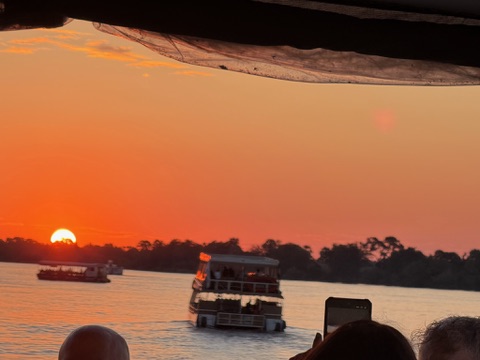
That evening we boarded a sunset cruise on the Zambezi River. The river was beautiful.
The food was excellent and the drinks flowed freely. But the real attraction was the world around us. Hippos began emerging from the water. Bird calls shifted as day gave way to evening. The sky transformed through layers of gold, orange, pink, and deep purple.
Everyone reached for cameras. Everyone wanted to capture the moment. I remember thinking there was no way anything could top it. I was wrong.
The following morning, while most sane people were still asleep, we boarded another boat. A sunrise cruise. At first it sounded redundant.
It wasn’t. Not even close. The river felt entirely different.
Quieter. Cooler. More patient.
As the first hints of light appeared above the horizon, I found myself standing near the rail, simply watching.
And listening. There was no soundtrack. Yet somehow there was music. If I had to describe it, it felt like Mannheim Steamroller’s Earthrise/Return had somehow escaped some set of hidden speakers and become part of the landscape itself. It had not, the music was all internal.
As the sun slowly climbed above the African horizon, the river began to glow. The water reflected gold and orange. Mist drifted across the surface. The world seemed to pause.
For once, I wasn’t trying to photograph everything. I wasn’t looking through a lens. I was simply there. Watching. Listening. Experiencing.
The sun rises every day. Most of the time we barely notice.
But standing on the Zambezi River, halfway around the world from home, watching Africa wake up around us, I found myself appreciating something we often take for granted.
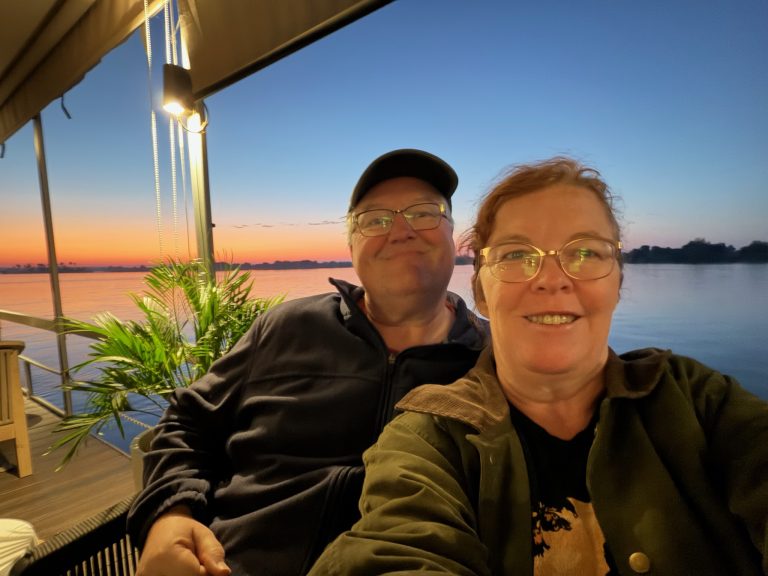
When I finally sat down next to Teresa, she quietly said it was something she would never forget.
I understood exactly what she meant.
More Than a Waterfall
We came to Zimbabwe to see Victoria Falls.
And we did. We stood in its rain.
We listened to its thunder.
We watched its mist create its own weather.
But when I think back on those days, I don’t just remember the waterfall.
I remember Bheki. I remember Ella. I remember the women at the front desk trying to figure out what to do with a postcard. I remember conversations over meals, sunsets on the river, and quiet moments watching the world wake up.
The Falls were why we came. The people are why we’ll remember it.
And now, with our African adventure nearly complete, all that remained was the journey home.
We use cookies to improve your experience on our site. By using our site, you consent to cookies.
Manage your cookie preferences below:
Essential cookies enable basic functions and are necessary for the proper function of the website.
These cookies are needed for adding comments on this website.
Google reCAPTCHA helps protect websites from spam and abuse by verifying user interactions through challenges.
Statistics cookies collect information anonymously. This information helps us understand how visitors use our website.
Google Analytics is a powerful tool that tracks and analyzes website traffic for informed marketing decisions.
Service URL: policies.google.com (opens in a new window)
Marketing cookies are used to follow visitors to websites. The intention is to show ads that are relevant and engaging to the individual user.
Facebook Pixel is a web analytics service that tracks and reports website traffic.
Service URL: www.facebook.com (opens in a new window)