After our abbreviated visit to Tübingen, we collected our bags and set off for Munich. It was another journey involving more than one train. But one of the stops along the way made this particular trip special for me: Augsburg.
I was born in Augsburg while my father was stationed in Germany with the military. Obviously, I don't have memories of the city from the time I was born, but it was still a little strange—and rather nice—to pass through the place where my story began. We didn't get off the train or explore the city. We simply stopped at the station and continued toward Munich. Still, I was glad the route took us there.
Germany has a way of connecting pieces of my life across decades. Heidelberg brought back fragments of childhood memories; Augsburg was a reminder of a chapter I know mostly through family history. I hadn't planned an elaborate homecoming, but sometimes just passing through is enough to make you stop and think.
Munich's main railway station is enormous compared with some of the stations we'd been using. There are platforms and tracks in seemingly every direction, and after getting off our train, my first thought was to find a taxi. We had luggage and backpacks, and although Teresa said the hotel was centrally located, I didn't feel like dragging everything through an unfamiliar city.
We followed the taxi signs out of the station, found a line of cabs, and loaded our bags into the trunk of the first available car. Then we showed the driver the hotel address. He immediately began saying, “No, no, no, no.”
For a moment, we wondered whether we'd booked somewhere he didn't want to go. Was it a bad neighborhood? Was there some other problem? Between his limited English and our limited German, it took a minute to understand. Finally, he told us we were on the wrong side of the station. We needed to go back through it and turn right.
So out came the luggage, back on went the backpacks, and off we went through the station again.
On the other side, we found more taxis. Surely this would solve the problem. We approached the next cab, loaded everything into the trunk, and showed the second driver the same address. He looked at us as though we were playing a joke on him. Were we serious? Were we trying to prank him?
He wasn't going to drive us either. Instead, he pointed down the street and explained: walk about half a block, turn left, go another half block, and there it is.
We finally understood. The hotel was practically next door to the station. Two taxi drivers had essentially told us to stop trying to hire a car for a trip we could walk in a couple of minutes.
So we unloaded our bags for the second time, walked the short distance, and found our hotel. At least we'd gotten some exercise.
Our hotel was called Hotel Cocoon, a name that stuck with me because it was a little unusual. It had a playful alpine feel, small but comfortable rooms, and an emphasis on sustainability. It was also cashless, with payments handled electronically rather than through a traditional cash register.
The hotel didn't automatically clean every room every day. If you wanted fresh towels or housekeeping, you could request it. I actually liked that approach. For a short stay, I don't need someone changing my towels every morning, and reducing unnecessary laundry and cleaning seems sensible.
One feature I particularly enjoyed was the elevator. It was enclosed, but decorated so that when you rode it, you felt as though you were traveling up a mountainside in a cable car. It was a clever little touch, and one of the things I remember most about the building.
We checked in, got to our room, dropped off the bags, and finally had a chance to contact our friends. They'd arrived in Munich before us, having started their own European trip in Belgium and worked their way south. We'd begun in Paris and traveled through Germany. Munich was where our routes would meet.

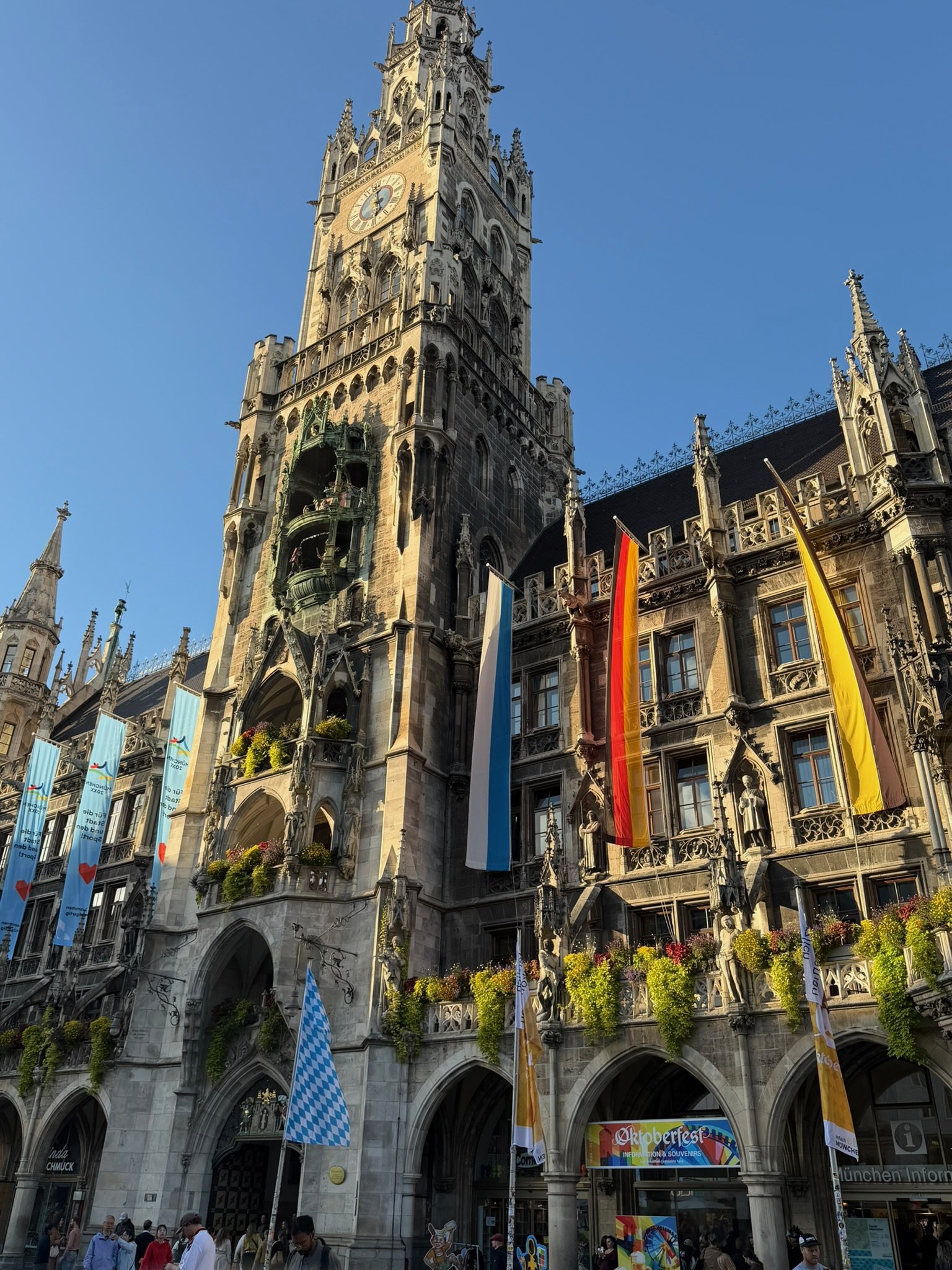
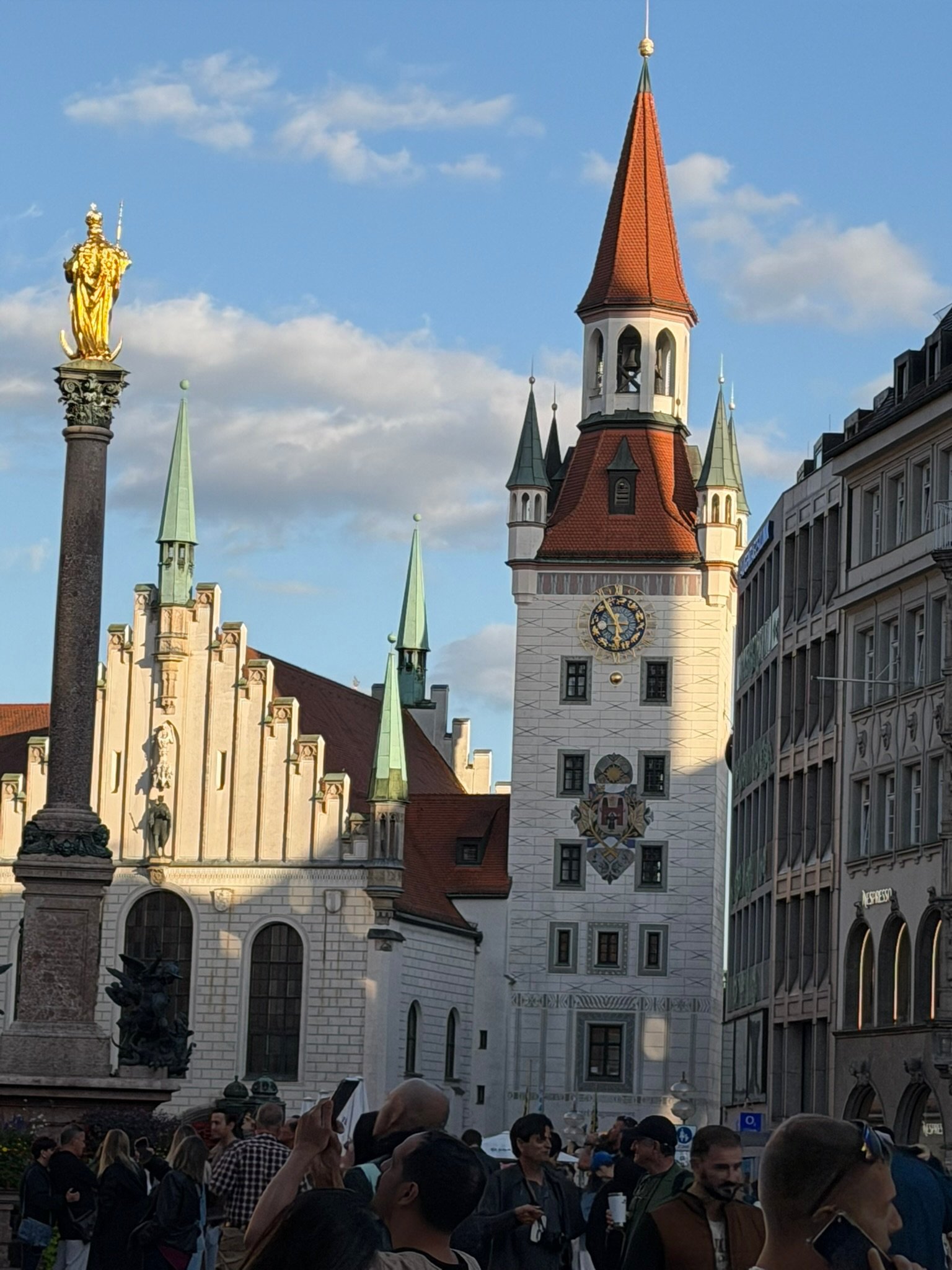
We texted our friends to find out where they were. They were already at a traditional German beer hall, not at Oktoberfest itself, but in the city near Marienplatz, Munich's famous central square with the Glockenspiel on the New Town Hall. They sent us the address, the Augustiner Stammhaus, and we headed over to join them.
Now, here's something you should know about me: I'm not much of a beer drinker. Which makes going to Munich specifically for Oktoberfest a little funny, doesn't it?
I never developed a taste for most American beers. When I was growing up, my aunts and uncles drank brands like Stroh's and Michelob, and I never understood the appeal. Teresa teased me that I'd better build up my stamina and find a beer I liked before Oktoberfest.
She had a point. I just didn't make much progress on that particular training program.
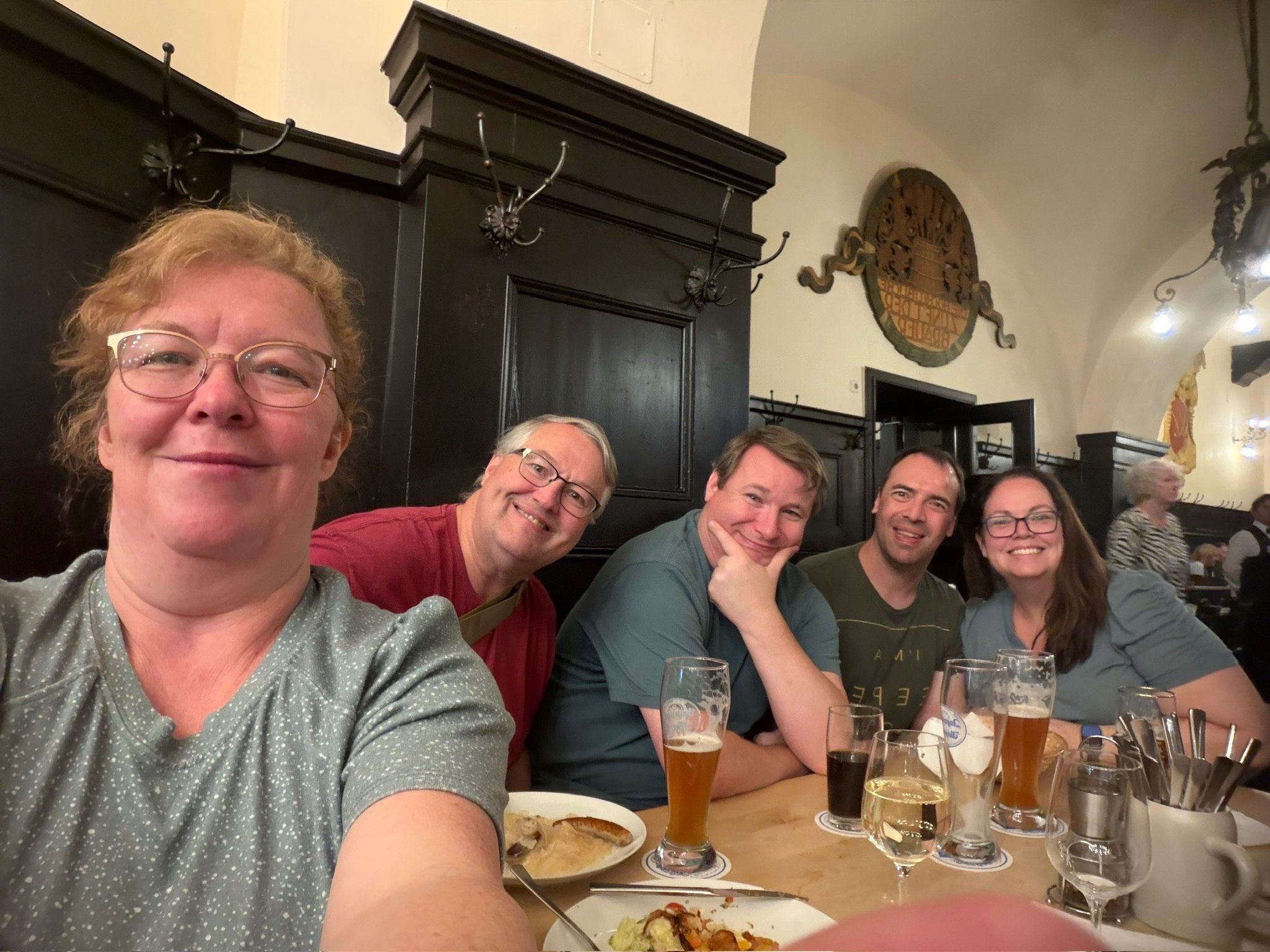
We found the Stammhaus without a problem, but it was a large hall and had many rooms, so it took a minute to find them. Greeting and hugs were exhanged and room was made around the table for us. And within a moment, the waiter appeared. I ordered a proper German beer and gave it a try. And it wasn't bad. I also ordered German sausage with sauerkraut, because if you're in Munich, why not lean into the experience?
The sausage was good, and the sauerkraut was excellent. That brought back a memory of my mother's Polish sausage and kapusta (sauerkraut). Growing up, I always ate the sausage and left the sauerkraut behind. But several years ago, during the Food & Wine Festival at Disney's EPCOT, I stopped at a Polish pavilion for a little taste of nostalgia. I ordered the Polish sausage and forgot to ask them to leave off the kapusta. I decided to try it anyway, and to my surprise, I liked it. Apparently my tastes had changed somewhere between childhood and EPCOT. Since then, I haven't shied away from sauerkraut, and I certainly wasn't going to start in Munich. I enjoyed every bite.
Somewhere in the converstation, Tom was telling us about some of the sightseeing they'd done around Munich, including climbing the tower of St. Peter's Church, known locally as Alter Peter, just off Marienplatz. It's roughly 300 steps to the top, and apparently Tom's legs were still reminding him of every one of them.
Teresa and I hadn't climbed that particular tower, but we've done our share over the years, including one in London that involved three hundred and something steps. I've never decided which is worse, going up or coming back down. Climbing gets your heart pumping, but descending seems to turn your legs into rubber. And, of course, what goes up must come down. So I understood exactly what Tom was complaining about. Naturally, I had absolutely no sympathy for him.
They also showed us pictures of gelato they'd eaten. Naturally, I had an opinion. The texture in the photos looked a little too icy and not quite creamy enough for my taste.
Yes, I'm a gelato snob. Teresa and our friends would be the first to tell you that, and I make no apologies for it.
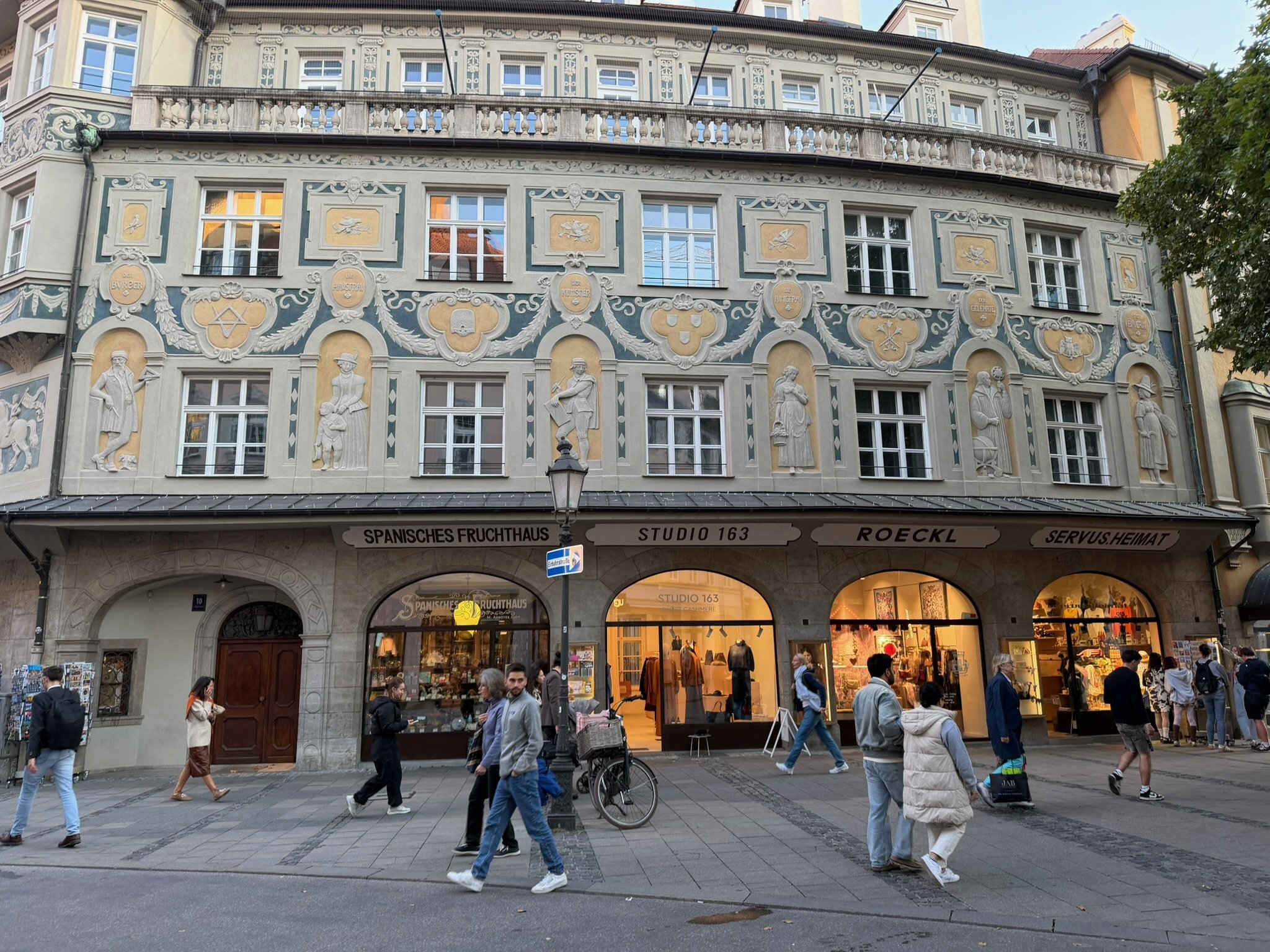
We spent some time wandering around, having drinks, and catching up on the sights we'd each seen. Eventually we returned to our hotel room, opened one of the bottles of wine from Heidelberg, and settled in with some cheese or snacks.
There were five of us together now, sharing stories from two different journeys through Europe. Our friends had worked their way down from Belgium; we'd come from Paris, Disneyland, and a series of German towns. It was nice to stop moving for a while, pour a glass of wine, and compare adventures. And the next day, we'd all be heading to Oktoberfest. For someone who isn't really a beer drinker, I was about to get a fairly thorough introduction.
We use cookies to improve your experience on our site. By using our site, you consent to cookies.
Manage your cookie preferences below:
Essential cookies enable basic functions and are necessary for the proper function of the website.
These cookies are needed for adding comments on this website.
Google reCAPTCHA helps protect websites from spam and abuse by verifying user interactions through challenges.
Statistics cookies collect information anonymously. This information helps us understand how visitors use our website.
Google Analytics is a powerful tool that tracks and analyzes website traffic for informed marketing decisions.
Service URL: policies.google.com (opens in a new window)
Marketing cookies are used to follow visitors to websites. The intention is to show ads that are relevant and engaging to the individual user.
Facebook Pixel is a web analytics service that tracks and reports website traffic.
Service URL: www.facebook.com (opens in a new window)