
We were in Munich for Oktoberfest, which is a funny destination for somebody who has never been much of a beer drinker. But I was determined to give it a fair chance. We got up early Wednesday, met our friends for breakfast at Hotel Cocoon, and headed to Bavarian Outfitters (https://bavarian-outfitters.de/en/). We'd reserved real leather lederhosen and dirndls—not costumes, although I kept catching myself calling them that. The shop was conveniently along the way to the fairgrounds, so we collected and tried on our outfits, then decided to take them back to the hotel and change there rather than carry our street clothes all day.
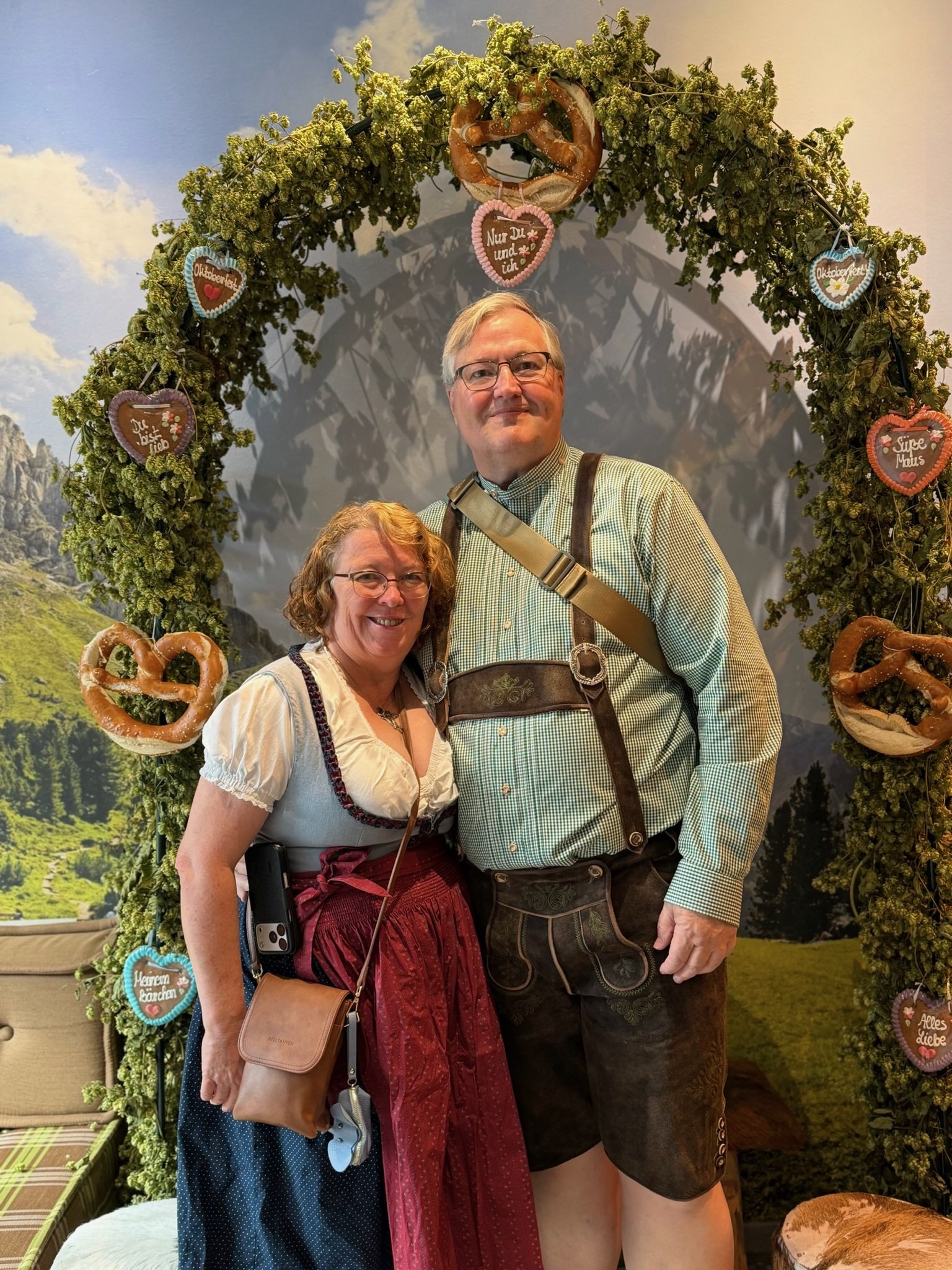
Tom was the only one who hadn't made a reservation. He's a fairly conservative dresser, which is a little amusing considering that he's also part of a Gasparilla pirate crew back home in Tampa. I talked him into at least trying lederhosen if they had his size. He agreed, and an employee checked the inventory, but Tom is a tall guy and they didn't have anything that fit. He'd be the only one of us without the traditional outfit. As it turned out, at Oktoberfest the people not dressed in lederhosen and dirndls were the ones who stood out.
One thing I learned about the traditional Bavarian dirndl is that the bow on the apron isn't necessarily just decoration. Apparently, there's a whole little code to it. Tied on the left means single, while the right means married or otherwise spoken for. A bow in the front center traditionally suggested virginity, although these days it can simply mean someone isn't advertising her relationship status. And tied in the back? Traditionally a widow, although waitresses often wear theirs that way because it's more practical when carrying beer mugs.
I suppose I shouldn't have been too surprised. In several cultures, particularly in parts of the Pacific, the placement of a flower behind a woman's ear can carry a similar message. In Hawaii, for example, a flower behind the right ear traditionally means she's single, while the left suggests she's taken. Other cultures have their own variations, and the meanings aren't always consistent from one place to another. It's interesting how something as simple as a flower in the hair or a bow on an apron can quietly communicate something about a person without a word being spoken. Of course, these days, not everyone knows or follows the traditions, so I wouldn't recommend making too many assumptions based on which side someone's bow happens to be tied.
Back at the hotel we got dressed, made sure we had phones, cameras, cards and cash, and set off on foot with Mike navigating. We'd heard all the warnings about crowds and pickpockets. I carried a small shoulder bag I'd bought for our Japan trip but never actually used there; it turned out to be just right for keeping things close in Munich.
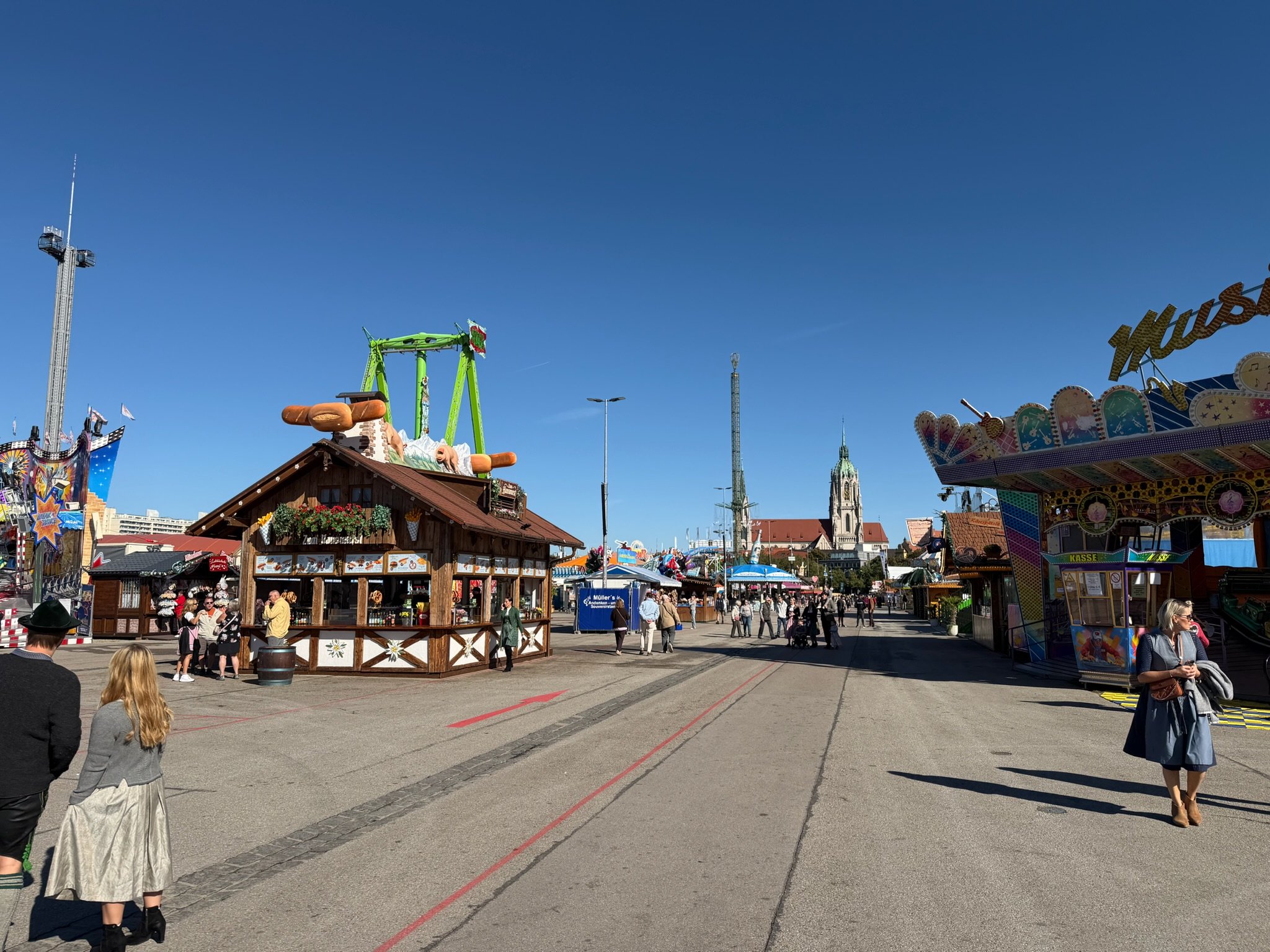
We came in through what seemed to be a eastern entrance shortly after opening and practically walked in. Security gave my bag a quick look and waved us through. The next day the bag inspection was more thorough, but neither experience felt like airport security.
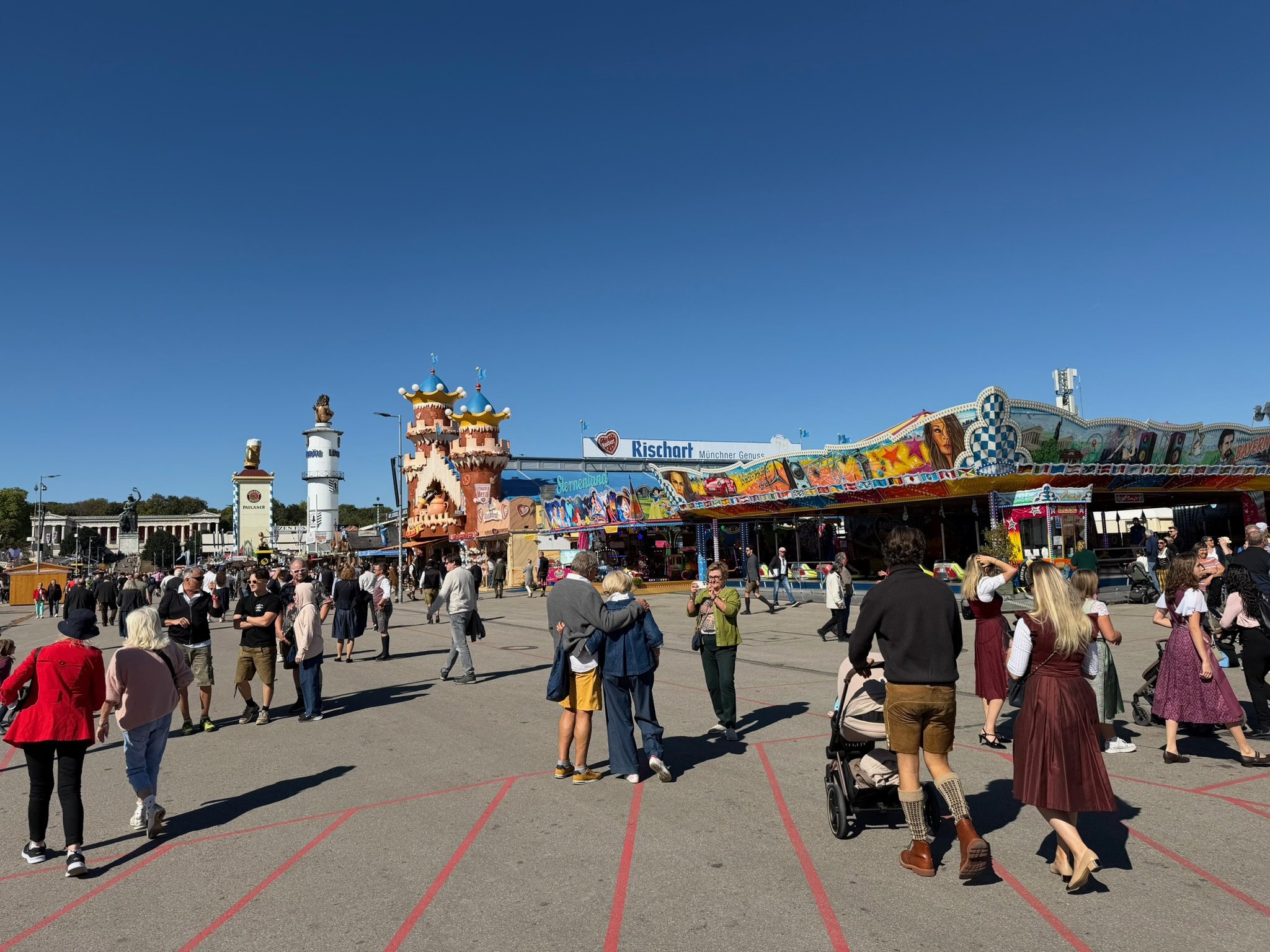
As we wandered through Oktoberfest, I was amazed at just how enormous everything was. This wasn't simply a collection of beer tents and carnival rides. Some of the larger beer halls could accommodate thousands of people, with the biggest holding nearly 10,000 when you included their outdoor areas. And then there were the rides. One massive roller coaster, appropriately named Olympia Looping, had five complete loops and was apparently the world's largest transportable roller coaster.
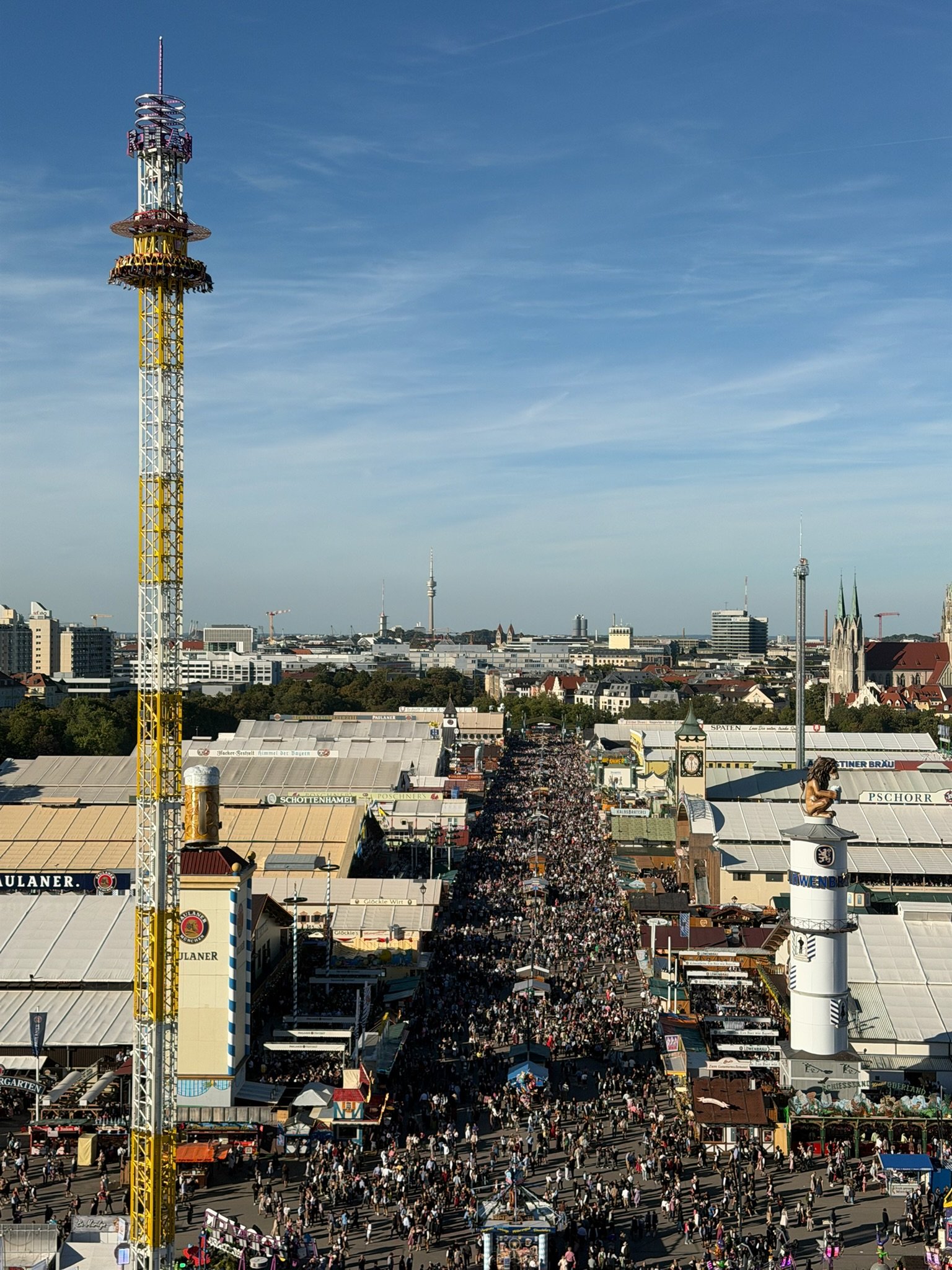
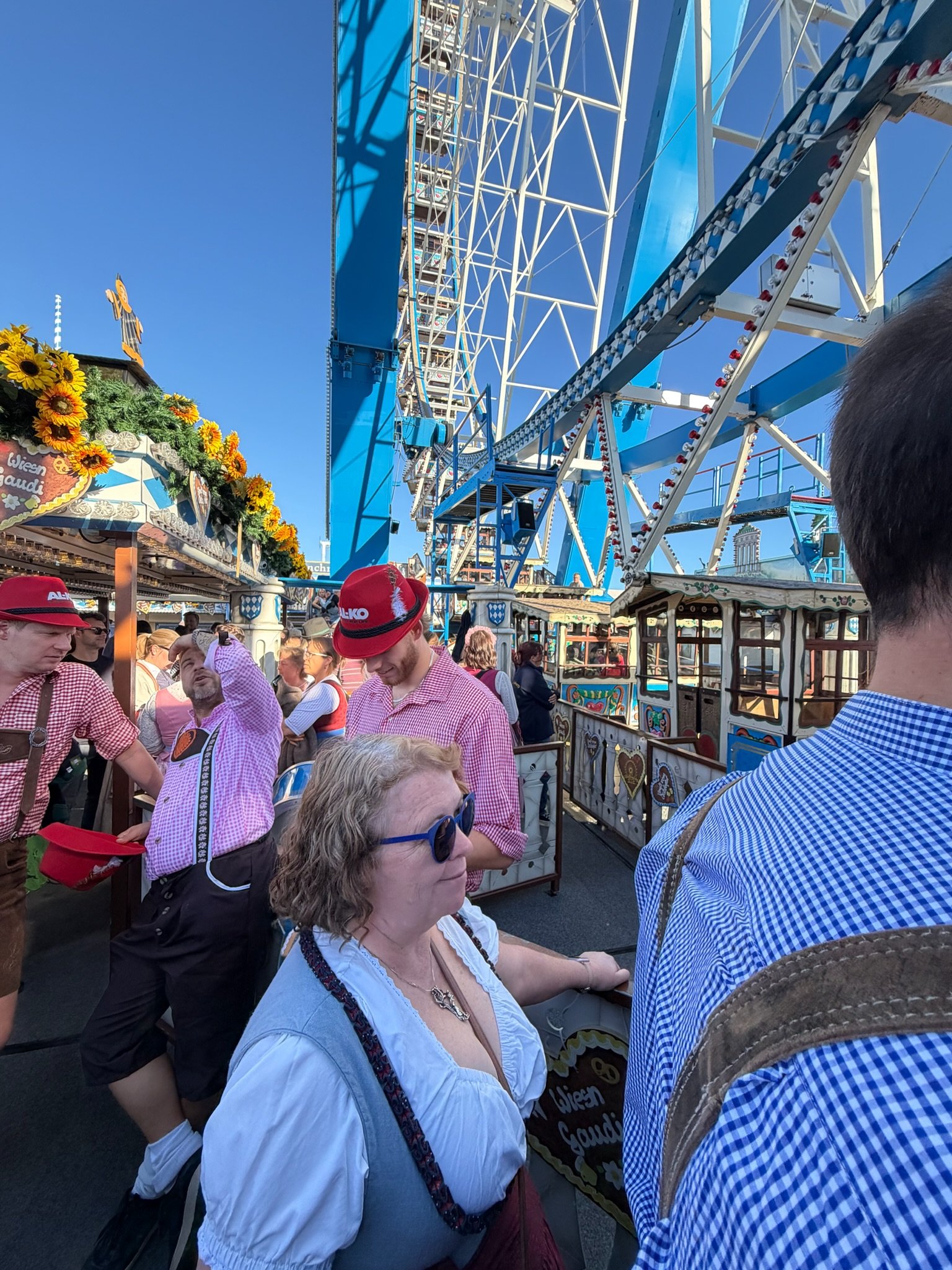
Towering over everything were several enormous swing rides and drop towers, the tallest reaching 90 meters, nearly 300 feet, or about 30 stories. From the ground, even the smaller ones looked like fifteen- or twenty-story buildings. There was also a giant Ferris wheel, 50 meters high, about 165 feet or some 16 stories, which looked impressive enough on its own until you compared it with the towers nearby. It was quite a sight, particularly with all the movement, lights, music, and thousands of people wandering around.
At our first small beer vendor, I explained to the waitress that I wasn't much of a beer drinker and preferred something sweeter. I can appreciate certain dark beers—Dragon's Milk, for example, has a cocoa-like finish I enjoy—but the usual lighter Oktoberfest beers aren't generally my thing. She smiled as if she knew exactly what I needed. When the drinks arrived, mine looked almost like a stout. I took a sip, liked it immediately, and passed it around for the others to try. It was Colaweizen, wheat beer mixed with Coca-Cola, sometimes called Diesel or other regional names. I also sampled Radler, beer mixed with lemon soda, and liked that too. So I had found at least a couple of ways to participate in Oktoberfest without pretending I had suddenly become a beer connoisseur.
We stopped for dumplings and shared different varieties, making a point of eating as well as drinking. There was plenty more of both to come.
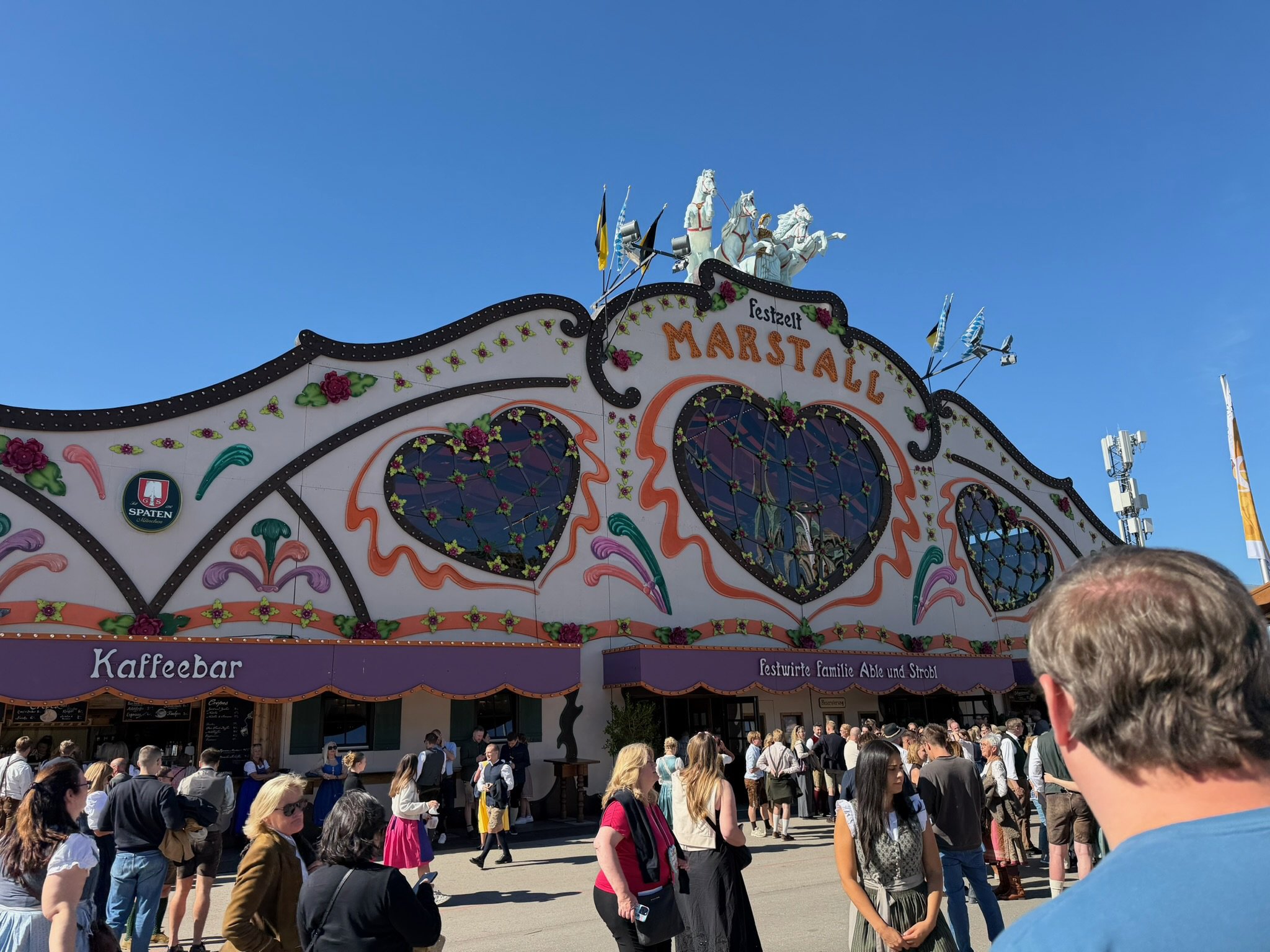
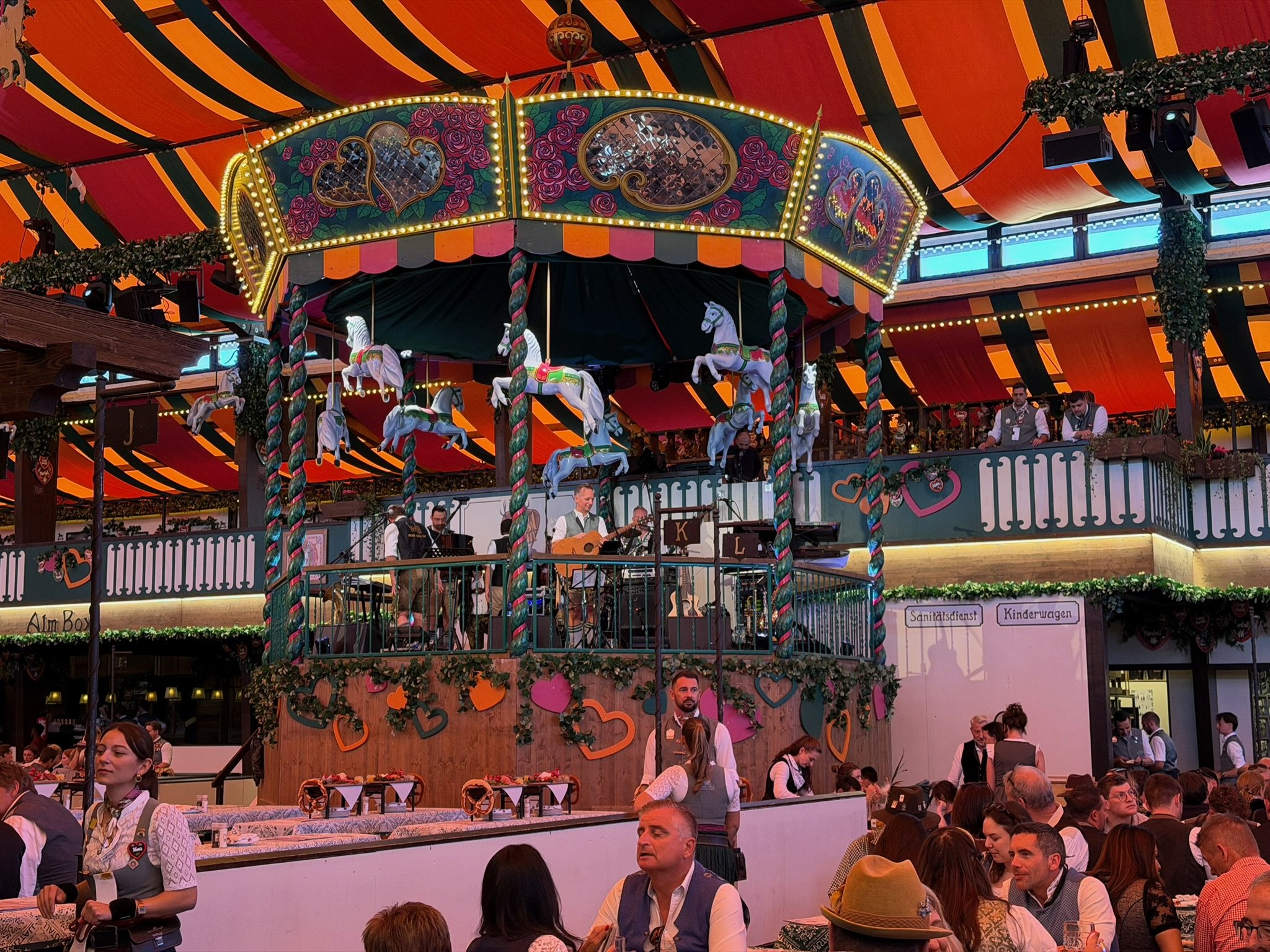
We spent a good part of the day walking into beer tents to see how different they were. Some had open space near the stage, while others had tables and benches almost all the way to the band. In one large blue-and-white tent, the reserved seats were closer to the music. In others, reservations seemed farther back. Maybe that changed by time of day; I couldn't say. Some tents had particular food themes: hunting, fish and seafood, and one where an ox was roasting in full view. Two of our friends dislike seafood, so we avoided going into the fish tent. A couple of us stepped into the ox tent, but we didn't stay for a meal.
If I were giving one piece of Oktoberfest advice, it would be this: reserve your table early, especially if you're going with friends or have a particular tent or evening in mind. Reservations typically begin opening in the spring, often between February and May, depending on the tent, and the most desirable dates and times can disappear quickly. Each tent handles reservations differently. Some allow you to request a particular seating area, while others simply assign you a table. We also discovered that some travel companies package and resell reservations, although individual tents have different rules, and unauthorized resale is prohibited.
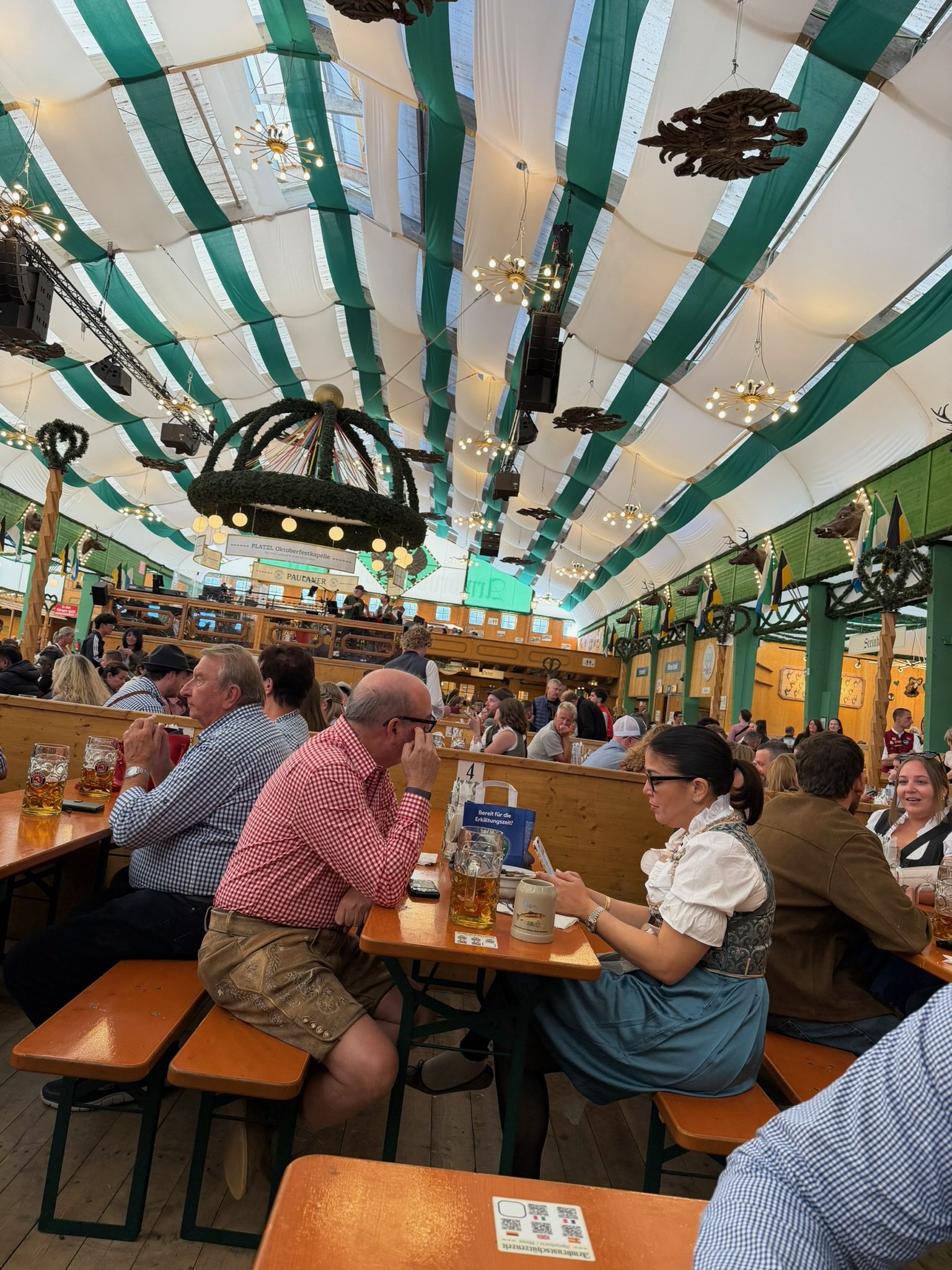
Early in the day, we saw unreserved seats available in several tents. But as the afternoon wore on, reservation signs appeared, open seating became harder to find, and by evening there were substantial lines outside the more popular tents. You can certainly enjoy Oktoberfest without a reservation, but if you're planning a special evening with a good sit-down meal, music, and friends, I'd strongly recommend checking your preferred tent's reservation website early in the year and booking as soon as reservations open. It takes much of the uncertainty out of the experience, and that's one less thing to worry about when you're there to have a good time.
Even the restrooms deserve a mention. Throughout France and Germany, we'd encountered public toilets with coin-operated gates, collection boxes, or attendants with tip trays. It was common enough that we got used to keeping a little change handy. At Oktoberfest, however, the restrooms were officially free, and the ones we used, both around the grounds and inside the beer tents, were generally well maintained. There was usually an attendant near the exit, along with a small tray or jar for tips. Some people dropped in a few coins, while others walked right past. Nobody appeared to be demanding payment, and tipping was entirely optional.
The men's rooms were a little different from what some Americans might expect, with long, open urinal troughs as well as enclosed stalls. We also noticed that the attendants weren't necessarily the same gender as the people using the facilities. None of this bothered us; it was simply another little cultural difference worth mentioning. And I couldn't tell you whether the people leaving tips were locals or tourists. With nearly everyone dressed in lederhosen and dirndls, it was pretty hard to tell who was who anyway.
And the servers! A traditional one-liter glass beer mug, called a Maßkrug, weighs nearly three pounds empty and about five pounds when filled. And these aren't flimsy little beer glasses, either. They're thick, heavy, remarkably sturdy things. We saw several dropped during our time at Oktoberfest, and rather than shattering, they actually bounced off the floor! Of course, I wouldn't recommend testing that yourself, but it gives you some idea of how solid they are. Now imagine carrying ten of those mugs, filled with beer, through a crowded tent. That's roughly fifty pounds of beer and glass. We watched servers carry remarkable clusters of them in both hands, weaving through packed aisles to tables of ten or more people, making it look almost effortless.
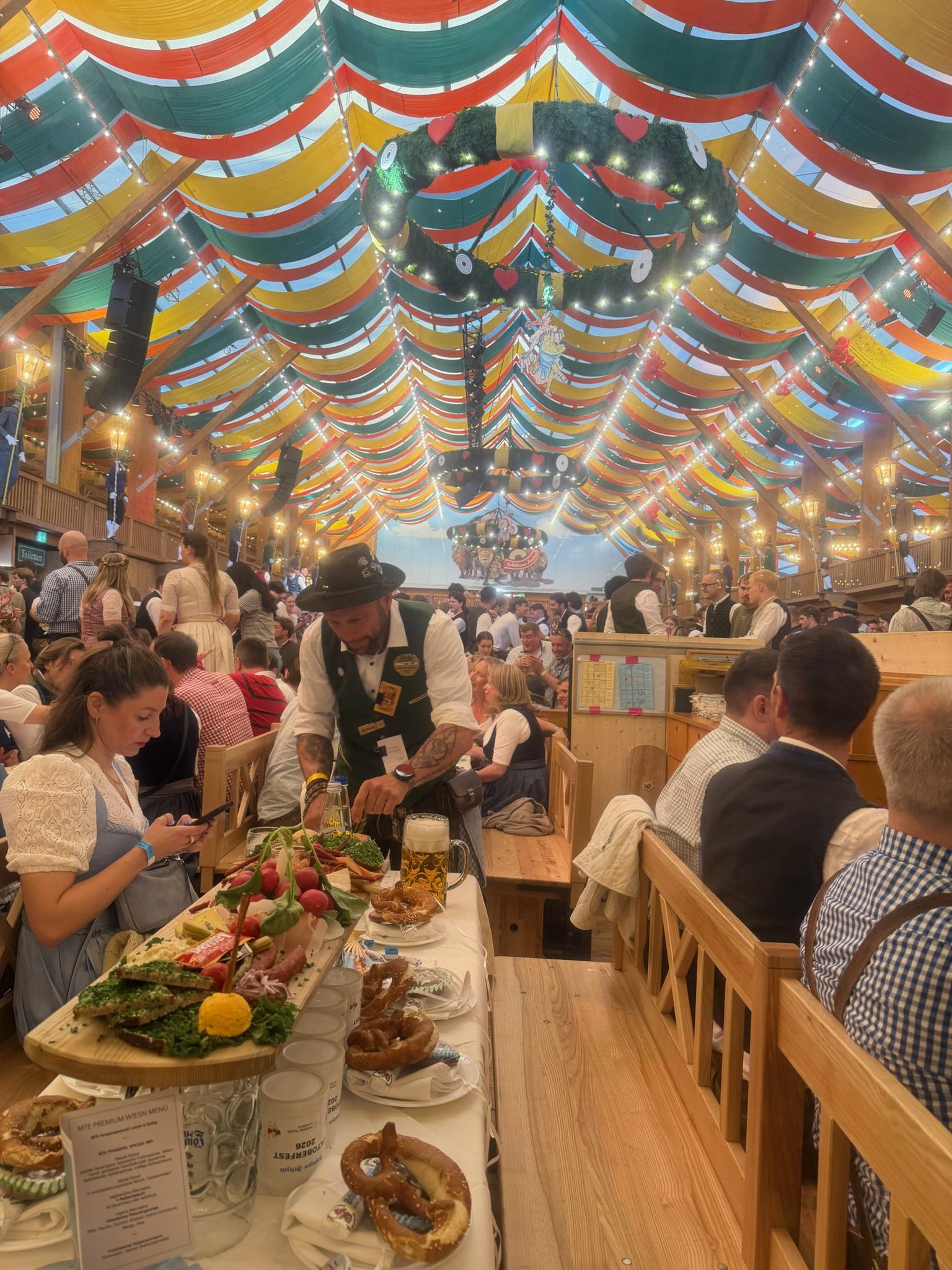
Then there were the enormous snack boards, piled with meats, cheeses, radishes, and other Bavarian specialties. We watched servers carry them in and set them above the tables, supported by empty beer mugs. Between the food, the beer, the crowds, and the constant movement, it was quite a production. We'd already learned a little about German tipping customs from our bartender friend in Heidelberg, who had taken excellent care of us and explained how tipping expectations differed from those back home. Germany generally doesn't have the same tipping culture as the United States, but watching these Oktoberfest servers work gave me an entirely new appreciation for what they do. We received excellent service and tipped generously, just as we had in Heidelberg. Frankly, they earned every bit of it.
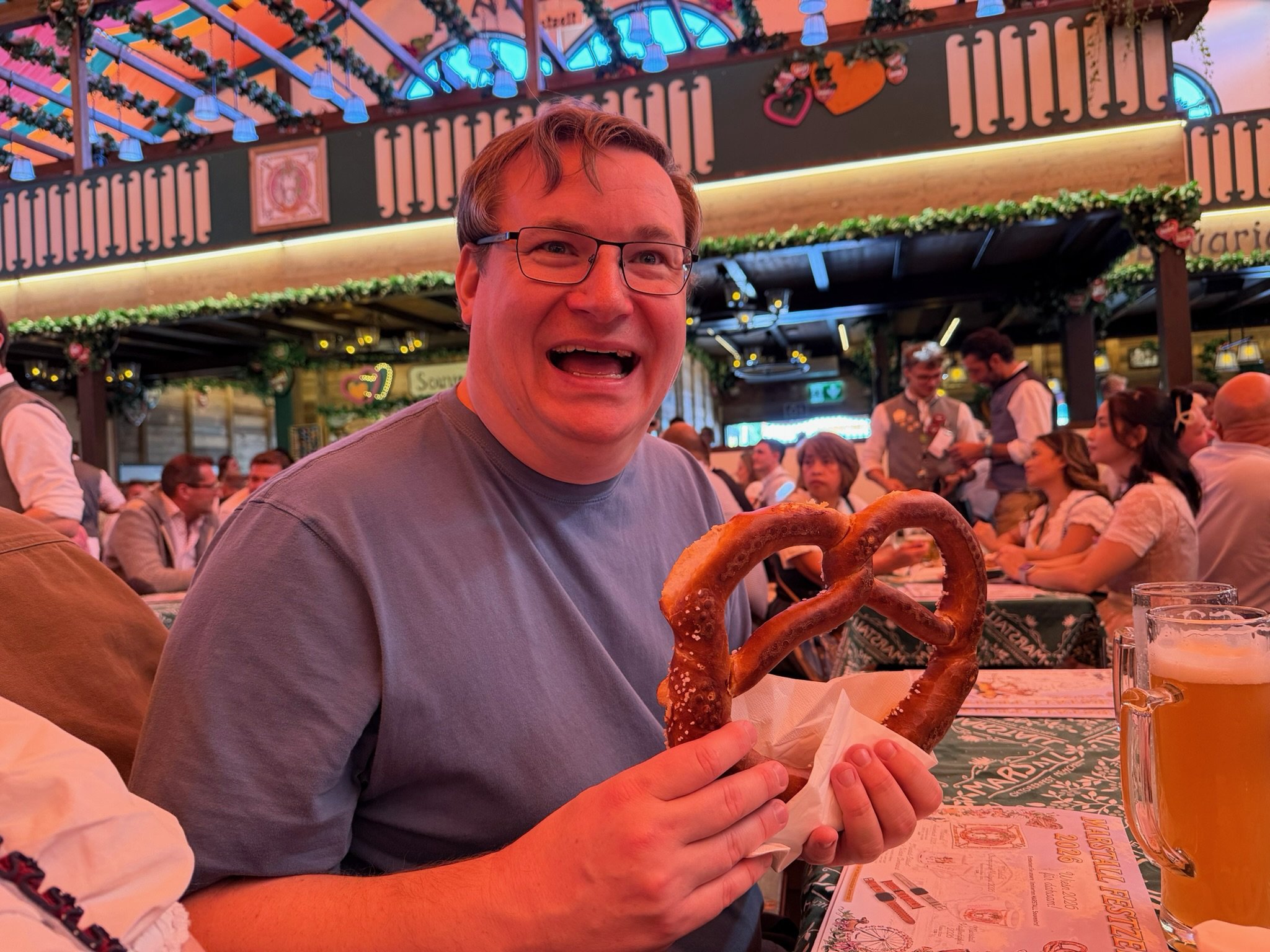
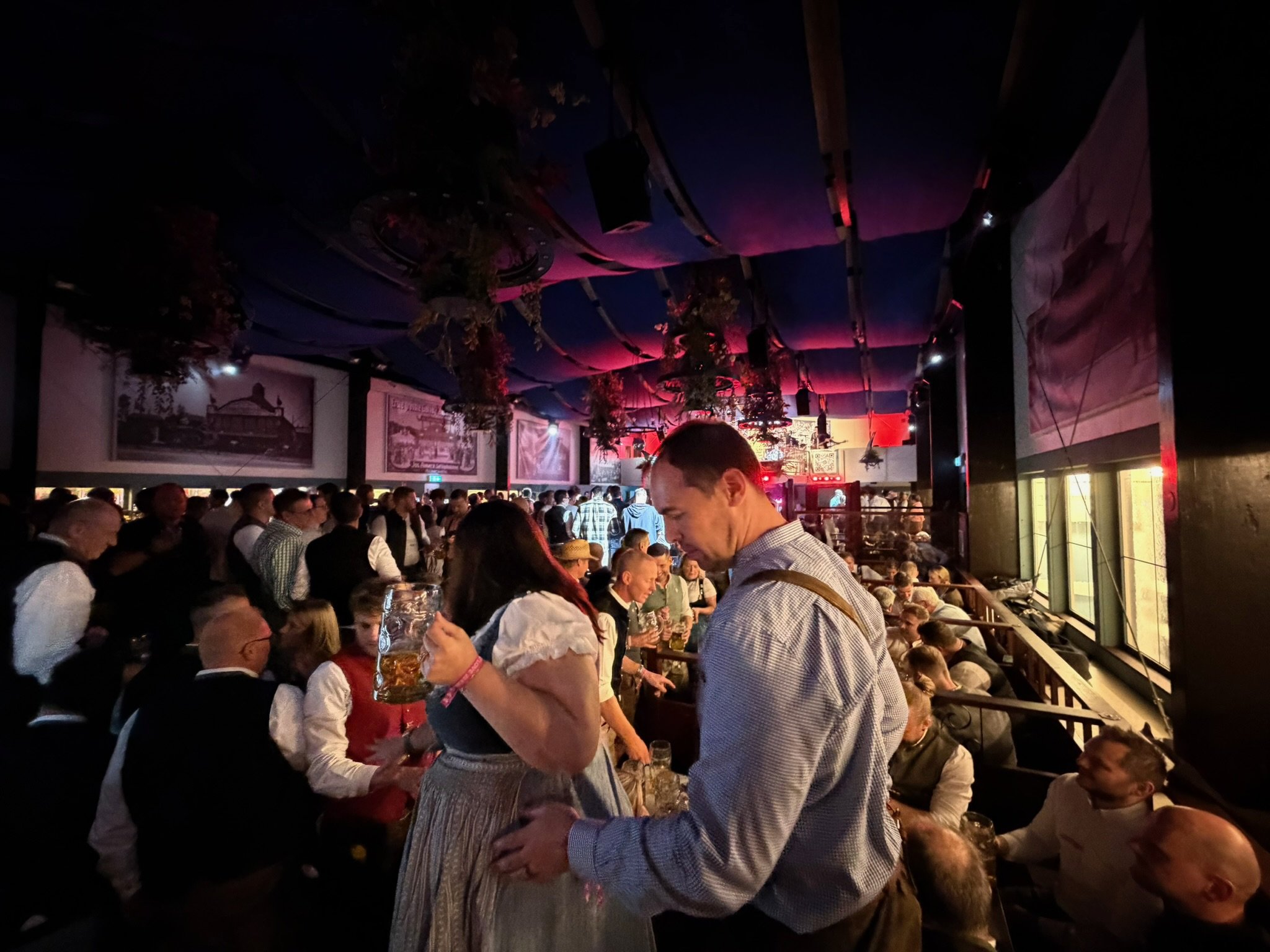
In one of the first big tents, we ordered beers and a snack board while a new band set up. They began with a German song, and then something very familiar came through the speakers: John Denver's “Take Me Home, Country Roads.” I've heard all kinds of versions of that song, including heavy metal, but never like this. The entire tent seemed to know every word—not just the chorus—and the singing grew louder and louder. People were standing on benches, swaying and raising their steins. It was one of those moments when you look around and think, Well, I didn't expect that.
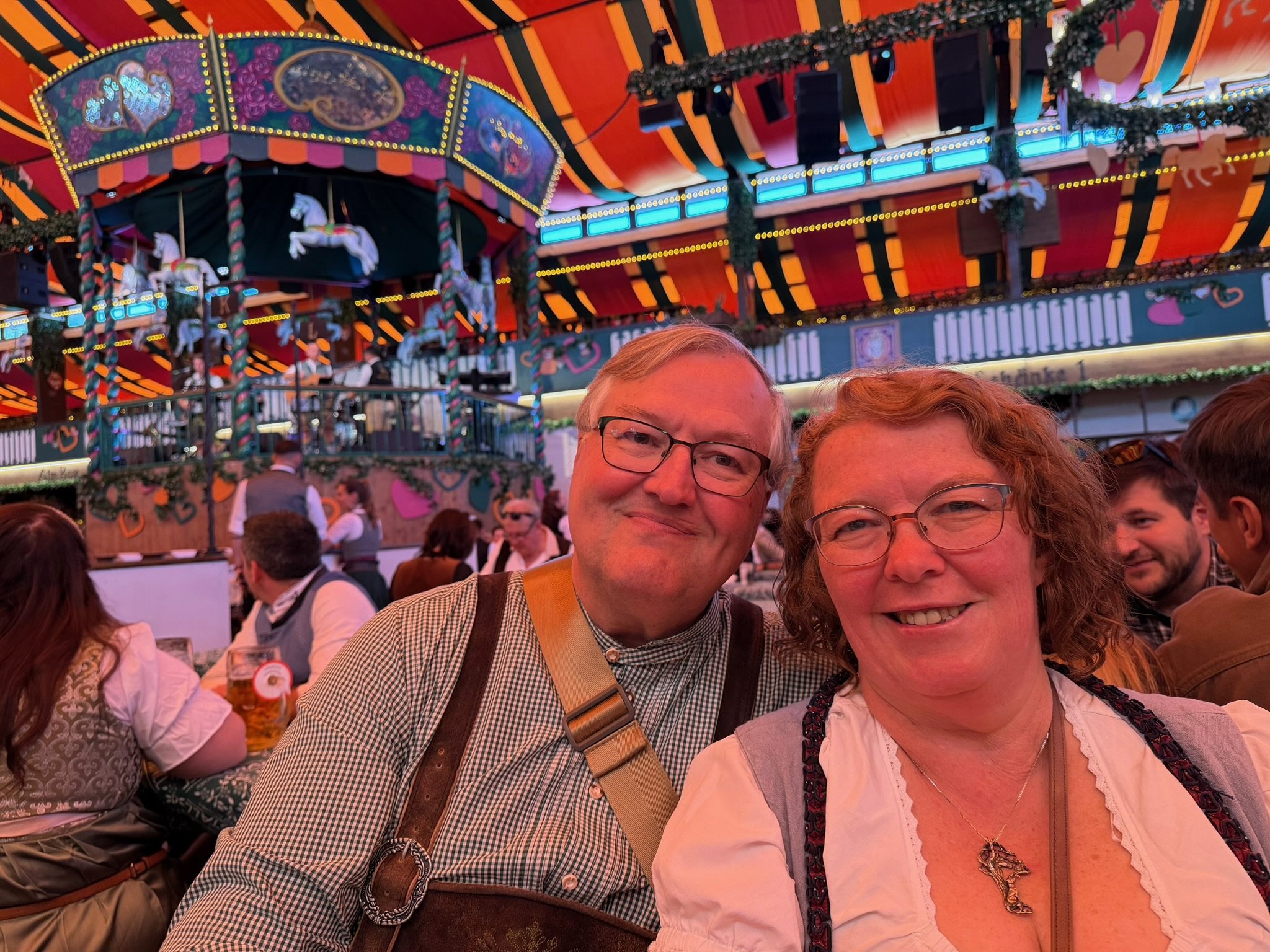
The music was a mixture of German drinking songs and songs we recognized from home, and some of it came with plenty of audience participation. There was Fliegerlied (roughly, “The Flying Song”), with everyone waving their arms and following along with the motions. Then there was Kakadu, a song by the Austrian group Mountain Crew, with its wonderfully silly bird calls and people flapping their arms like chickens. It reminded me of the Chicken Dance back home, and watching an entire beer tent join in was quite a sight. Another favorite was Mountain Crew's Oktopus (100.000 Hände), or “Octopus (100,000 Hands),” which I believe we heard twice. I've since seen videos of Mountain Crew performing these songs to enormous audiences, with entire concert halls singing along. Watching them command a crowd like that reminded me a little of Freddie Mercury at Live Aid. Very different music, obviously, but that same remarkable ability to get thousands of people participating together.
And it wasn't all German music. Neil Diamond's “Sweet Caroline” brought out the familiar audience responses, too. Between songs came the traditional “Ein Prosit” toast, which seemed to be an invitation for everyone to raise their glasses together. We also learned that saying “Prost!” and clinking glasses has its own etiquette: look the person in the eye as you toast them, then move to the next person. Whether the more elaborate folklore about it is true or not, it's a nice ritual and one we enjoyed adopting.
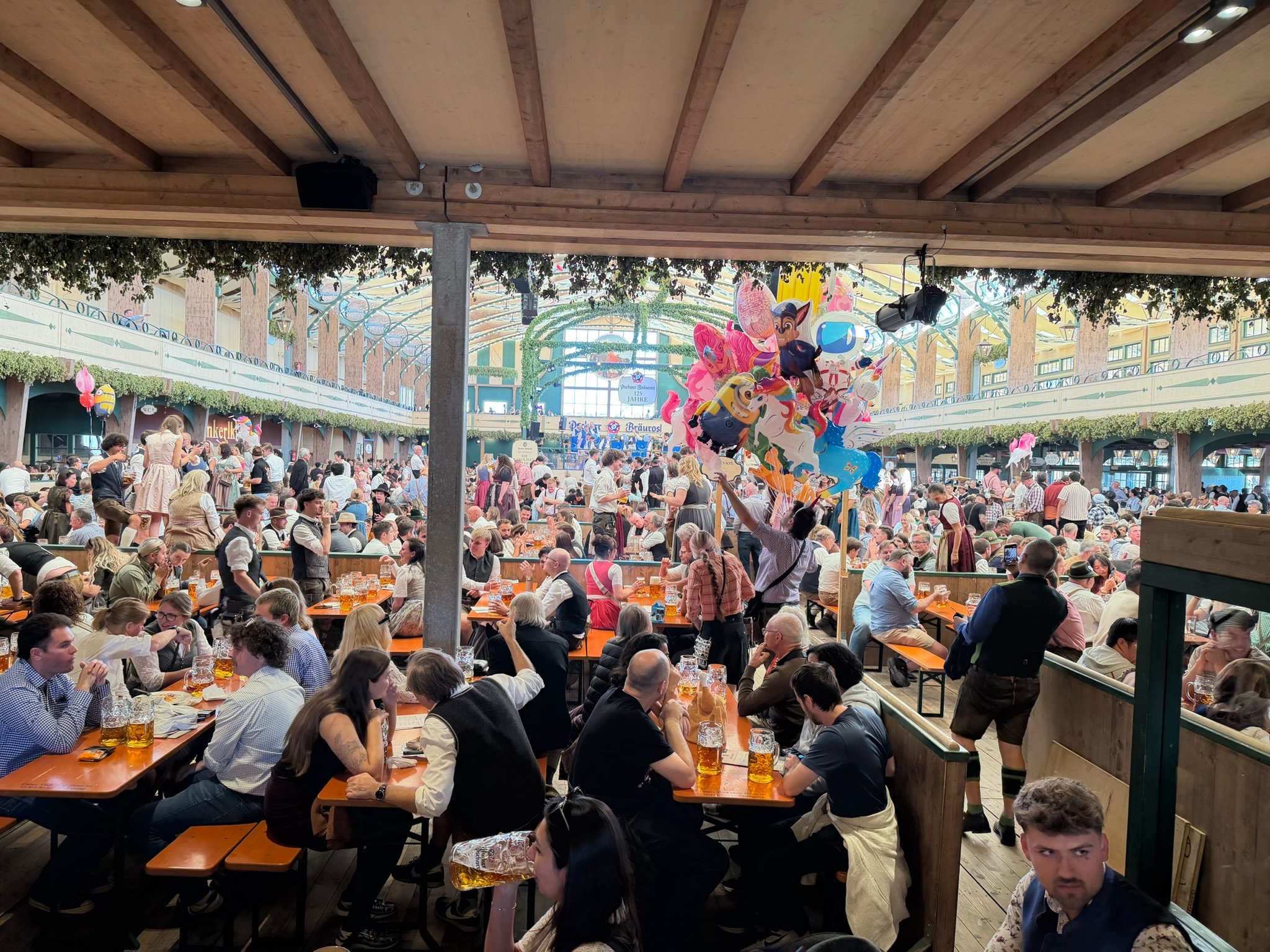
As the evening wore on, the atmosphere inside the tents became even livelier. Standing on the benches, singing, swaying, and dancing along with the music was all part of the fun. In fact, we visited a few tents where practically nobody was sitting anymore. Everyone seemed to be on their feet, having a wonderful time. But here's a little warning for first-time visitors: standing on the benches and standing on the tables are two very different things. We saw signs in nearly every tent warning people not to stand on the tables, and apparently the rule is taken seriously enough that you can be escorted out for ignoring it. We even heard a rumor that putting a foot on a table meant you owed everyone at that table a round of beer. I couldn't verify that one, and suspect it may be more folklore than an actual rule, but I certainly wouldn't test it. My advice? Enjoy yourself, join in the singing and dancing where it's allowed, and pay attention to the posted signs. They're there for a reason.
Outside, there was no shortage of entertainment. I wanted to try two traditional attractions but never caught them at the right time. One was the Toboggan, a slide reached by balancing on a surprisingly fast moving walkway. The other was the Teufelsrad, or Devil's Wheel, where people sit on a spinning platform and try not to be thrown off while the operators make staying on increasingly difficult. Both looked like great fun from what I knew of them, but we didn't get a chance to participate.
We did ride the Ferris wheel, which was much better for sightseeing than the towering swing rides; the cars held several people and gave us a few leisurely rotations. I'd recommend that one to anyone wanting a view without the thrill-ride element.
I tried the old hammer-and-bell strength game and didn't exactly distinguish myself—I don't think I got the marker even a quarter of the way up. I also played a shooting game and won Teresa a small stuffed animal. We didn't go wild on the rides. With that much beer being consumed, I couldn't help wondering how well some of the more aggressive spinning rides worked out for everybody. I didn't see anything go wrong, but the thought crossed my mind.
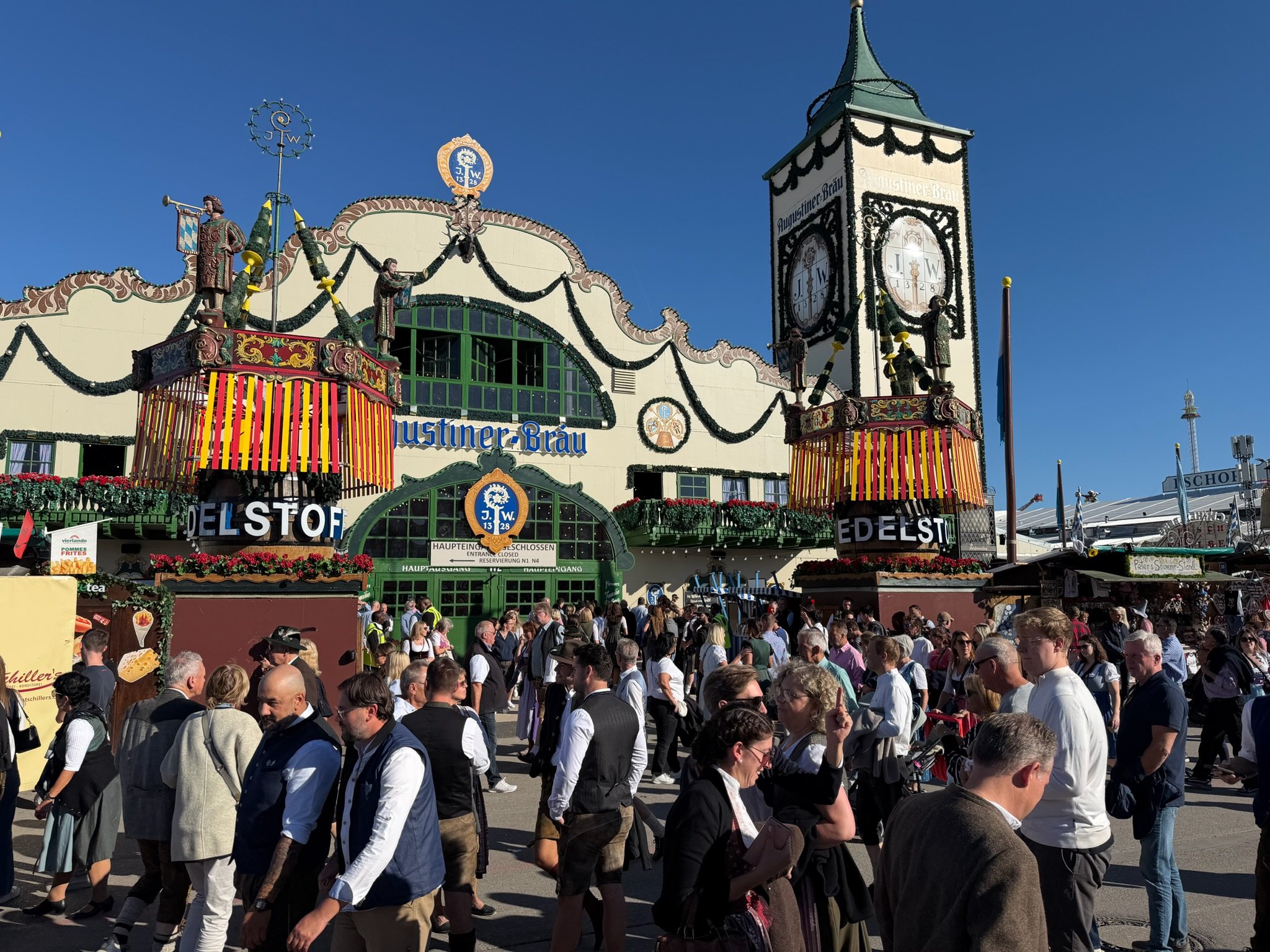
After a full day of wandering, snacking and sampling, we headed to the Augustiner Festhallo tent where we'd reserved our evening table. We'd picked up wristbands earlier, so we could bypass the hopeful line outside and go straight in.
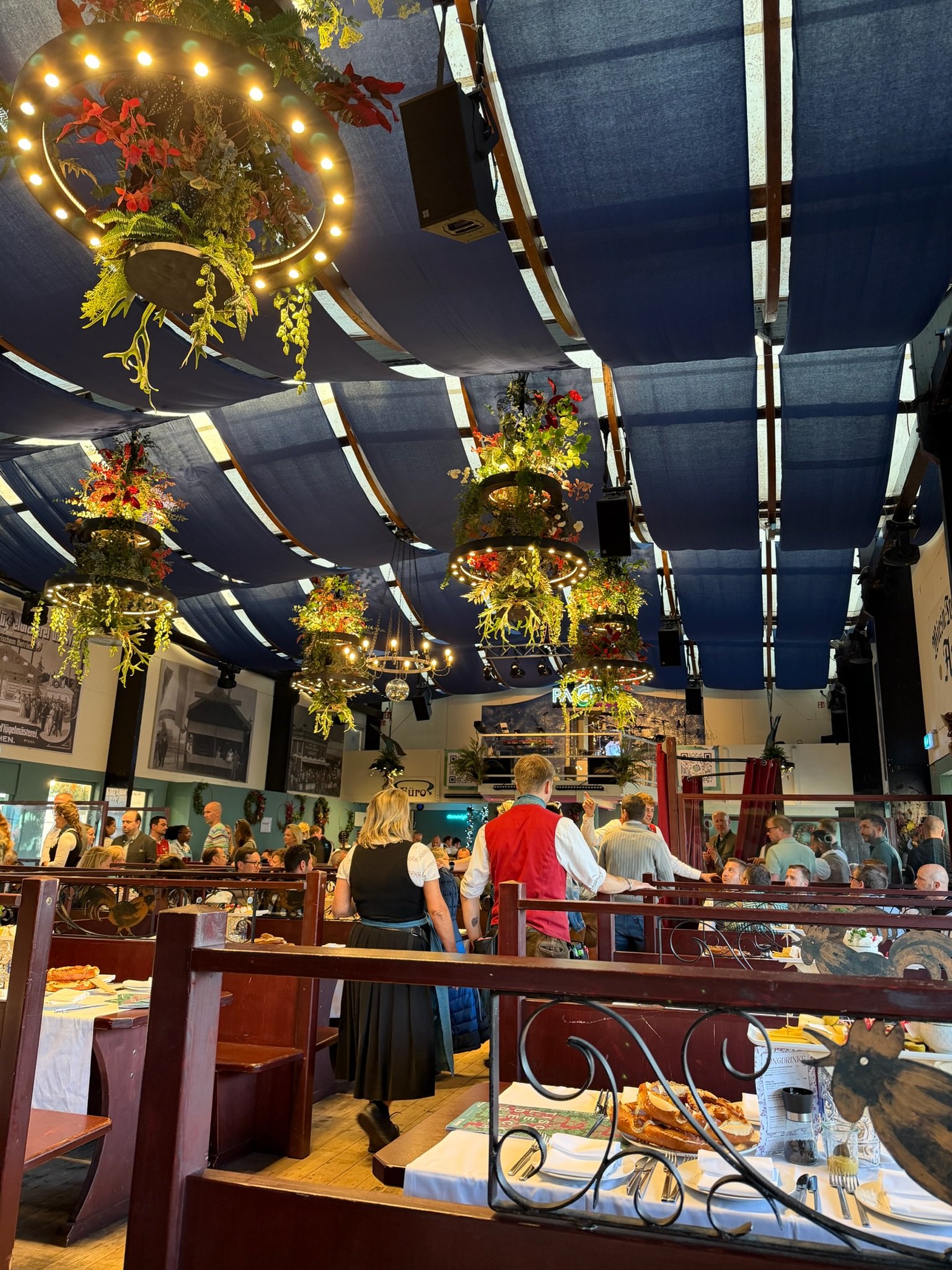
There were five of us, and the table seated more than that. Staff brought in a couple of other guests to fill some of the spaces. We tried to strike up conversation, but they weren't particularly interested in talking to us or, from what I could tell, to each other. A little awkward, perhaps, but it didn't spoil our evening.
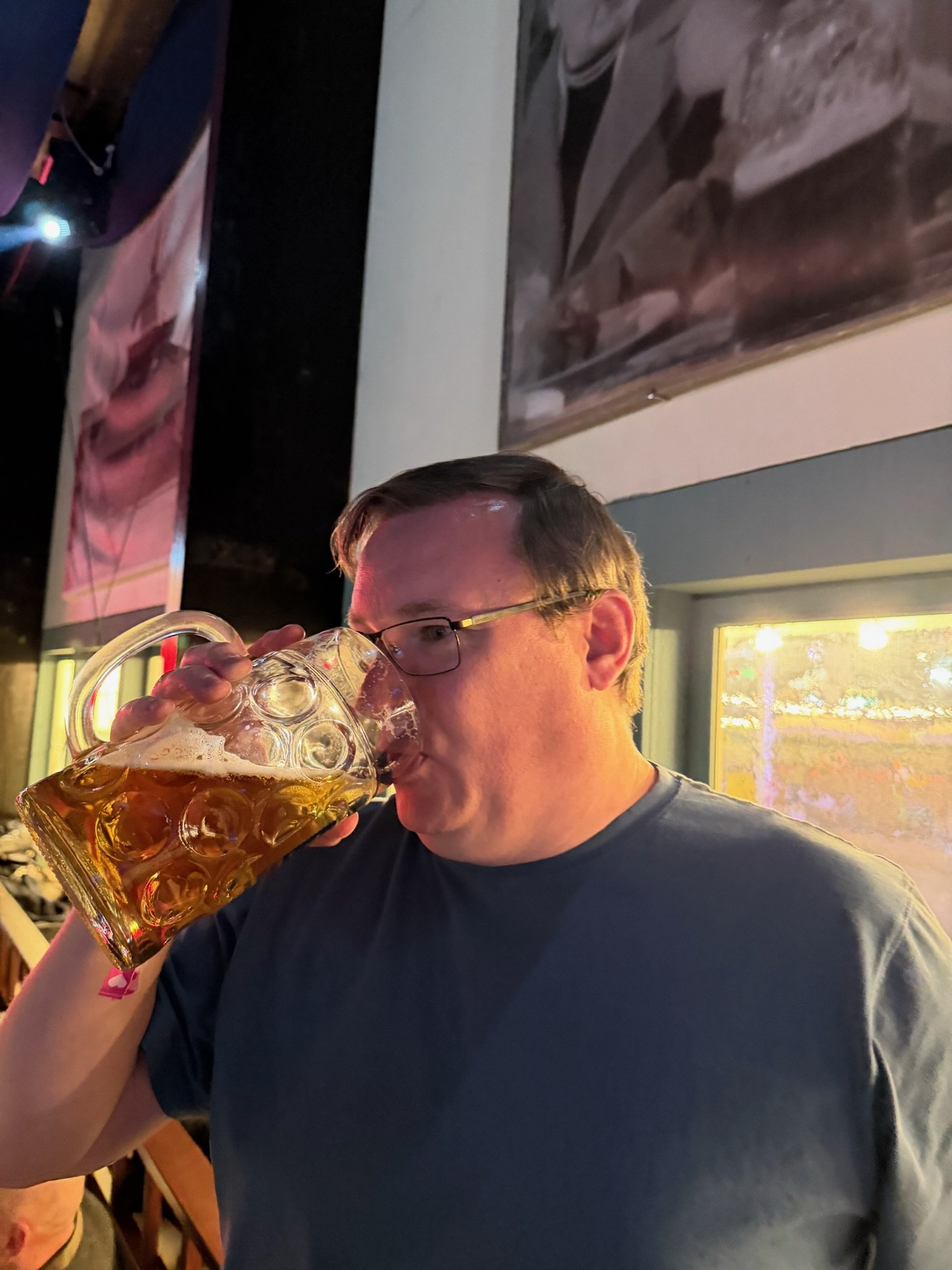
The reservation included prepaid food and drink vouchers. We'd heard the shorthand description of “two liters of beer and half a chicken,” although there were other menu choices. I chose a German-style sandwich instead of chicken, enjoyed a liter of beer and something else to drink, and later suggested a round of cherry schnapps to finish the night. The food was good, and once the sound crew sorted out what seemed to be a microphone problem, the band was good too. We were farther from the stage than in some of the other tents, but there was still plenty of singing and dancing.
By the time we left, the fairgrounds looked different under the lights. There were still crowds, but the paths outside felt a little less packed than the tents. We tried peeking into a few more venues, found long lines, and decided we'd seen enough for one day. We wandered, took in the lights, perhaps found another snack despite being full, and walked back to the hotel. One full day of Oktoberfest, and I finally understood why people make a trip of it.