
First Steps into Africa
After Months of Planning, Africa Finally Becomes Real
There is a strange moment that happens on every big trip.
For months, sometimes years, a destination exists only as a collection of airline reservations, hotel confirmations, packing lists, YouTube videos, and daydreams. You talk about it over dinner. You tell friends about it. You spend far too much time checking weather forecasts for places thousands of miles away.
But it still doesn’t feel real. Then suddenly, after crossing oceans and continents, the wheels touch the runway. And reality arrives all at once. For me, that moment came in Johannesburg, South Africa.
After months of planning, researching, budgeting, packing, repacking, and wondering whether we’d forgotten something important, we had finally arrived on the African continent.
Africa was no longer an idea. It was outside the airplane window.

The Long Journey Ends
When I was young, I used to watch airplanes crossing the sky and wonder about them.
Where were they going? Who was on board for the first time? What amazing place were they about to see?
As I got older, and after many flights for both work and vacation, airplanes became more of a means to an end. They were simply transportation. Necessary, but not particularly magical.
Lately, though, some of that magic has returned. Not because of the destination, but because of what happens during the journey.
On our flight to Japan a few years ago, I noticed the flight crew slowly manipulating time itself. The cabin lights dimmed and brightened at specific intervals. Meals appeared according to the time zone we were flying toward rather than the one we had left behind. Passengers were gently nudged toward a new schedule without even realizing it.
The flight to South Africa worked much the same way.
Somewhere over the Atlantic and Africa, our bodies began adjusting to a clock that was six hours ahead of Florida. It wasn’t perfect, and seventeen hours in transit is still seventeen hours in transit, but by the time we landed, we were already partway there. I’d call that a little bit of travel magic.
By the time we landed, excitement and exhaustion were fighting for control. Excitement won. At least for a little while.
Walking through O.R. Tambo International Airport, everything felt familiar and different at the same time. The airport itself was modern and well organized, certainly not the rough-and-rugged image some people mistakenly imagine when they think of Africa. Digital displays, international airlines, duty-free shops, restaurants, and bustling crowds could have easily been found in many major airports around the world.
Yet there was an unmistakable feeling that we were somewhere new. The accents were different. The languages were different. And after nearly sixty years of life, I had finally stepped onto a continent I had only experienced through books, documentaries, movies, and wildlife programs.
That realization hit harder than I expected.
The Porter Experience
One of the first lessons we learned happened almost immediately after collecting our luggage.
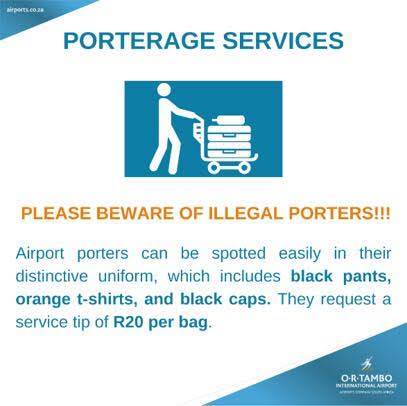
As we entered the baggage claim area, several airport porters approached offering assistance with luggage carts and transportation through the terminal.
If you’re accustomed to most U.S. airports, this can be a little surprising.
Several people approached us offering help. Some were official airport personnel. Others appeared to simply be offering a service in exchange for a tip. Before long, you begin wondering if you’ve accidentally become the most popular person in the terminal.
We quickly learned that a polite but firm “No thank you” was usually enough. Most people moved on immediately. A few were more persistent. None were threatening.
But it was definitely one of those moments where you realize you’re no longer operating under the same unwritten rules you’re used to at home.
For first-time visitors to South Africa, it can be a bit of culture shock.
My advice? Keep hold of your luggage and politely say “No thank you” if you don’t need assistance. Most international airports have excellent signage, often in English, and it’s perfectly fine to take your time, walk around, and figure things out yourself.
If you do need help, look for someone who appears to be official and understand that a tip is generally expected. Most won’t simply point toward your destination. They’ll walk you there, help with your bags, and provide a service. That’s how they earn their living.
Once you understand that, the whole experience makes a lot more sense.
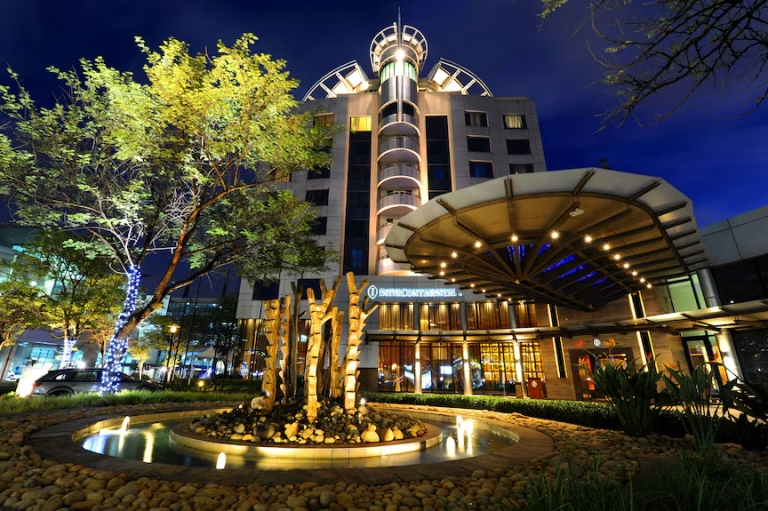
The InterContinental
The InterContinental was a part of our plans, thanks to Hippo Lakes. It was because it served as the pickup location for guests heading to the reserve the following morning. As it turns out, Hippo Lakes had this process figured out.
After a long international flight, nobody wants to immediately pile into another vehicle for several more hours of travel. Instead, guests arrive, recover, get a decent night’s sleep, and start the next phase of the adventure rested. At least that was the theory.
We still had jet lag. But we also had a comfortable room, a hot shower, room service, and a bed that looked increasingly attractive with every passing minute. Not necessarily in that order.
After getting settled, we ventured back into the airport in search of a drink and a chance to stretch our legs. We wandered through a few shops, took in the atmosphere, and enjoyed the simple fact that we were finally there, in Africa.
Tomorrow the real adventure would begin. Tonight, however, was about recovery. A shower, a meal, a bed. Sometimes that’s exactly the adventure you need.
Tomorrow we’d leave the city behind and head into the African bush, but first there was one stop that none of us would soon forget.
0 Comments