
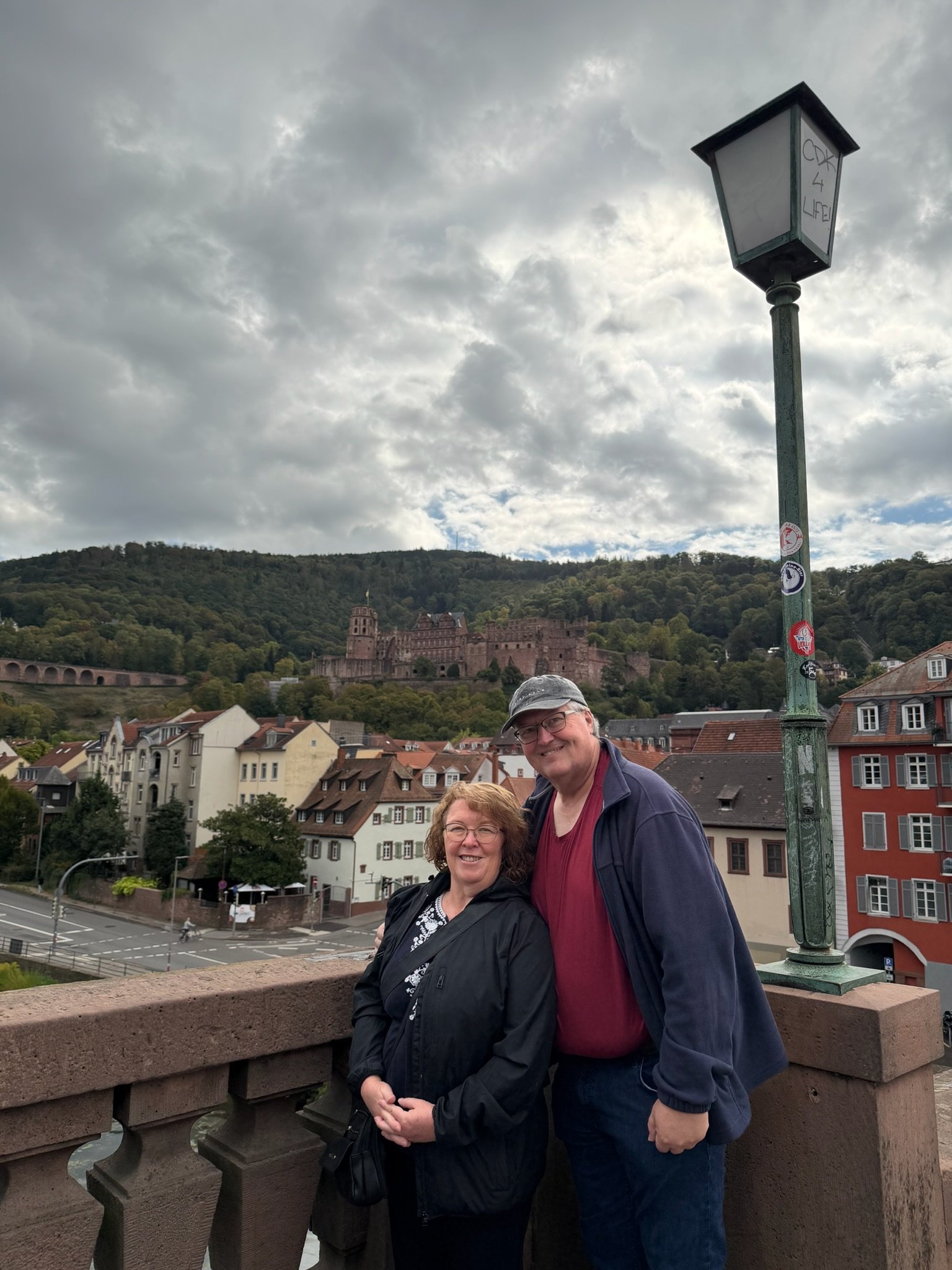
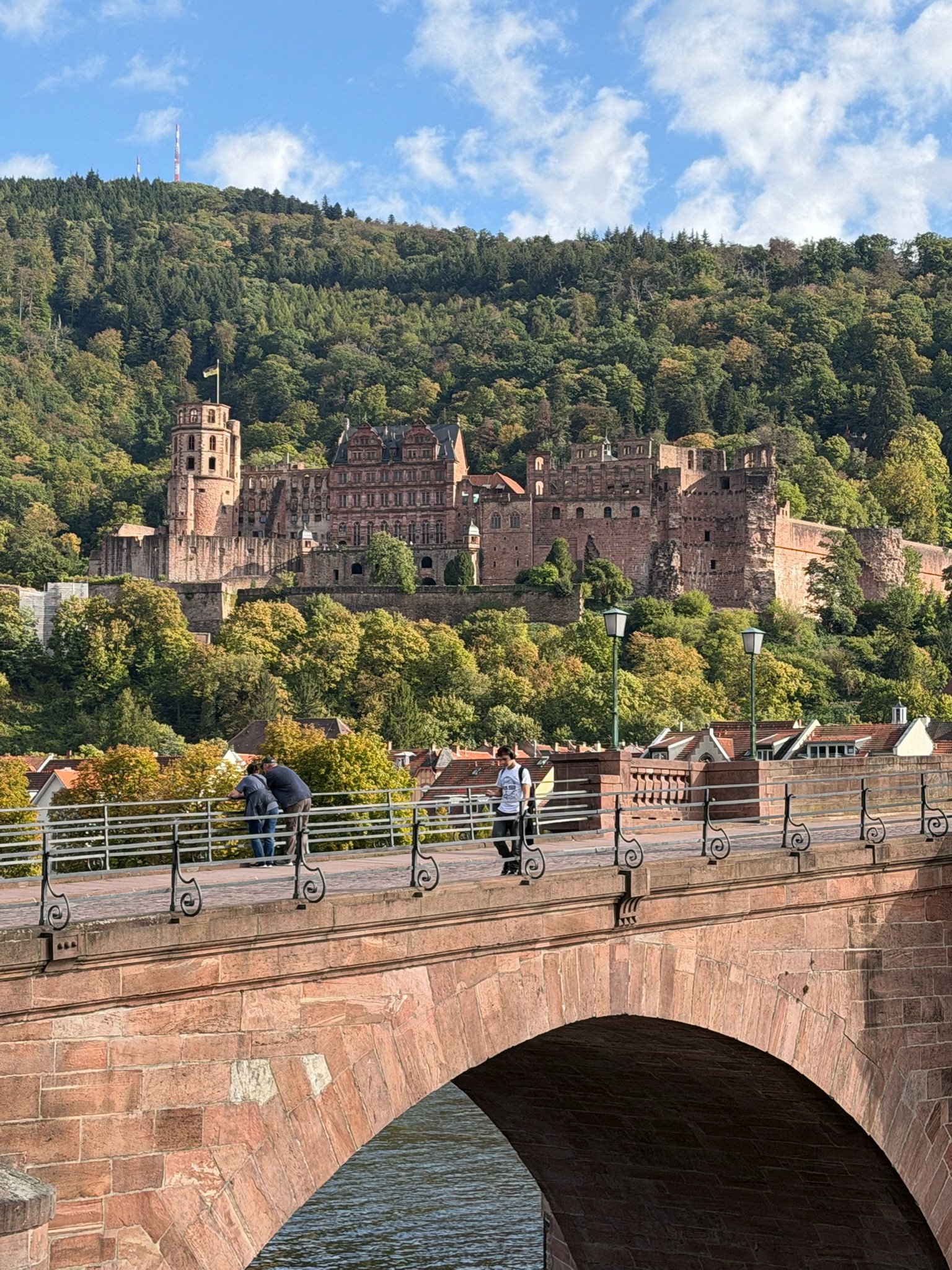
Of all the places on our trip, Heidelberg held a special place for me. When I was four or five, my father was stationed with the military in Kaiserslautern, and our family visited Heidelberg. More than fifty years later, I still had fragments of that trip: the castle on the hill, the view from the bridge, and a feeling about the place that had stayed with me. When Teresa and I planned this trip, Heidelberg was somewhere I wanted to see again—not just another town on the route, but a chance to revisit a childhood memory.
What follows are highlights from the couple of days we spent here, not a checklist we managed to complete in one afternoon. Heidelberg had far too much to see for that. Our guide introduced us to much of the city and castle on our first full day, and we deliberately left time to return and explore some of those places on our own the next day.
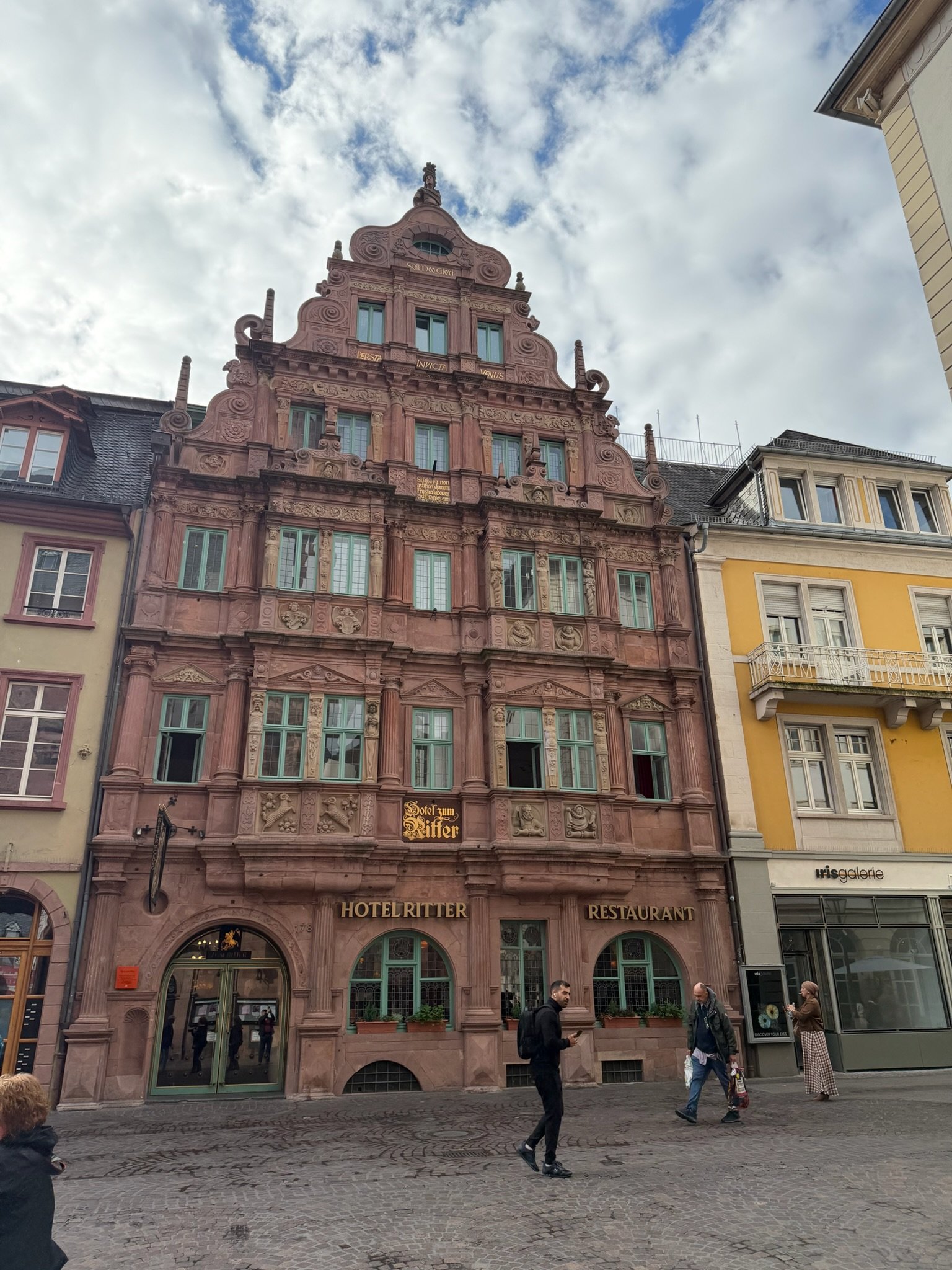
Teresa had found another excellent location, the Hotel Zum Ritter St. Georg, right in Old Town, across from a historic church. We were told that the building had once housed a long-running family cloth-weaving or garment business and was one of the older buildings to survive a destructive fire. Its Saint George imagery gave us another dragon connection after Disneyland Paris, which was becoming an amusing theme of the trip.
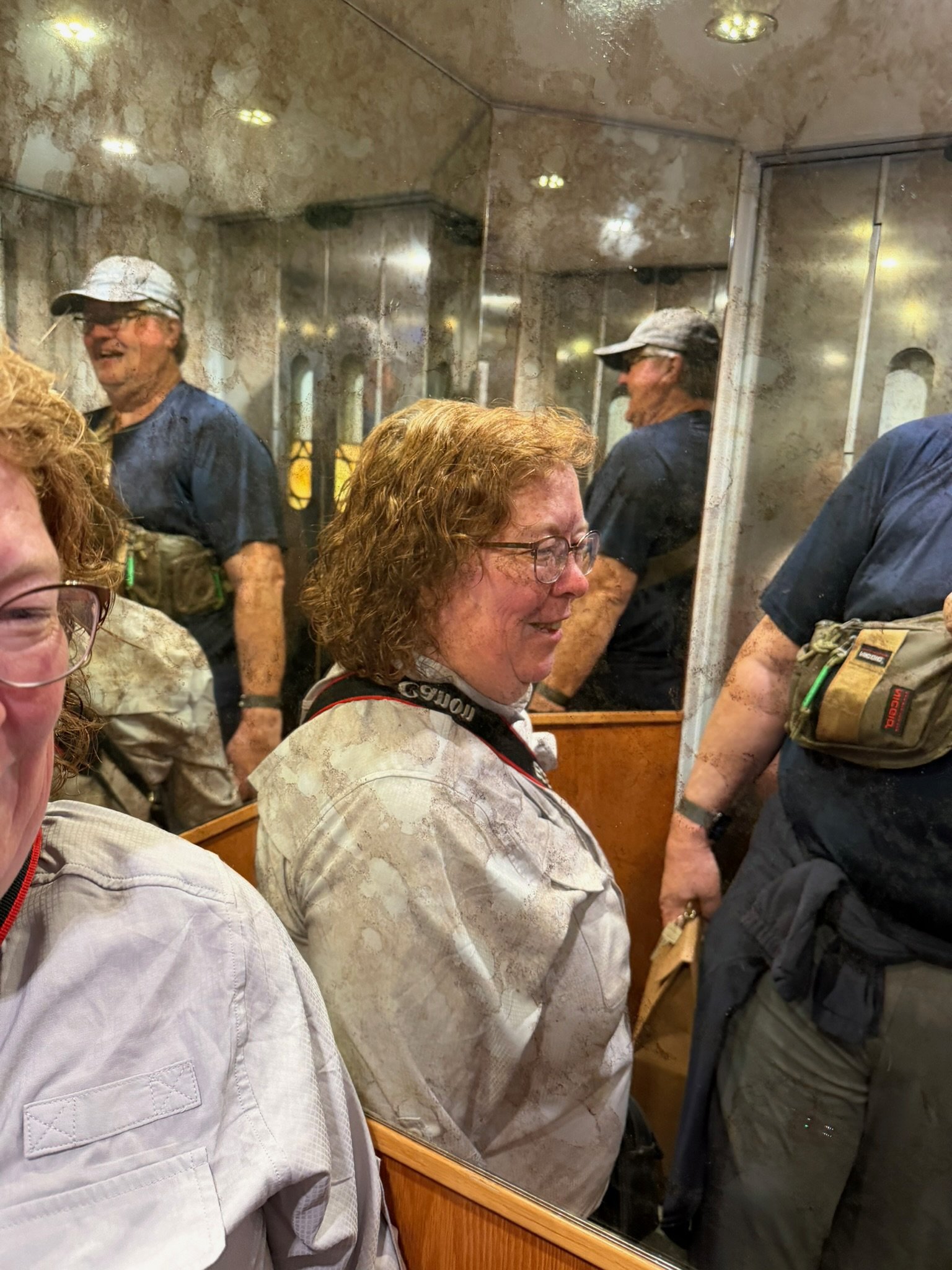
The building was beautiful, although getting our luggage upstairs was a reminder that historic European hotels aren't designed like modern American ones. One elevator could barely fit Teresa, me, and perhaps another person. A member of staff guided us and our luggage into a slightly larger lift, where everyone had to be rather friendly about personal space. The stairs worked fine, and I used them several times.
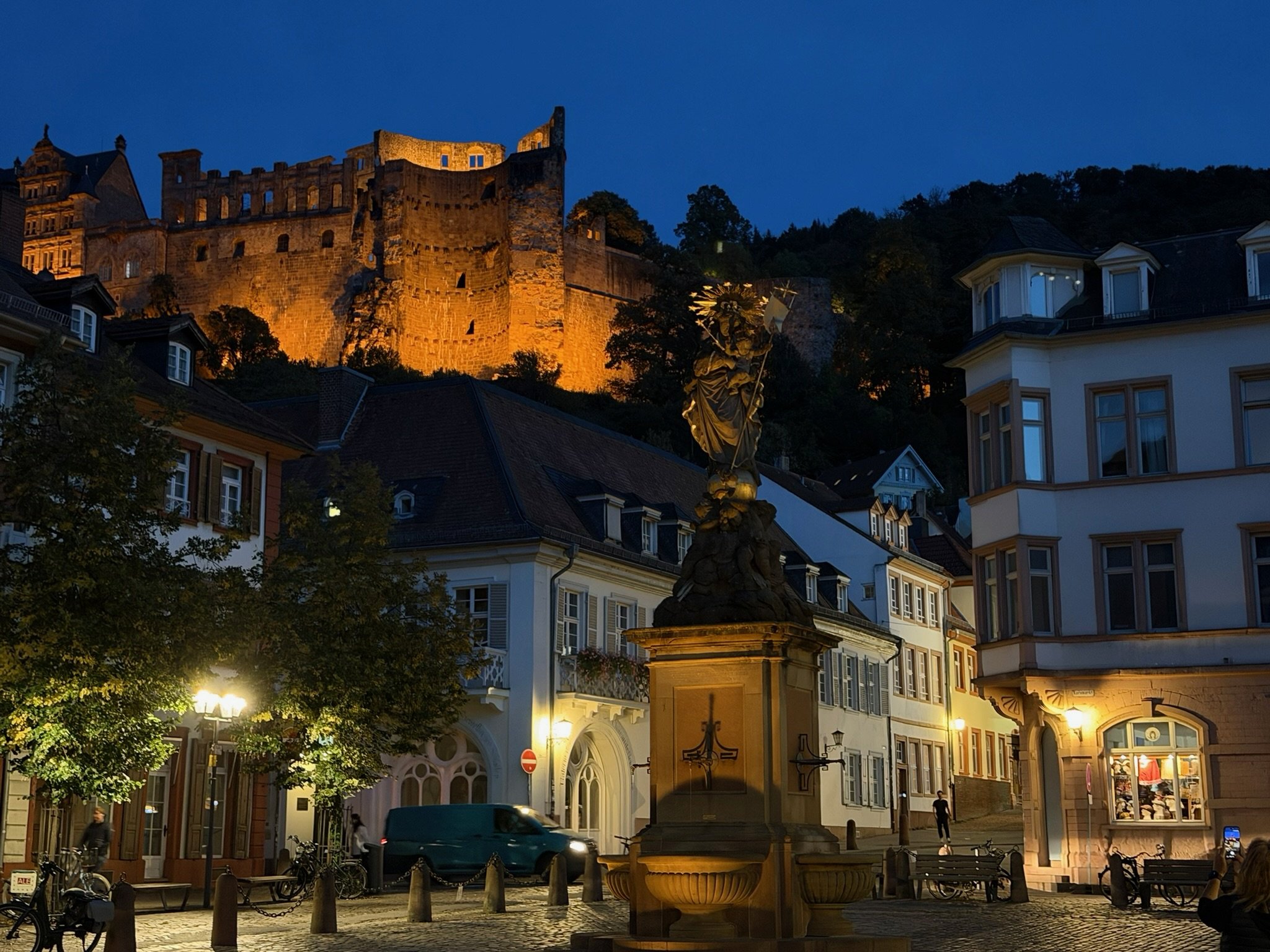
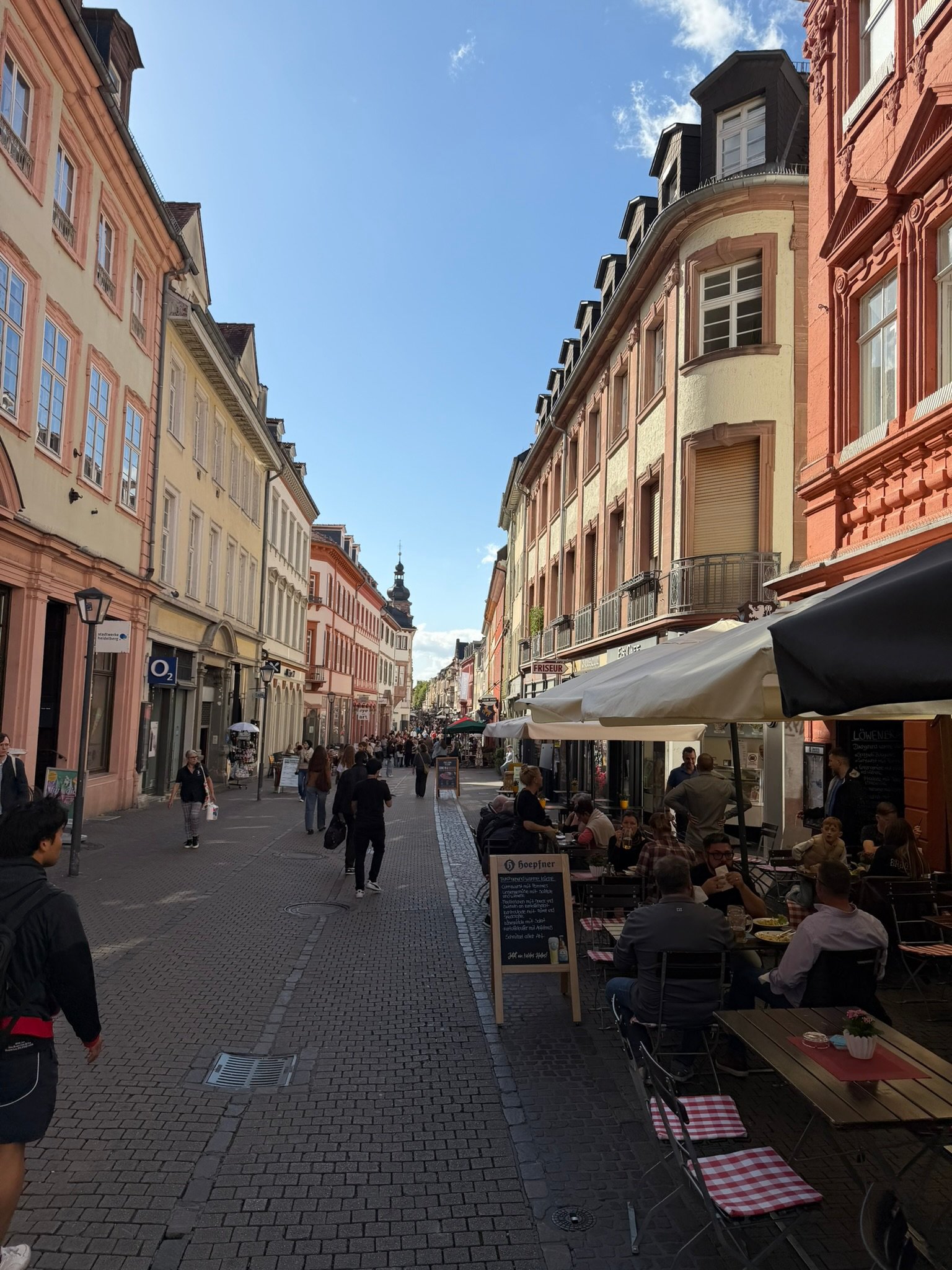
Once we were checked in, we headed down the long, mostly pedestrian shopping street. There were occasional vehicles, but in the evening it felt like a place made for walking. We browsed shops, found a whiskey shop and another offering schnapps samples, and noticed an extraordinary cheese shop right next to our hotel. There were restaurants of every description and a steady crowd of people.
Heidelberg is a university town, although we wouldn't learn about the academic gathering involving prominent scholars or mathematicians until our guide explained it the following day. The university term hadn't quite started, but the city was certainly busy. We also scoped out a laundry service that Teresa had found while planning the trip. Heidelberg was about our halfway point, and we'd learned from traveling in Japan that carrying two weeks of clothes is unnecessary if you can arrange laundry along the way.
We had a private walking tour booked for the following morning, so this first evening was mostly about exploring, snacking, and getting our bearings.
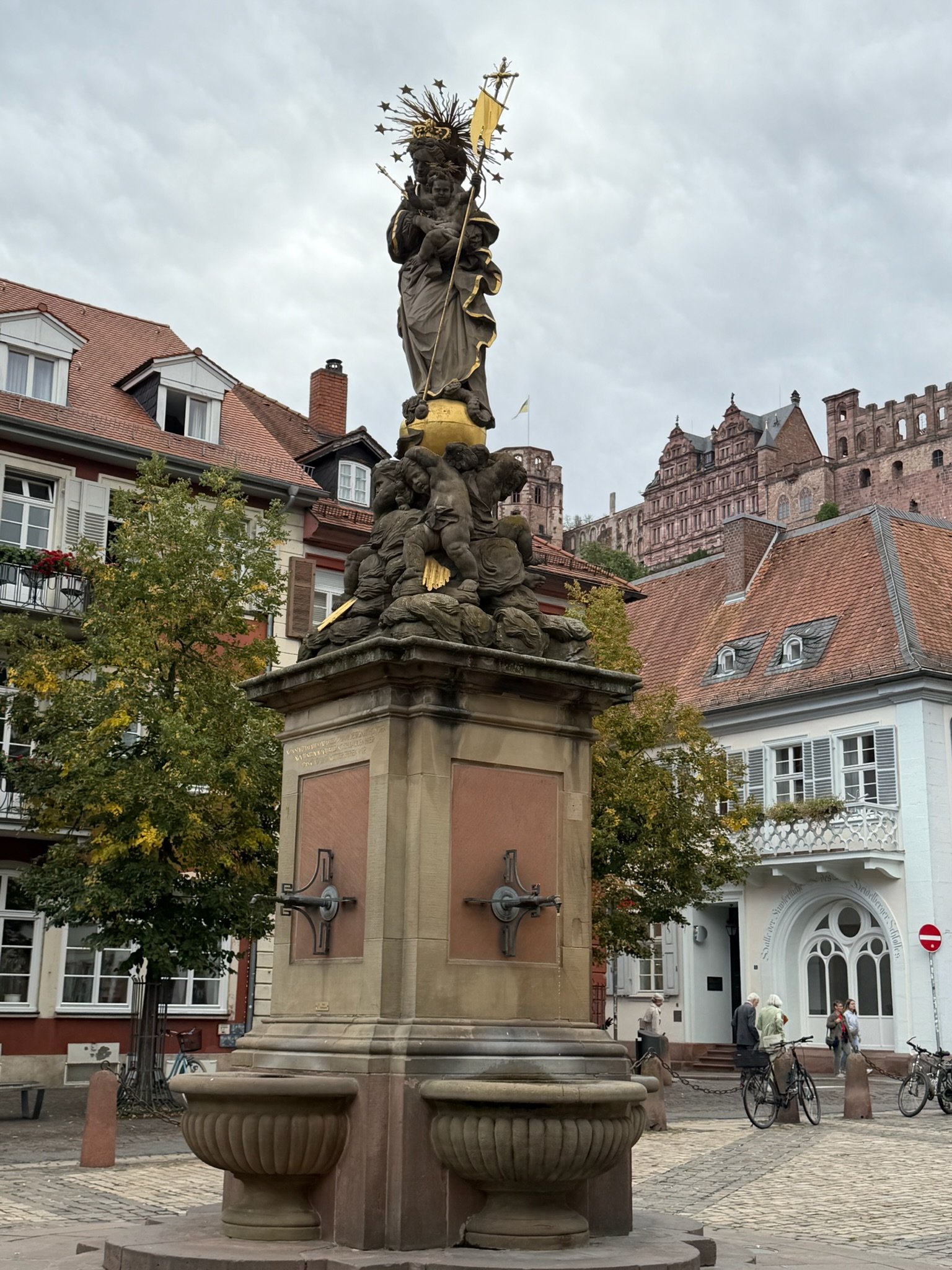
After a very good hotel breakfast, we met our private guide. He knew our hotel's history from the outside but said he'd rarely had an opportunity to see the interior, so he was as interested in the building as we were. We started there, then crossed to the church facing the hotel. It is the Church of the Holy Spirit (Heiliggeistkirche), one of Heidelberg's most recognizable landmarks.
The church was interesting, although I wasn't particularly taken with the interior. Our guide explained how religious reforms and changes over the centuries had affected the building and its stained glass. One window in particular caught my attention. Our guide pointed to a date and asked whether we recognized it. I stared for a moment and said something along the lines of, "Was that Little Boy, or Fat Man?" The date was August 6, 1945—the day Little Boy was dropped on Hiroshima. The window, called the Physics Window (Physikfenster), was created by Johannes Schreiter and installed in 1984. It includes Einstein's equation, E=mc², and invites reflection on scientific achievement and the destruction science can make possible. It was unexpected imagery to encounter in a church, and while I appreciated the message, I can't say I found it beautiful.
We continued to other churches, hearing how Heidelberg's religious and political history left visible traces on its buildings.
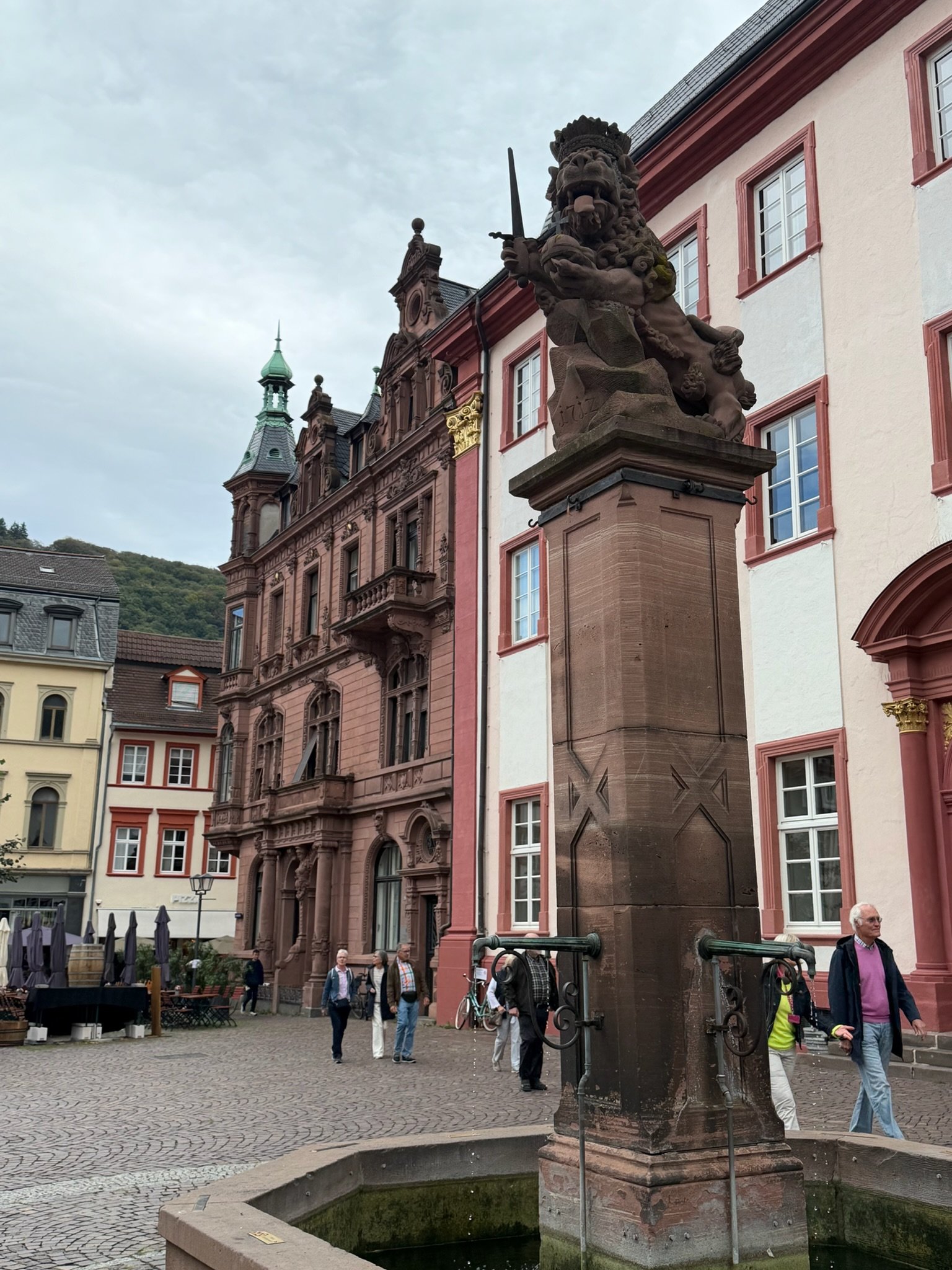
Heidelberg University has a long history, and our guide brought that history to life as we walked. He explained the scholarly gathering going on that week, the Heidelberg Laureate Forum, which brings prize-winning mathematicians and computer scientists together with young researchers from around the world, and pointed out buildings we might normally have entered. Some areas were reserved for invited attendees.
I'm the sort of person who'll politely walk up to a guarded door and ask if I can take a peek. Most of the time the answer is no, but you never know until you ask. Teresa occasionally has to keep that instinct in check and she looked at me and I smiled back. She knew that I had slightly acquiesced.
We also saw the historic student jail and heard about the days when the university could discipline students in its own unusual way. These were exactly the kinds of stories I'd hoped a guide would tell us: the history behind the buildings, rather than simply a list of dates.
Before we headed up to the castle, our guide took us to Heidelberg's Old Bridge (Alte Brücke), officially the Karl Theodor Bridge. He knew some excellent places to photograph the castle above the river and even took a few pictures of us. Seeing the castle from the bridge brought back one of those fragments of my childhood visit.
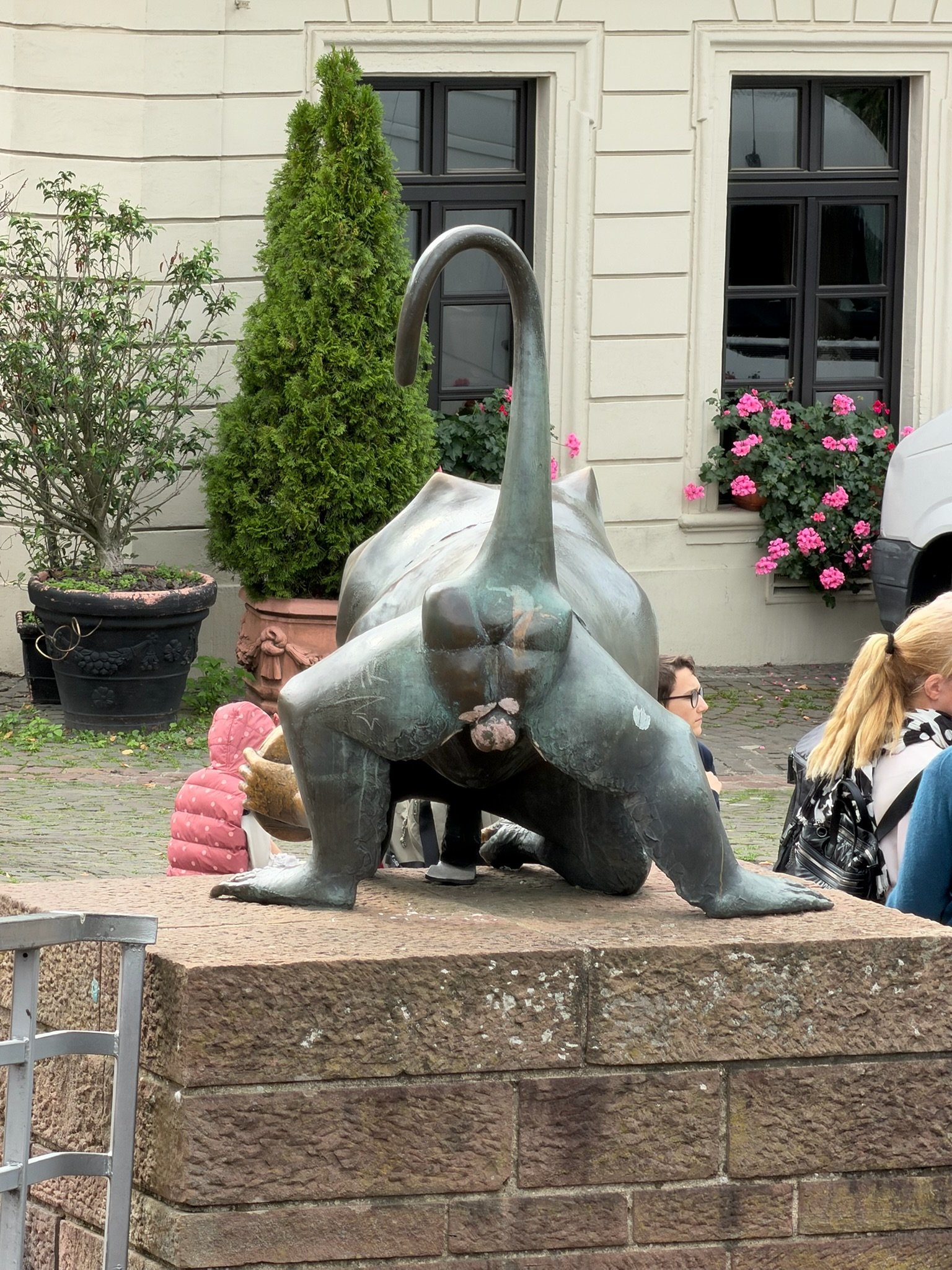
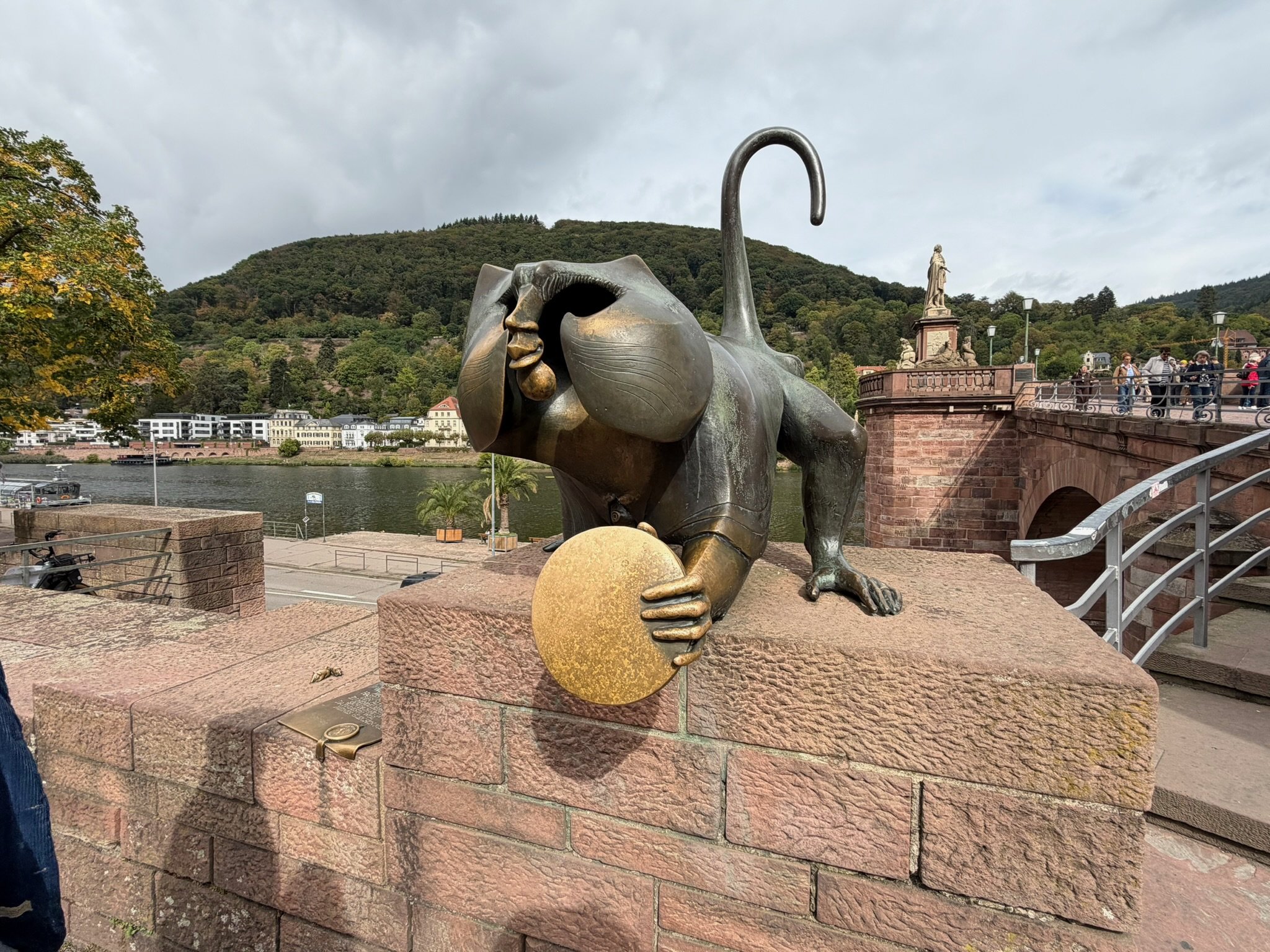
He also made a point of showing us the Heidelberg Bridge Monkey (Brückenaffe), a bronze sculpture near the bridge entrance. The monkey holds a mirror, and there's a good deal of local folklore about what it means and which parts you're supposed to touch for luck. Our guide told us a particularly memorable version involving the monkey showing its backside to people crossing the bridge. It turns out there's real history behind that. A monkey was recorded here as early as 1481, on the bridge's north tower, grabbing its bare behind in what was known as the Electoral Palatinate greeting. It faced Mainz, so the gesture was aimed especially at the bishops there, a blunt reminder of whose territory began at the bridge. That monkey held a mirror too, inviting passersby to take a critical look at themselves. It was lost with its tower in the War of the Palatine Succession, and today's bronze, by sculptor Gernot Rumpf, went up in 1979.
Our guide pointed out how sculptures develop shiny spots wherever generations of visitors keep rubbing the same places. Naturally, the monkey gave us a pretty good demonstration of that phenomenon. Stroke the mirror for prosperity, the stories go, the outstretched fingers to return to Heidelberg, and the mice for many children. I'd treat all of that as local lore rather than settled history.
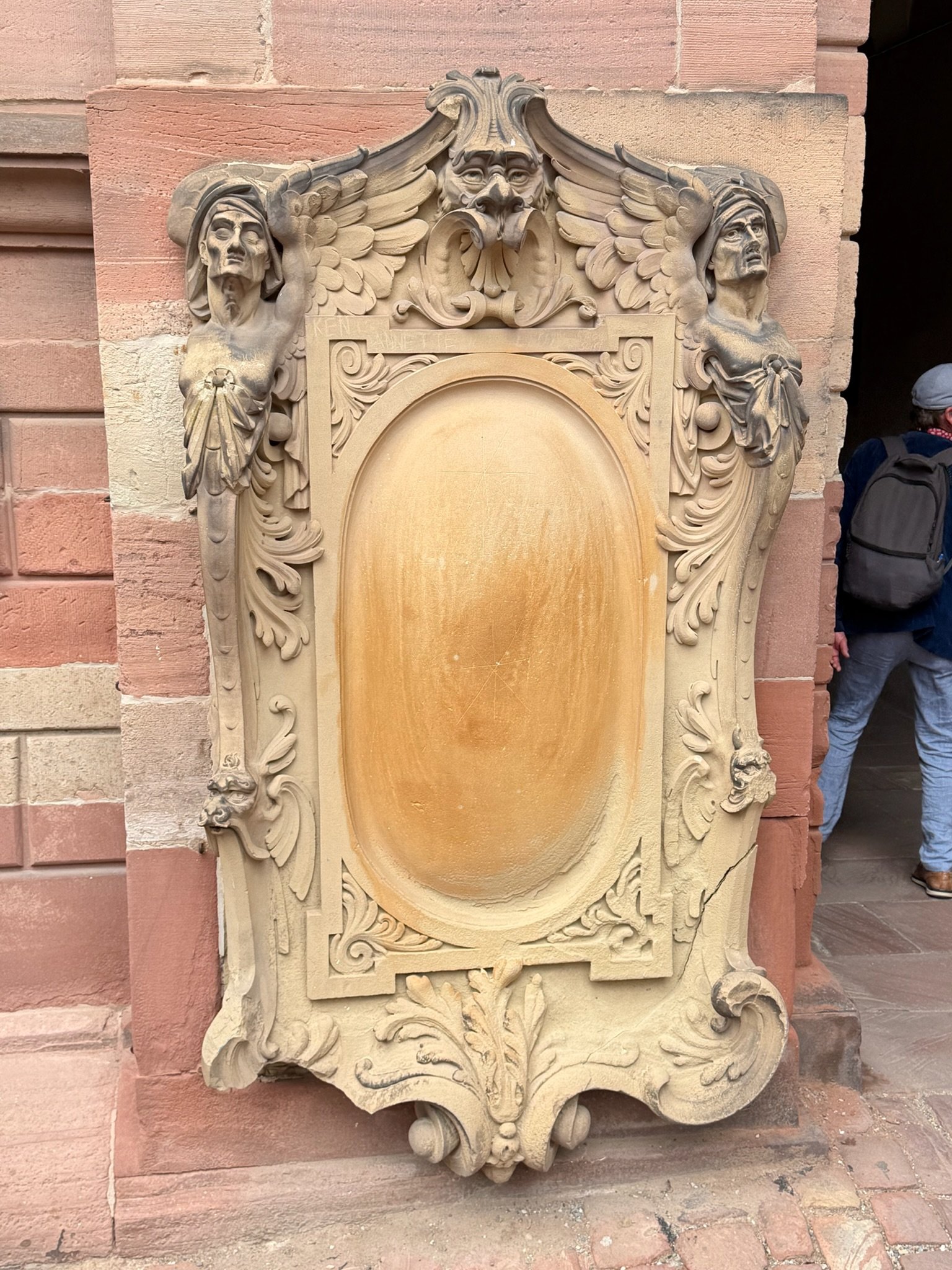
We rode the funicular railway up to the first castle station, and there it was: the castle I remembered from childhood. It was larger and more complicated than my scraps of memory suggested, but looking at it again after all these years was something special.
Our guide walked us around the grounds, telling us about the rulers who lived there, the statues on the façades and the stories behind them, the buildings and towers, and the old defensive spaces. One area that looked like a moat, he explained, was also used to keep deer and other animals as a ready food supply. I glanced at Teresa, who isn't particularly fond of hearing about animals kept for dinner, but it's a reminder that a castle was a working community as well as a royal residence.
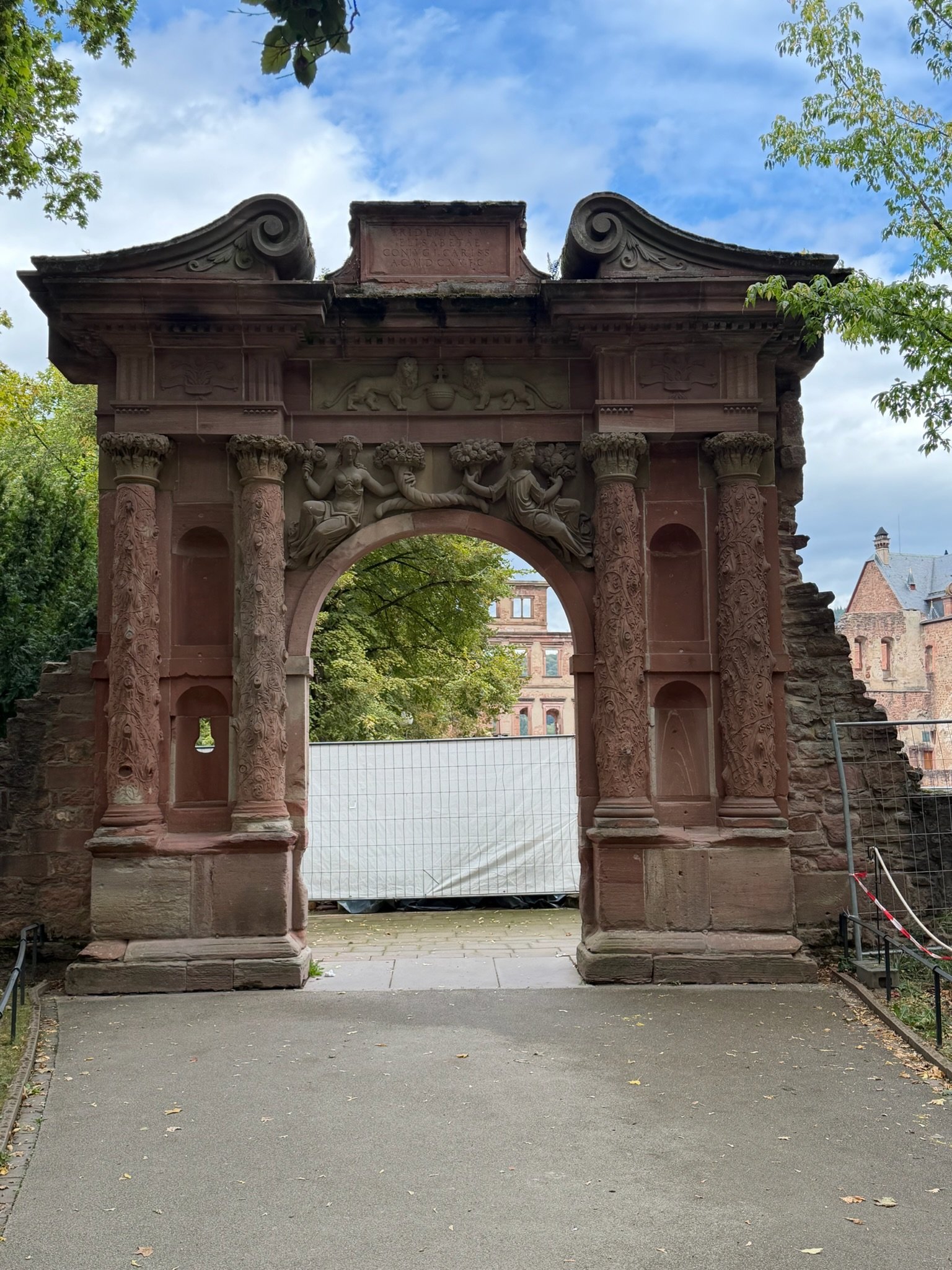
Another interesting feature our guide showed us was the Elisabethentor, or Elizabeth Gate. Built in 1615 by Elector Frederick V for his wife, Elizabeth Stuart, the daughter of England's King James I, it was supposedly presented to her as a birthday gift, assembled in a single night as a surprise. The ornate stone columns are decorated with leaves, branches, and little animals hidden among the carvings, including frogs, lizards, and squirrels. Teresa particularly enjoyed looking for the animals tucked into the stonework.
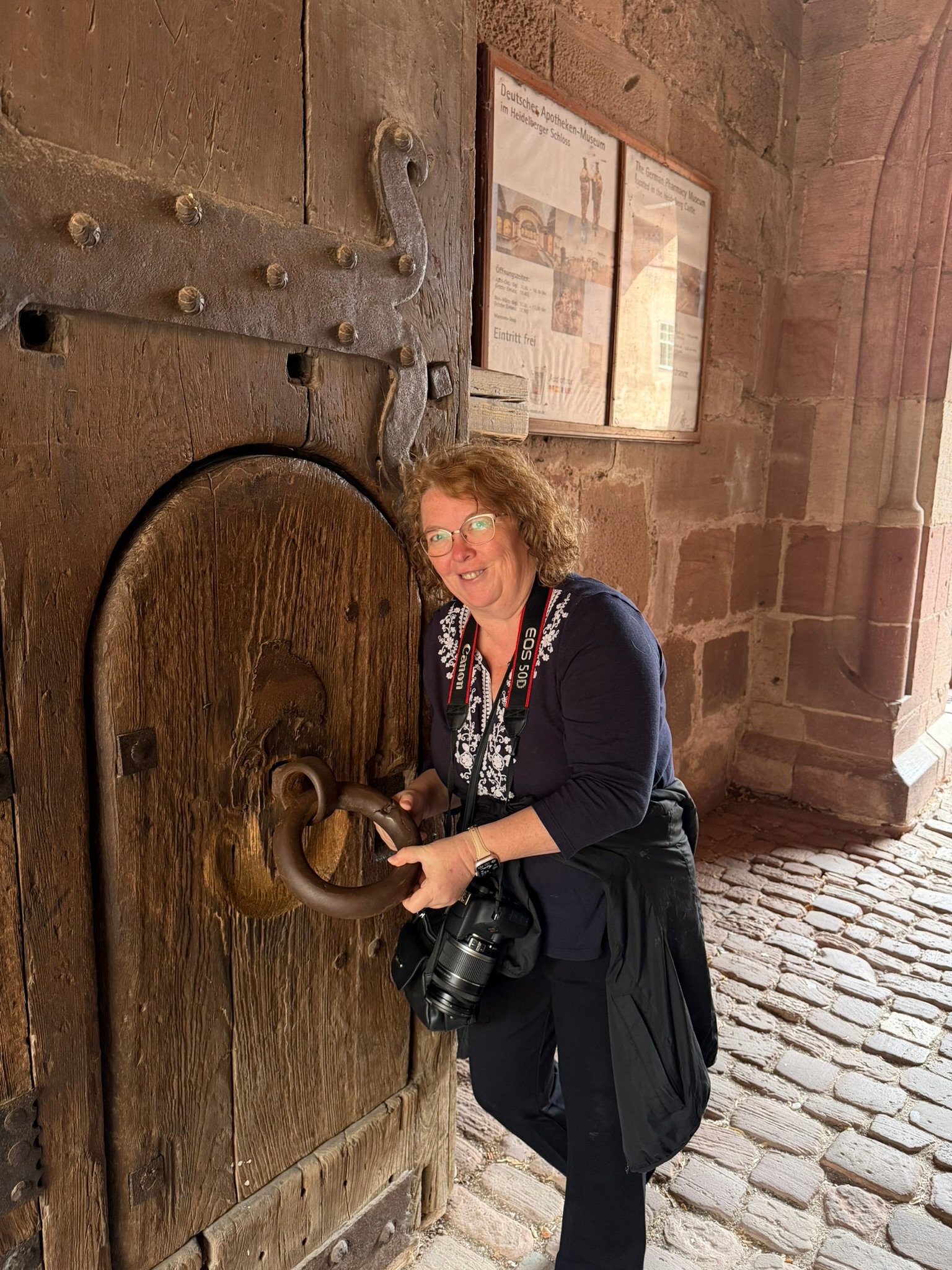
Then there was the old iron door knocker at the castle entrance, with a curious crack in its ring. According to a local legend our guide shared, anyone who could bite completely through the iron ring would be given the castle. One day, a witch decided to take up the challenge. She sank her teeth into the iron with all her magical strength, but couldn't break it. All she managed to leave behind was a deep mark and a crack, still visible today and known as the Hexenbiss, or “Witch's Bite.” Apparently, even magic wasn't enough to win yourself a castle.
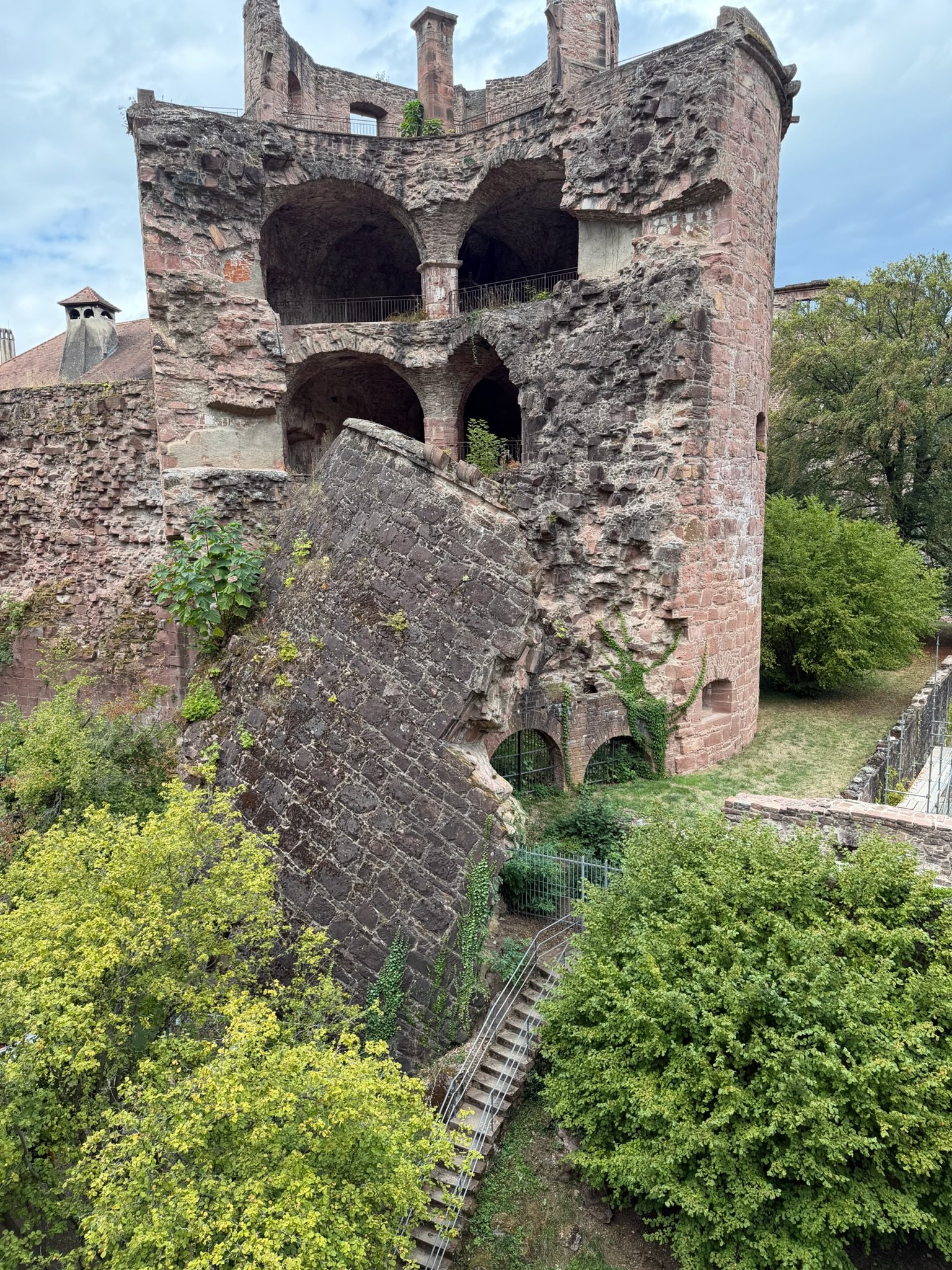
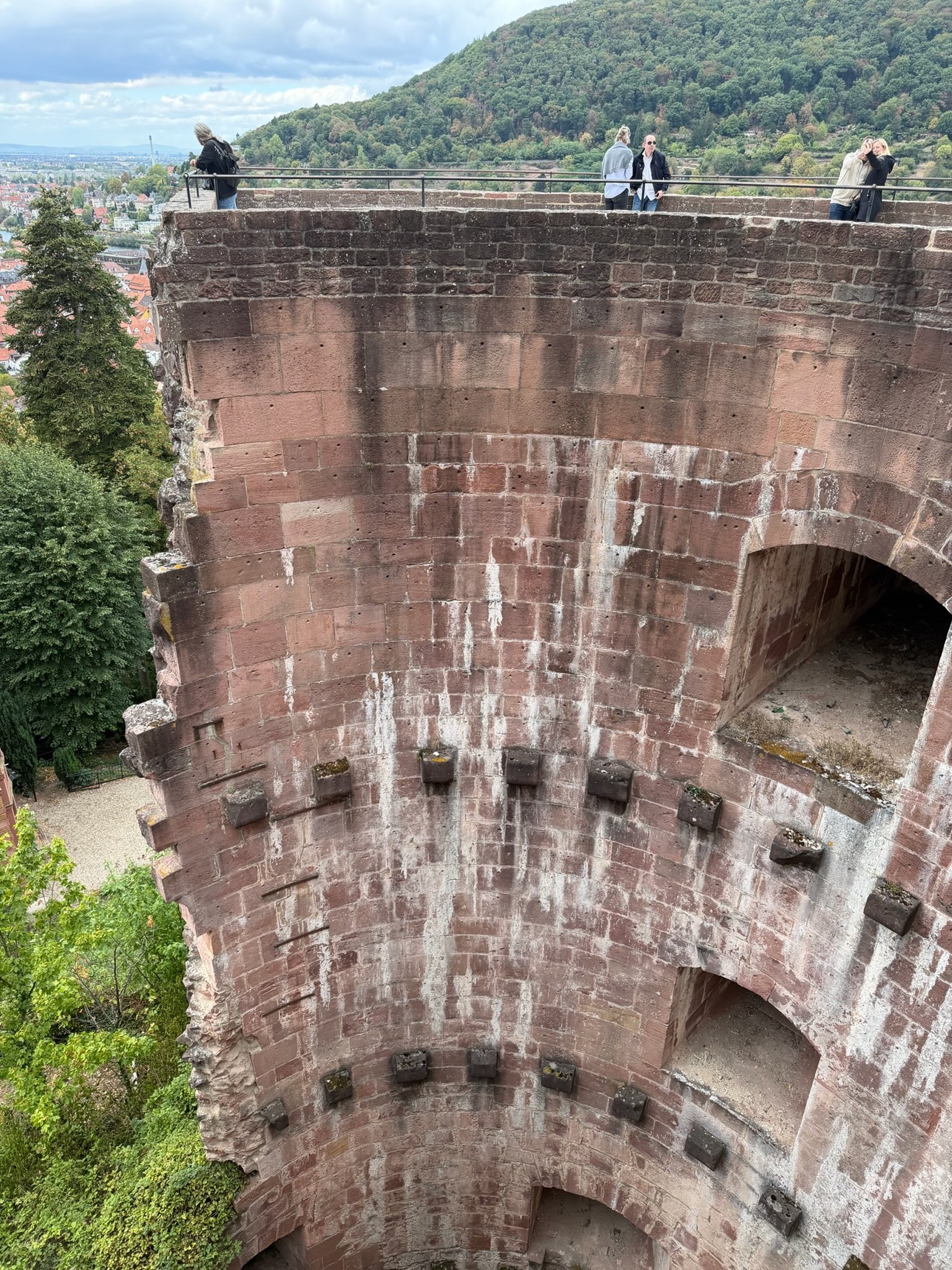
One of the most remarkable sights at Heidelberg Castle was the \*Krautturm\*, or Powder Tower, named for the gunpowder once stored in its lower level. French troops had tried unsuccessfully to destroy it in 1689, but returned in 1693 and deliberately detonated explosives that tore through walls nearly 21 feet thick. About a third of the tower broke away and fell into the moat, where that enormous section of stonework still rests today. Looking at it, I was struck by how the wall seemed to have been pushed outward almost as a single piece rather than simply crumbling. It's an extraordinary sight, especially when you consider how much force that must have required.
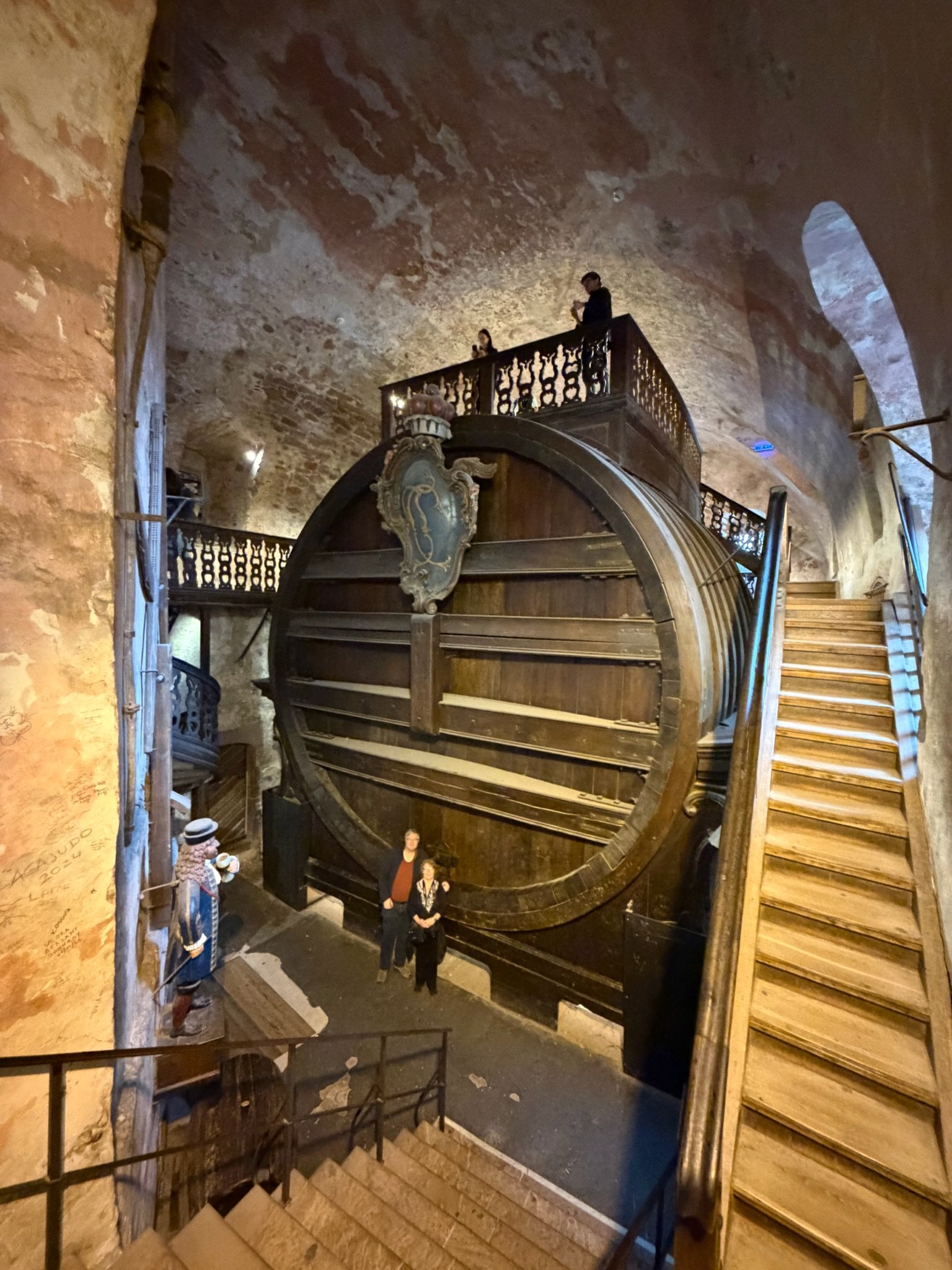
Inside the castle, our guide showed us two enormous wine barrels. Even the smaller one—the so-called pony keg—was bigger than any pony keg I'd ever seen. But the real attraction was the Great Heidelberg Tun. Our guide explained that there had been something of a competition among rulers over who could build the largest wine barrel, and Heidelberg's rulers certainly took that challenge seriously. The barrel we saw was built in 1751 and could hold roughly 58,000 gallons of wine. It's so enormous that there's actually a staircase leading to a platform above it, supposedly once used for dancing. Standing beside it, I couldn't help wondering whether the rulers were more interested in storing wine or simply outdoing one another.
Before we finished at the castle, our guide pointed out the German Pharmacy Museum and showed us where the garden terraces were. He gave us some background on both, but we didn't have time to explore them properly during the tour. That would have to wait until our return visit the next day.
At the end of the tour, our guide gave us a choice: wait in what he expected would be a long line for the funicular, or walk down the steep old path sometimes called the donkey path. We walked. It was steep, but manageable going downhill, and it brought us back near the town square and our hotel. I certainly wouldn't have wanted to climb it in the other direction. This was the castle-side descent, not the Philosophers' Walk on the opposite bank of the Neckar. Along the way we'd also met his wife, whom we'd encountered at the castle. We thanked him, tipped him, and said goodbye. It had been a wonderful way to hear the stories behind Heidelberg.
We freshened up, went back out to shop and explore, and looked for a German dinner. Heidelberg offered plenty of choices—Greek, Middle Eastern, Italian, brew houses, and more—but nothing struck us quite right that evening. So we ate at a Japanese restaurant. Yes, Japanese food in Germany, and it was very good.
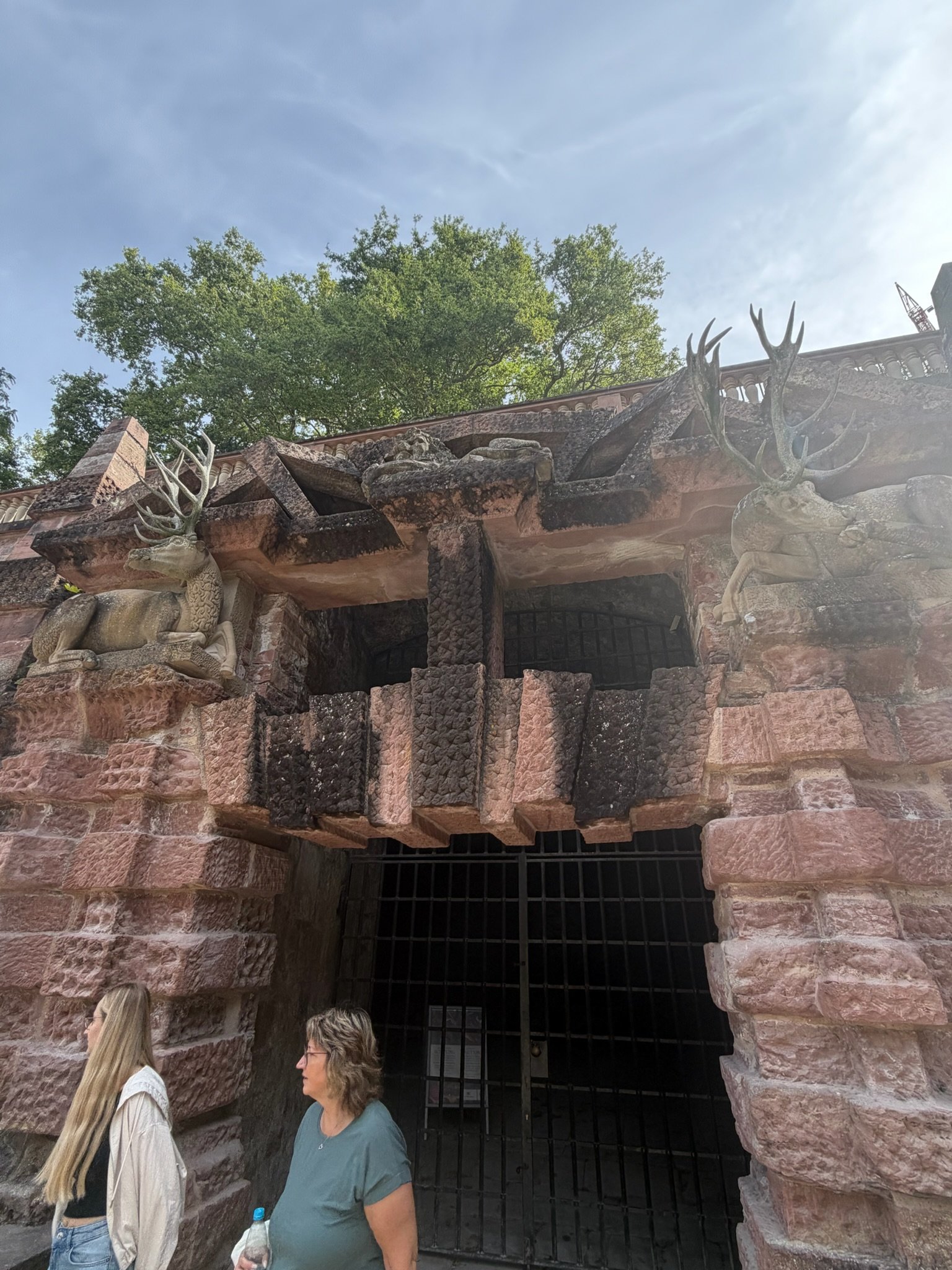
During our guided tour, we learned about the Hortus Palatinus, an ambitious garden complex commissioned by Elector Frederick V for his wife, Elizabeth Stuart. Designed by Salomon de Caus in the early 1600s, it was intended to transform a substantial portion of the hillside surrounding Heidelberg Castle into a spectacular series of landscaped terraces, fountains, sculptures, grottoes, and elaborate water features. Our guide showed us the general layout, but we didn't have time to explore it properly until we returned the following day.
I had seen an illustration of the original plans, and the scale was astonishing. It seemed as though they intended to reshape acres upon acres of hillside. Looking at what remains today, I would have guessed that only a fraction of the original vision had been completed. Historians aren't certain exactly how much was actually built, but the project was interrupted by the turmoil surrounding the Thirty Years' War and was never finished. At one time, it was even celebrated as the eighth wonder of the world.
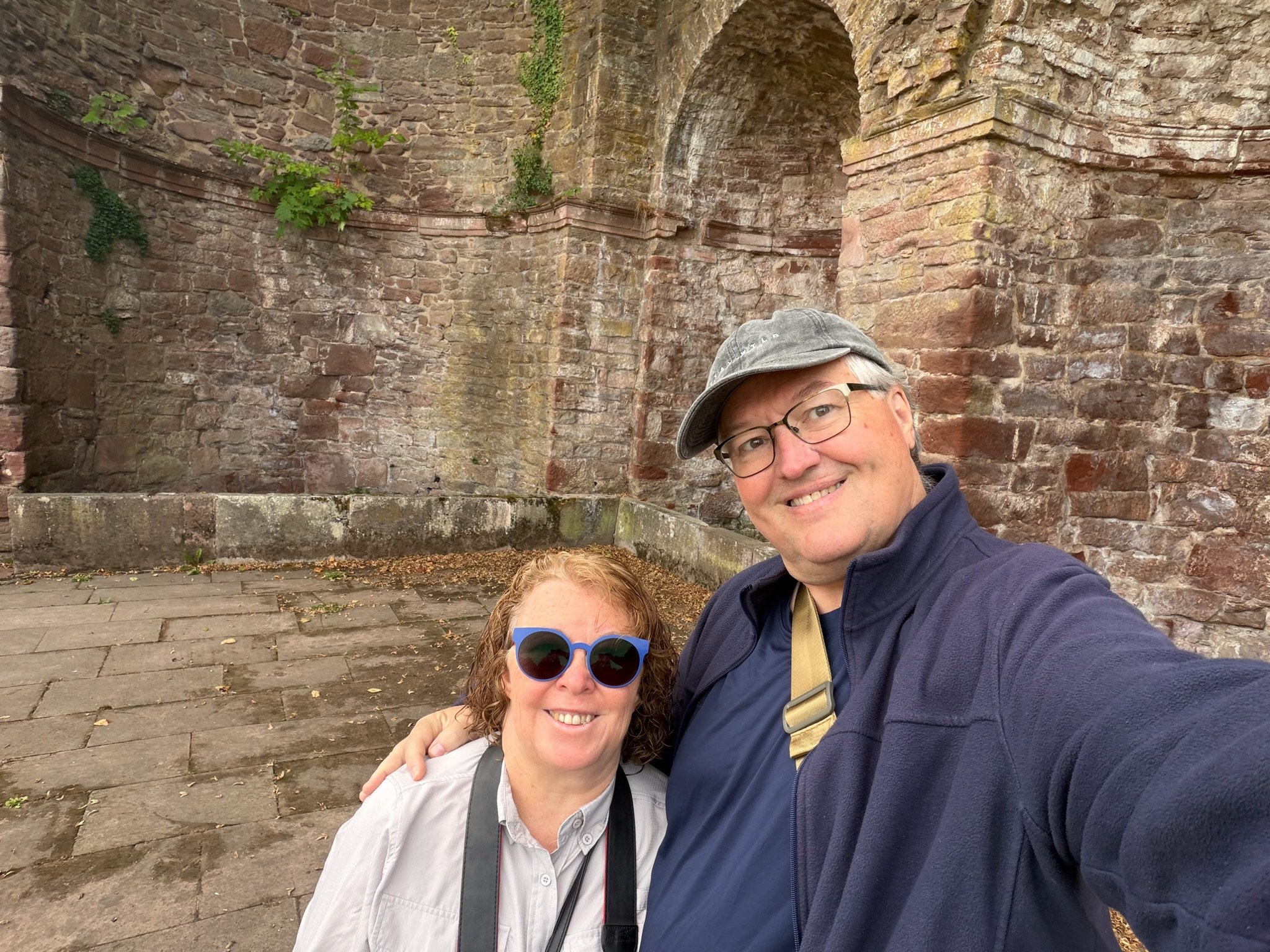
On our second visit, we wandered through the surviving terraces, exploring the gardens and enjoying the views. We found a narrow spiral staircase tucked into the stonework and followed it upward until it brought us out onto a road above the gardens. There was still plenty more hillside to climb, but we decided we'd gone far enough. Along the way, we noticed several dark openings and small chambers built into the walls, some protected by iron bars. I wondered whether they had once been used for storage or perhaps served some more elaborate purpose. The original garden plans included grottoes, secluded chambers, and even mechanical water features, although I couldn't tell which, if any, of those surviving openings we were looking at.
What made the gardens fascinating wasn't just what was still there, but imagining what the entire hillside might have looked like if Frederick's grand vision had actually been completed.
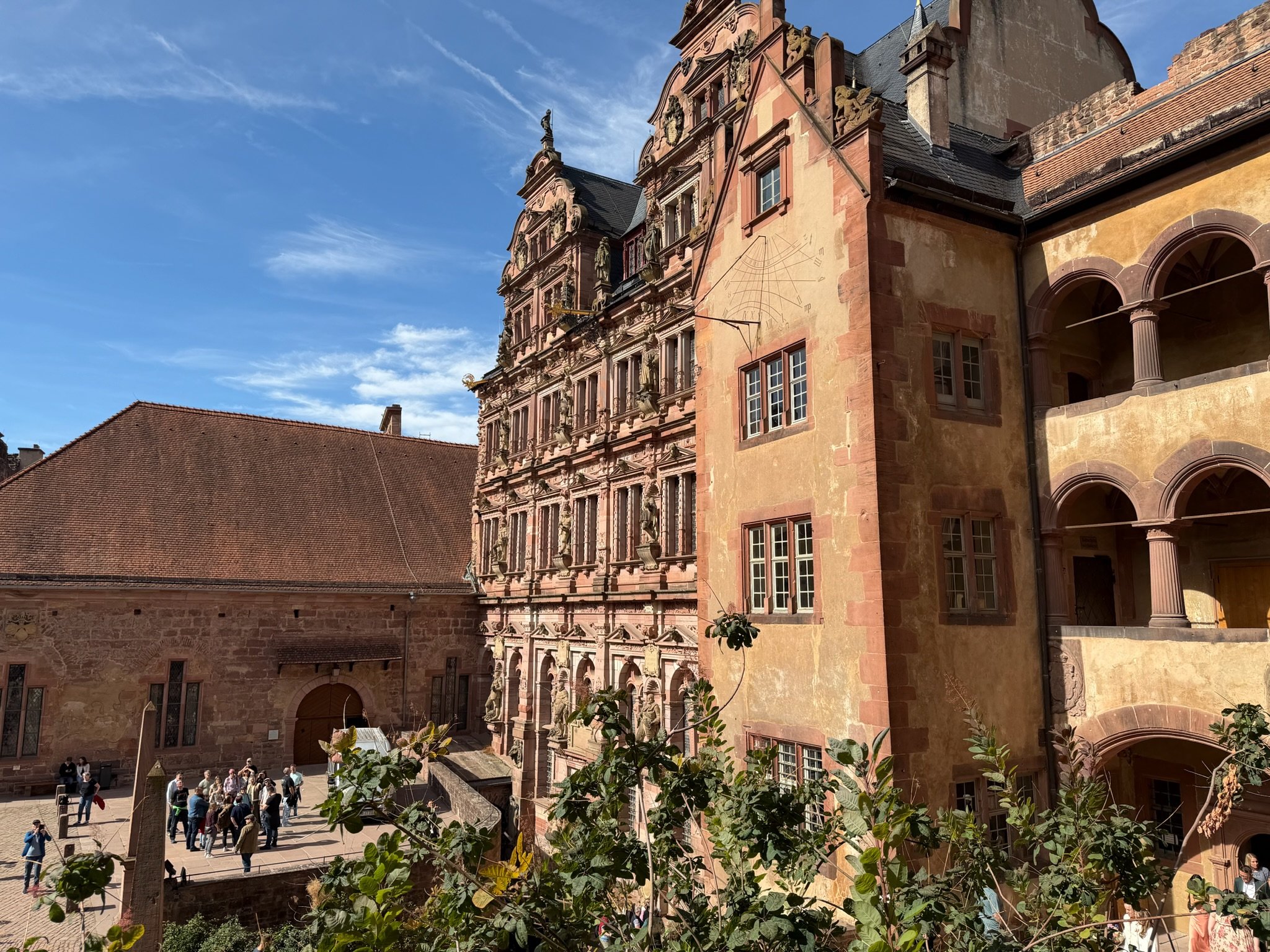
After exploring the castle gardens, we were getting hungry and decided to look for somewhere to eat. Back inside the castle courtyard, we spotted what looked like a little pizza or flatbread restaurant. We approached the gentleman at the entrance, who promptly escorted us to a table without asking a single question. In hindsight, that probably should have been our first clue that something wasn't quite right.
The tables were long, communal affairs, with room for perhaps eight to twelve people on each side. We started chatting with a couple of women seated nearby, who asked how we were enjoying Heidelberg. Nothing unusual about that. Then a waitress came around and began setting plates of sausage and sauerkraut in front of everyone, including Teresa and me. We hadn't ordered anything, and sausage certainly wasn't going to work for Teresa, who's vegetarian.
I flagged down the waitress and explained that we hadn't ordered yet and had been expecting to look at a menu, perhaps for some flatbread. She called another staff member over, and after a brief conversation in German, he turned to us and politely explained, "I'm sorry, sir, this is a private event."
We looked at each other, somewhat bewildered, when one of the women beside us asked, "Oh, you're not on the cruise?"
No, we weren't. Apparently, we'd wandered into a private luncheon for a cruise group, been seated with the guests, and nearly been served their meal. In our defense, we'd simply followed the gentleman who seated us. Everyone was very nice about the misunderstanding, and we excused ourselves to continue our search for lunch. I suppose we could have gotten away with a free meal if we'd kept quiet, but that wouldn't have been right. Besides, Teresa wasn't going to eat the sausage anyway.
Still looking for something to eat, we wandered back into the castle's barrel cellar, where our guide had shown us the enormous wine barrels the day before. There were pretzels, pastries, and a few other things available, but nothing that really appealed to us as a substantial lunch. What did catch our attention was the wine-tasting counter.
We approached the gentleman behind the bar and asked whether we could try a flight of wines. He explained that he was working alone and things were a little busy, but he'd be happy to accommodate us if we didn't mind standing beside a barrel near the end of the counter. He would bring us the wines, explain each one, and answer our questions, but occasionally he'd need to excuse himself to serve other customers. That sounded perfectly reasonable to us.
He asked what kinds of wine we enjoyed, and Teresa immediately volunteered, "Jim likes sweet wines." She's right. I've always preferred sweeter wines, although I've gradually developed an appreciation for some of the medium-dry varieties, especially when paired with the right food. My tastes have changed a little over the years, but I still know what I like.
The first wine he brought us was a German Riesling, and it immediately brought back a memory of New Orleans. Years earlier, at the Court of Two Sisters, we'd enjoyed a Riesling that became something of a benchmark for me. I can still remember how much I liked it, although I wish I'd taken a photograph of the bottle. Ever since, whenever I try a Riesling, I find myself comparing it to that one. Well, the Riesling at Heidelberg Castle was right up there with it. This time, we made sure to photograph the bottles.
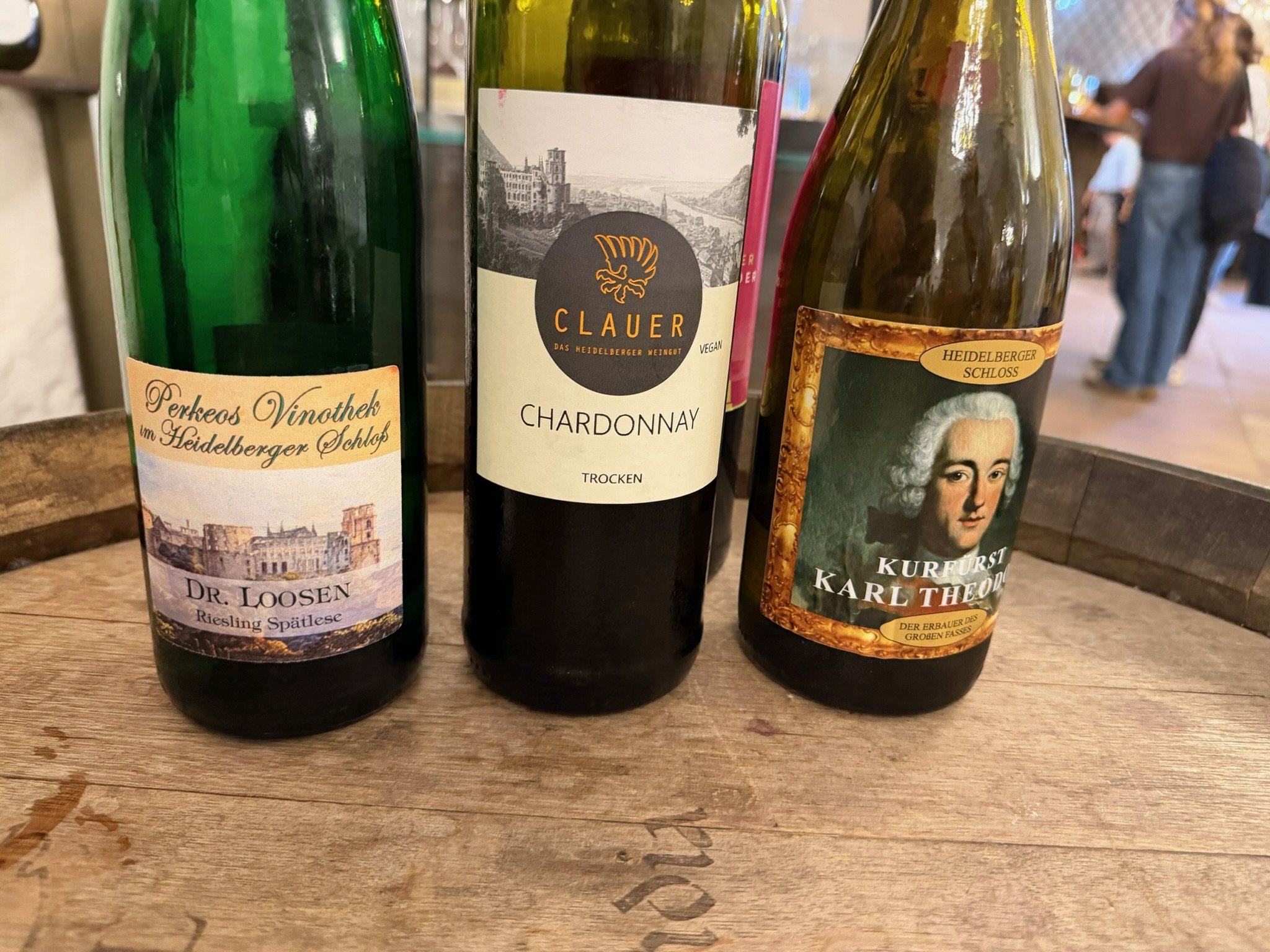
He followed it with a Clauer Chardonnay and a third wine, a Kurfürst Karl Theodor with the Elector himself on the label. We ended up buying three bottles: a Dr. Loosen Riesling Spätlese, the Chardonnay and the Kurfürst Karl Theodor. Throughout the tasting, he was knowledgeable, friendly, and genuinely interested in explaining what we were drinking. Whenever another customer approached the counter, he'd politely excuse himself, take care of them, and return to our little tasting. We never felt rushed or neglected.
When it came time to pay, we asked him about tipping. We'd heard different things about the customs in Germany, and since he'd taken such good care of us, we wanted to make sure we showed our appreciation appropriately.
His response was interesting. "We don't work for tips," he explained. Unlike what we're accustomed to in the United States, tipping wasn't something he depended on to make up his wages. He told us that a modest tip was appreciated for good service, that five percent was generous, and that anything approaching or exceeding ten percent would be considered quite exceptional.
That conversation stuck with me. We'd encountered different tipping practices throughout Europe, and it was refreshing to hear someone explain the local expectations without making us feel foolish for asking. We thanked him for the wonderful experience, left a tip to show our appreciation, and headed out with a better understanding of German wines and a little more insight into German hospitality.
We debated, though it was not much of one, Donkey Path or Train to get back to Old Town. We opted for the train this time, especially since we were carry three bottles of wine. This line was long, but it did move along.
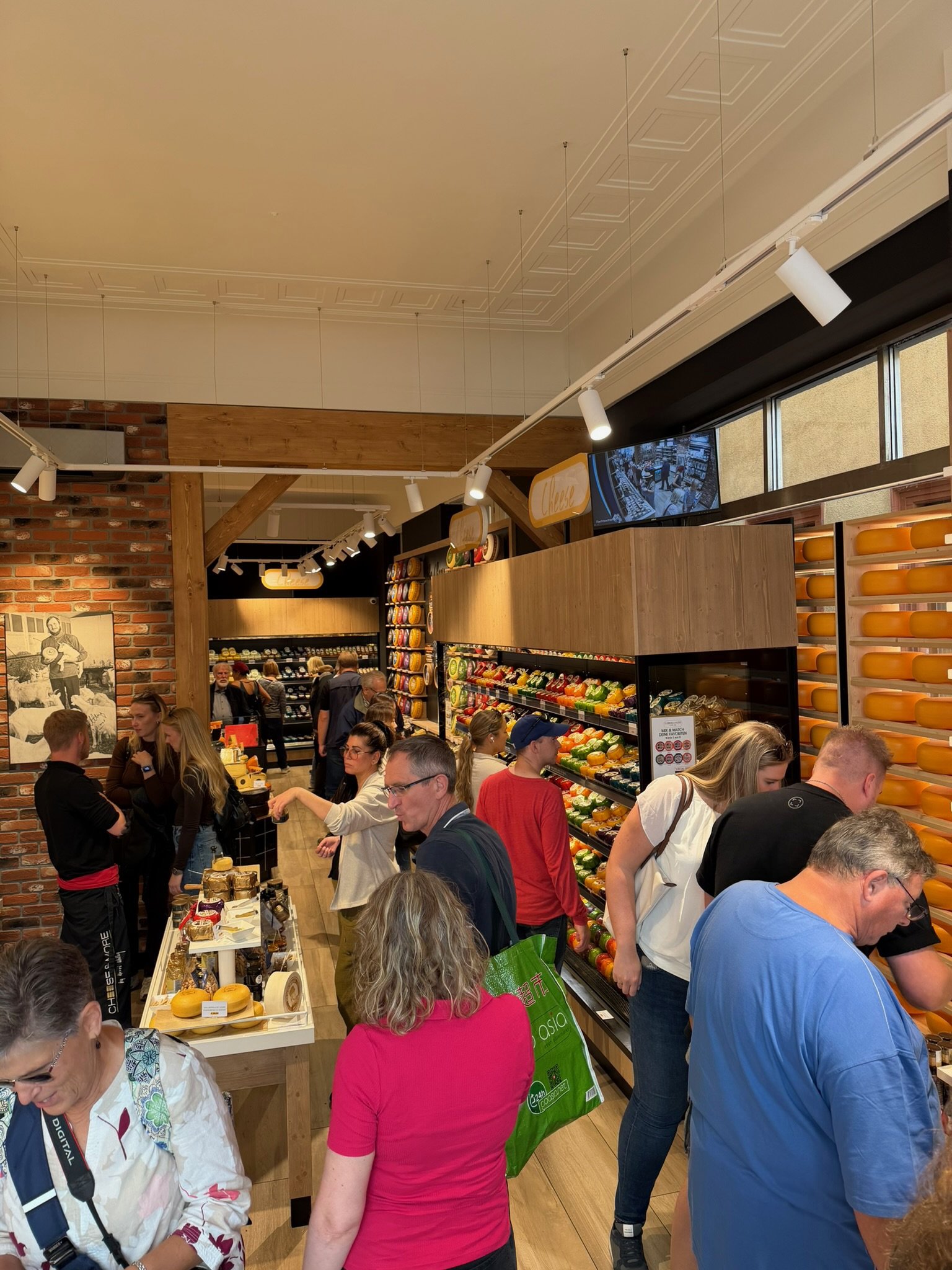
Later, Teresa was ready for a nap, and I wasn't ready to stop exploring. I wandered into the cheese shop next to our hotel. There must have been thirty or forty cheeses, maybe more, and the staff were generous with samples. One woman suggested a blue lavender cheese, which was excellent. I tried a red pepper cheese, too—not as spicy as I expected, but very flavorful.
I wanted Teresa to try them, so I checked the shop's closing time, wandered into the nearby whiskey shop for a few samples, and headed upstairs. We had already bought some wine at the castle, and I wasn't eager to carry bottles of whiskey through the rest of Europe.
I returned to our room, and Teresa was awake. I told her about the shops I'd been exploring, especially Dutch Cheese by Henri Willig, right next door to our hotel. She wanted to see them for herself, so back out we went. By the time we reached the cheese shop, the staff were starting to put things away, but there were still plenty of samples for Teresa to try, and she found several she liked. We eventually chose four cheeses. I asked about traveling with them, and the woman explained that their small, wax-coated cheeses could keep for several weeks without refrigeration, provided the protective coating remained intact and they were kept somewhere cool. I later found that Henri Willig's own travel advice confirms that these cheeses are designed to travel for extended periods, although refrigeration is recommended once you get home.
She also said the shop shipped to the United States and gave us a first-order discount, though I don't remember whether it was 40 or 60 percent. We haven't ordered yet because we were still eating the cheese we brought home. But we knew the wine and cheese would make a nice little gathering when we met our friends in Munich before Oktoberfest.