
Africa After Dark
Some of Africa’s best wildlife appears after sunset.
And some of its greatest beauty is overhead.
By the time our final evening at Hippo Lakes arrived, we had spent days exploring the bush, learning from our guides, spotting wildlife, and making new friends around campfires and dinner tables.
What we hadn’t fully experienced yet was Africa at night.
That would change.
When the Sun Goes Down, the Bush Wakes Up
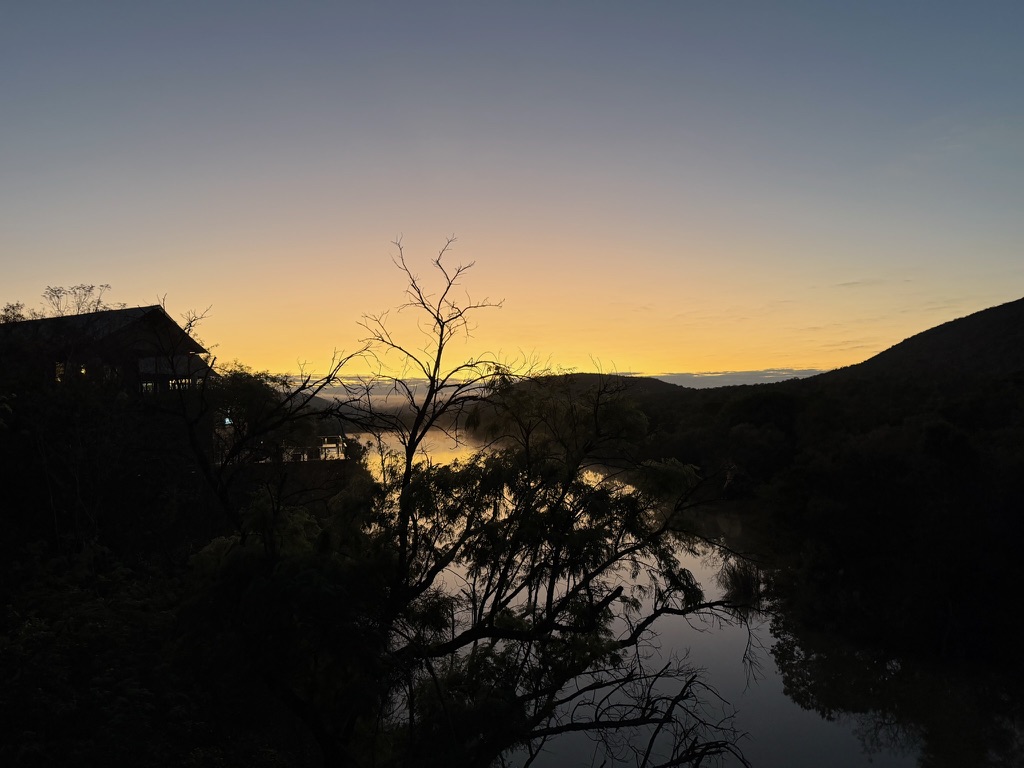
The day begins to surrender to evening. Long shadows stretch across the landscape. Birds make their final flights of the day. The colors of the bush shift from greens and browns into gold, orange, and eventually deep blue.
Most people hear “Africa” and picture relentless heat. We certainly did. What we found in late May was something different. South Africa was moving into winter, and as the sun sank lower, the temperature followed. By the time darkness arrived, those extra layers we’d tossed into our bags “just in case” no longer seemed optional.
Then darkness arrived.
Unlike many places in the United States, darkness here is truly dark.
There are no glowing strip malls. No traffic lights. No neighborhood porch lights. Just miles and miles of African wilderness.
And that darkness brings life.
Our night safari revealed an entirely different side of the ecosystem we’d been exploring all week. Animals that remain hidden during daylight suddenly became active. Every rustle in the grass carried the possibility of discovering something new.
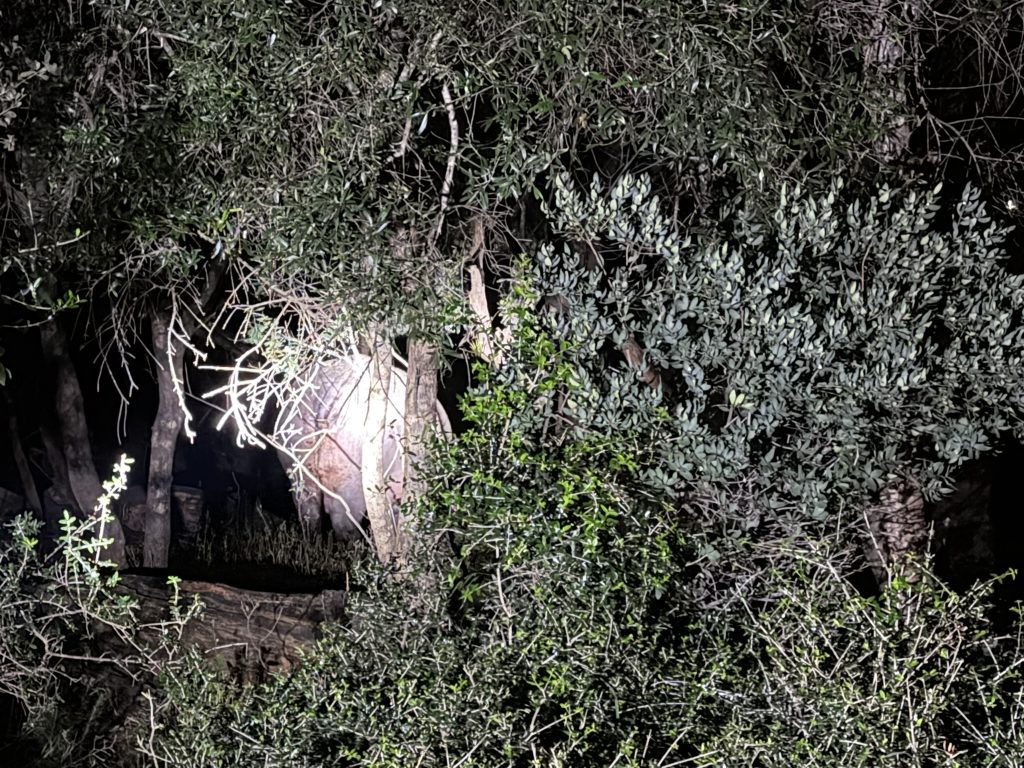
One of the surprises was a hippo.
During the daytime game drives, we’d seen plenty of them lounging in lakes and ponds. Water is their refuge. While they look like oversized floating potatoes, hippos don’t actually float the way many people imagine. They spend much of their time walking along the lake bottom, surfacing every few minutes for air.
So seeing one out on land after dark caught many of us by surprise.
Our guides explained that hippos leave the water at night to graze and rest. During the day, the lakes provide protection. Few predators are willing to challenge a fully grown hippo in the water, and even crocodiles know better than to start that fight.
On land, however, they are far from helpless.
A hippo can weigh several thousand pounds, run surprisingly fast, and has little patience for anything standing between it and the safety of the water. The lesson was simple: if a hippo decides it wants to go somewhere, let it.
It was another reminder that the African bush rarely follows the assumptions we bring with us.
The Sounds You Never Forget
One of the unexpected lessons from safari is that wildlife isn’t always about what you see.
It’s often about what you hear.
During the day, cameras tend to dominate everyone’s attention. People focus on spotting animals, framing photographs, and mentally checking species off their lists. Did I see a lion? A giraffe? An elephant? Did I get the shot?
At night, those priorities change. Sometimes all you can do is sit quietly and listen. And that’s exactly what we did.
Sitting on the porch outside our tent one evening, we discovered that darkness changes the bush. The sounds were different from what we had heard during the day. It was a little unsettling at first. Back home, we’re accustomed to the constant hum of civilization… cars in the distance, air conditioners running, televisions playing somewhere nearby, even airplanes overhead.
Out here, there was none of that. Yet the silence wasn’t silent.
A branch cracked somewhere in the darkness. Something moved through the grass. A splash echoed from one of the nearby lakes. Insects filled the night with a constant chorus.
Every sound seemed amplified because there was so little else competing with it.
The sounds surrounded you and made you wonder: Was that something we’d already seen during the day? An impala? A zebra? A hippo heading out to graze? Or was it something entirely different, moving unseen through the darkness beyond the reach of our eyes?
The bush has a way of making your imagination work overtime.
As we sat there listening, one realization slowly settled in. While we may sleep at night, the bush never truly sleeps. Life continues. Animals hunt. Animals graze. Animals call to one another.
The rhythms simply change.
And for a little while, sitting on that porch beneath a star filled African sky, we had the privilege of listening to it all.
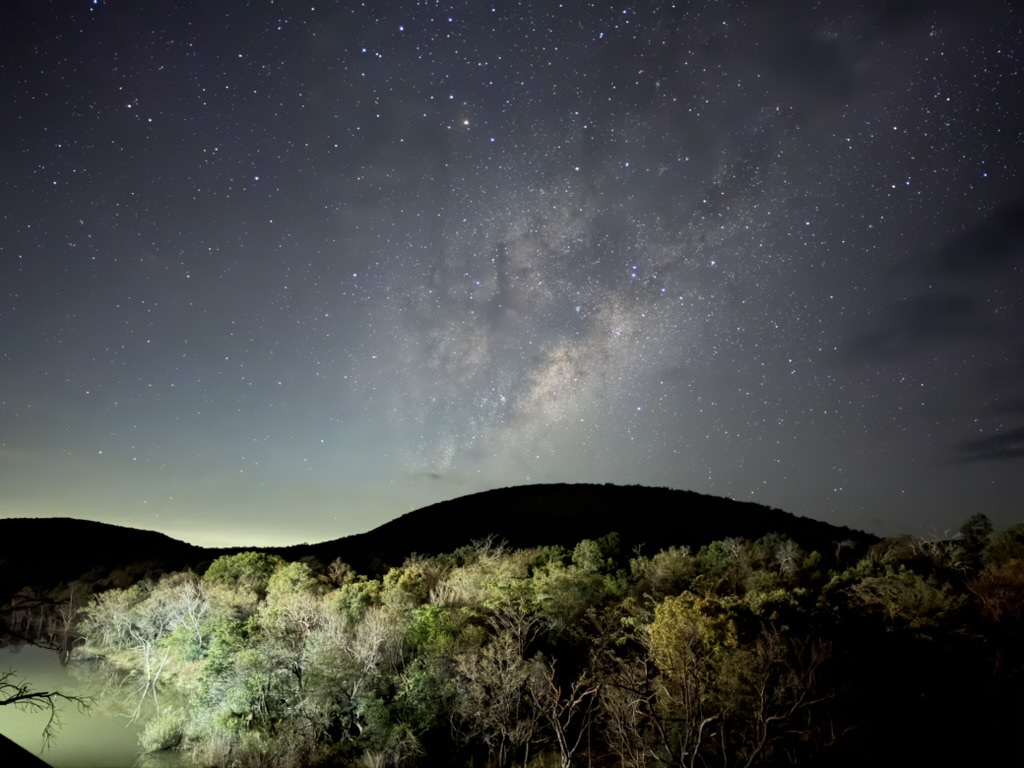
Photography in the African Bush, shooting the stars
I’ve always been fascinated by the stars.
Maybe that’s the lifelong Star Trek fan in me.
Before leaving for South Africa, I spent time researching astrophotography.
I read articles. I watched videos. I learned about exposure times, ISO settings, aperture values, and all the technical details that photographers debate endlessly online. My plan was simple: learn enough to help Teresa and myself and maybe come home with a few decent photos of the stars.
What I discovered was that I had been focusing on the wrong thing.
Traditional astrophotography often concentrates on the sky itself, for planets, galaxies, nebulae, and distant celestial objects. Those images are incredible, but standing in the African bush changed my perspective.
The stars were only part of the story.
Growing up in America, many of us have forgotten what a truly dark sky looks like. Even rural areas often have enough light pollution to wash out the faintest stars. South Africa gave us something entirely different.
The night sky exploded with detail.
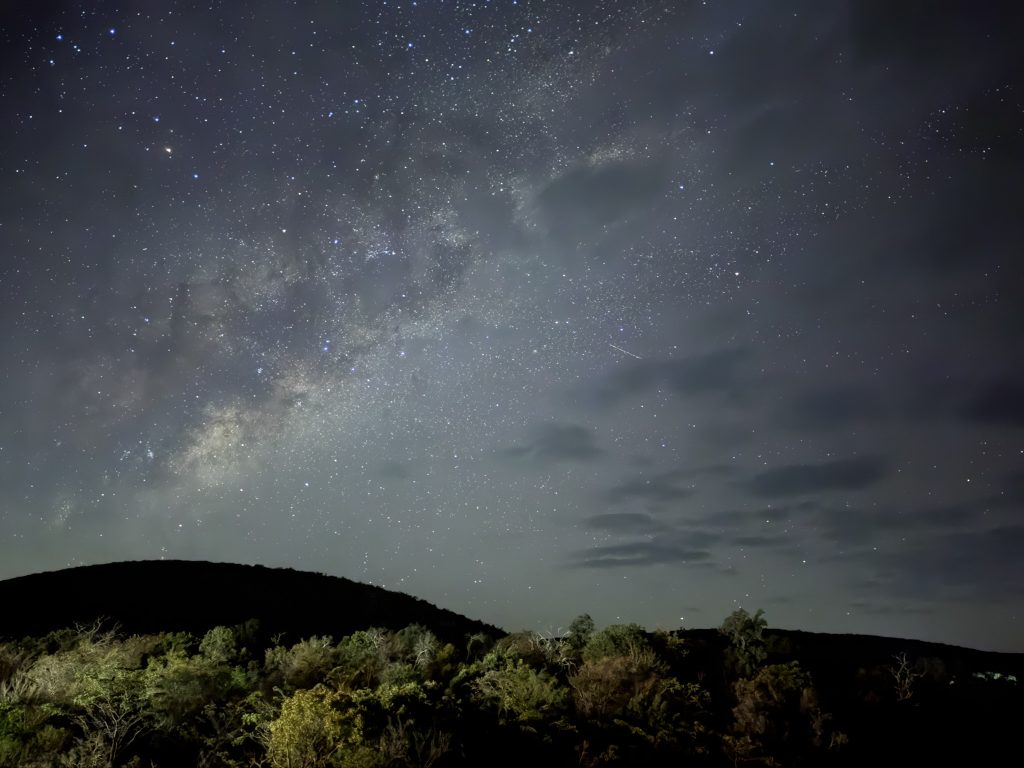
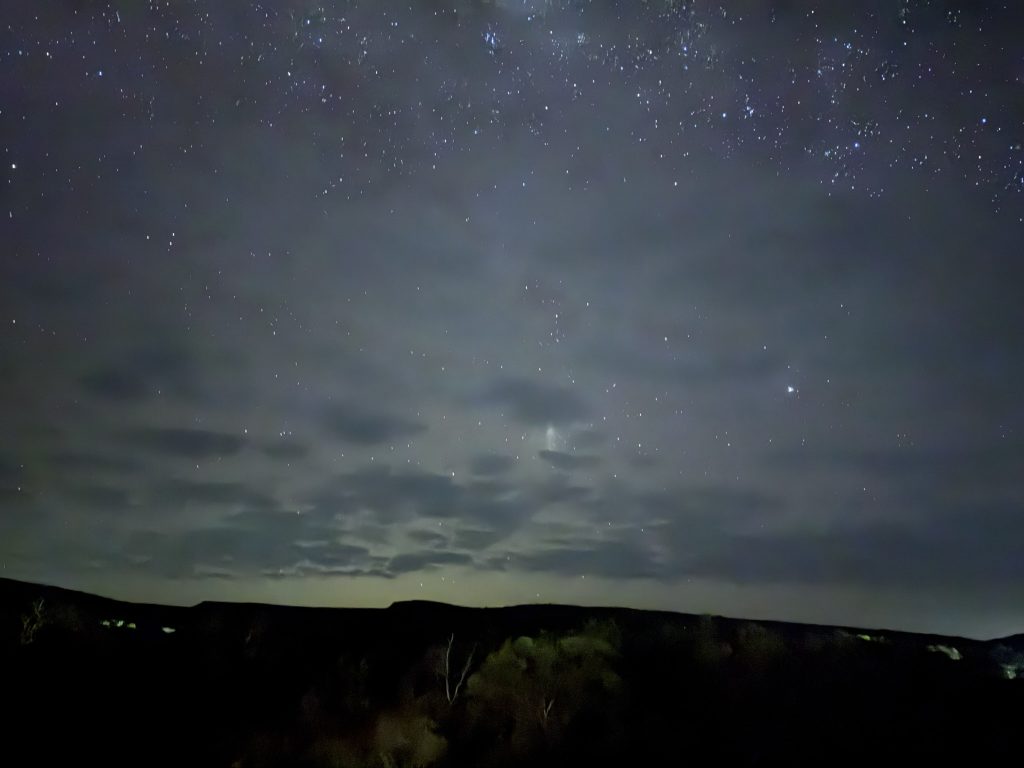
Thousands upon thousands of stars stretched from horizon to horizon. Constellations unfamiliar to those of us from the Northern Hemisphere appeared overhead. The Milky Way wasn’t a faint suggestion. It was a visible feature spanning the sky.
You didn’t need a telescope. You barely needed imagination.
The stars were simply there. Bright. Clear. Endless.
One evening, after dinner, we carried our cameras outside and started experimenting. The sky was already filling with stars, and the last traces of sunset still lingered along the horizon. Distant mountains stood in silhouette against the fading light.
At first, we saw what our eyes could see.
Then we saw what the camera could see.
As the longer exposures appeared on the screen, details emerged that had been hidden in the darkness. More stars. More color. More texture in the landscape. The faint glow of the Milky Way. The subtle outline of the mountains. The remaining twilight painting a thin band of color at the edge of the world.
The photograph wasn’t just about the sky. It was about the relationship between the sky and the land beneath it.
The mountains anchored the image. The horizon provided context. The stars supplied wonder. Together they created something far more meaningful than a photograph of a single celestial object floating in space.
Without realizing it, we had wandered into a different style of photography known as astrolandscape photography. The goal isn’t simply to capture the heavens. It’s to capture a moment where Earth and sky meet.
And that was exactly what Africa was giving us.
I’ve looked at one of those photographs nearly every day since returning home. In fact, it has become the wallpaper on my phone. Not because it’s technically perfect. Professional photographers could certainly point out flaws.
But every time I see it, I’m transported back to that evening.
I remember the cool air. The distant sounds of the bush. The quiet conversations between exposures. The feeling of standing beneath a sky so dark and full of stars that it hardly seemed real.
The photograph reminds me of the experience.
And honestly, that’s what I wanted all along.
As I sat there looking upward seeing the Milky Way, knowing it was not the only galaxy up there, a Star Trek memory came to mind. In the original series episode The Empath, Dr. McCoy reminds Kirk just how rare each of us truly is:
“In this galaxy, there’s a mathematical probability of three million Earth-type planets. And in all of the universe, three million million galaxies like this. And in all of that… and perhaps more, only one of each of us. Don’t destroy the one named Kirk.”
I’ve heard that quote dozens of times over the years. But sitting there in South Africa, beneath more stars than I could count, it landed differently. Every star was different. Every world potentially different. Every life different.
And yet there they all were, sharing the same sky.
Some constellations were unfamiliar. Others were old friends. The Milky Way stretched overhead with a clarity I had rarely experienced before.
And for a few quiet moments, none of the technical settings mattered.
Not the ISO. Not the exposure. Not the lens. Just the experience.
Sitting beneath those stars, listening to the sounds around us, I felt something that is difficult to put into words.
I felt small. I felt blessed. I felt alive.
As the trip progressed, I found myself appreciating the quieter moments more and more.
The excitement of spotting animals never faded. But there was something equally meaningful about sitting near the lodge after dinner, listening to conversations around the fire slowly wind down, watching stars emerge one by one overhead.
Travel has a way of creating space for reflection. Back home, life is usually moving at full speed. Work, errands, notifications, schedules, responsibilities.
Safari life slows everything down. The darkness encourages it. The stars encourage it. Even the wildlife seems to operate on a rhythm that reminds you that not everything needs to happen immediately. Sometimes the best thing you can do is sit quietly and take it all in.
On one of our final evenings, that is exactly what many of us did. Some gathered around the fire. Stories were shared. Laughter drifted into the cool night air. The staff checked on guests, made sure everyone had what they needed, and somehow continued delivering the same hospitality we had experienced all week.
As I sat there looking at the fire, then the stars, then the people who had been strangers only days earlier, I found myself reflecting on how quickly travel can turn acquaintances into friends.
A week earlier, we had all arrived carrying our own luggage, schedules, and expectations.
Now we carried shared memories.
The elephant encounter. The game drives. The braai. The stories. The photographs. The stars.
The trip was already beginning to feel like something we would talk about for years.
As amazing as our time in South Africa had been, another adventure was waiting.
The next morning we’d leave the bush behind, cross an international border, and head toward one of the most famous waterfalls on Earth.
Victoria Falls awaited.
0 Comments